University Researchers Studied Arctic Fog Near Utqiagvik in November
A University of Alaska Fairbanks researcher joined visiting teams at the Department of Energy atmospheric research station near Utqiagvik for a mid November observational campaign focused on mixed phase clouds and Arctic ocean ice fog. The work on November 20, 2025 gathered instrument data intended to improve regional weather forecasting and climate models, outcomes that matter for safety, operations, and planning across the North Slope Borough.
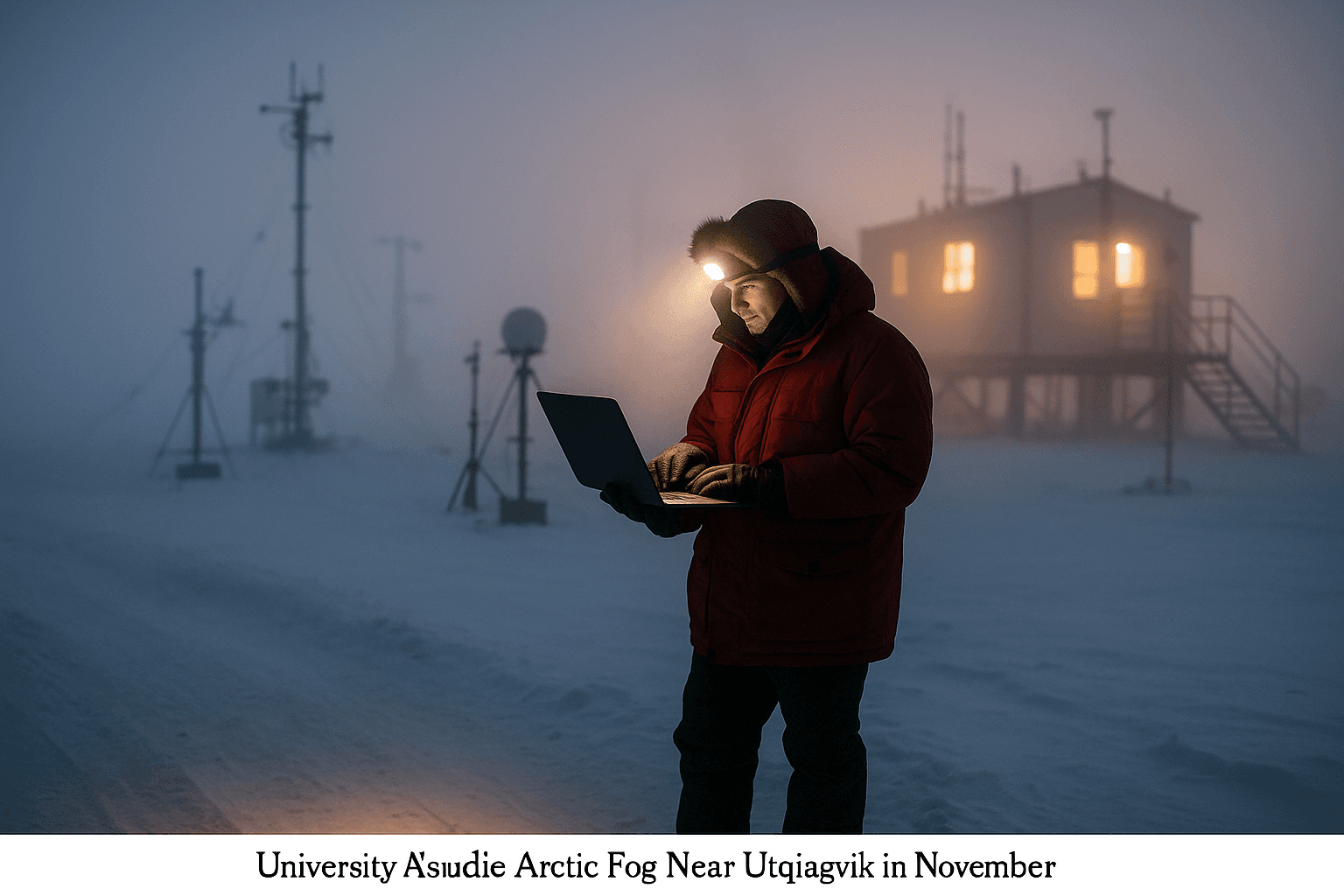
On November 20, 2025, University of Alaska Fairbanks researchers and visiting teams operated instruments at the Department of Energy atmospheric research station near Utqiagvik as part of a campaign affiliated with the FATIMA effort. The observational period in mid November concentrated on mixed phase clouds that contain both ice crystals and supercooled liquid droplets, and on the formation and persistence of Arctic ocean ice fog over shallow seas and coastal areas.
The field work deployed specialized instrumentation, including ice particle samplers, to capture physical properties of cloud and fog particles and to document conditions that lead to formation or dissipation. Scientists said the measurements aim to close knowledge gaps about how these cloud processes interact with the Arctic surface and nearby sea ice, and to refine representations of surface radiation budgets and local weather in models.
For North Slope residents the research has direct operational and community implications. Improved understanding of ice fog and mixed phase cloud behavior can lead to more accurate short term weather forecasts for aviation and marine operations, clearer guidance for oil and gas activity, and better timing of search and rescue responses. Local subsistence hunters and coastal communities that depend on travel over sea ice or open water stand to benefit from forecasts that more reliably signal low visibility events and rapid shifts in surface conditions.
Institutionally the campaign highlights the role of university federal partnerships in producing region specific atmospheric data. The work at the DOE station reflects coordination among UAF researchers and external teams, and underscores the need for sustained monitoring to support municipal planning, emergency management, and infrastructure resilience on the North Slope. Results are intended to feed into weather prediction tools and climate model development that state and borough officials rely on when setting policy and guidance.
As the region experiences rapid environmental change, the observational data collected in mid November 2025 offers a resource for local decision makers. Incorporating those scientific findings into planning and public safety protocols will be a practical test of how research investments translate into improved outcomes for North Slope communities.
Know something we missed? Have a correction or additional information?
Submit a Tip
