Utqiagvik's Tuzzy Library Bridges Culture, Education and Remote Access Across North Slope
Named for Evelyn Tuzroyluk Higbee of Point Hope, Utqiagvik's Tuzzy Library serves 5,000 North Slope residents as both a public library and cultural archive.
Named for a Point Hope woman who helped build a college, a small library on the shore of the Chukchi Sea has quietly become one of the most consequential institutions in the American Arctic. The Tuzzy Consortium Library in Utqiagvik, sitting about 150 miles north of the Arctic Circle, does something no single institution in the region could do alone: it functions simultaneously as the academic library for Iḷisaġvik College and the primary public library for every community across the North Slope Borough.
Named for Evelyn Tuzroyluk Higbee
The library's name carries a specific weight. Evelyn Tuzroyluk Higbee, a woman from Point Hope known by the nickname "Tuzzy," served on the original Board of Higher Education for Iḷisaġvik College. Naming the library after her was a deliberate act of recognition, honoring someone whose work helped make higher education on the North Slope possible. That origin story shapes how the library understands its own purpose: not as a neutral repository, but as an institution rooted in the people and communities it was built to serve.
A Town Built to Survive
Understanding what Tuzzy does requires understanding where it sits. Utqiagvik, formerly known as Barrow, is home to about 5,000 people, the majority of whom are native Iñupiat. The landscape shifts dramatically by season: expansive green-brown tundra in summer, swaths of icy snow in winter. Rutted dirt roads run through neighborhoods including Browerville and Bowerside, past homes and businesses built on pylons that raise structures above the water and melting permafrost below. The Chukchi Sea is both a source of sustenance through generations of whaling tradition and a persistent threat through intermittent flooding. Lagoons throughout town are connected by bridges. For residents, a library that can be reached without flying to Anchorage or Fairbanks is not a convenience; it is essential infrastructure.
The library sits three miles closer to town than the main campus of Iḷisaġvik College, a geographic fact that makes its dual role practical rather than just nominal. By positioning itself between campus and the broader community, Tuzzy can serve students attending the college and Utqiagvik residents who have no other local public library to turn to.
Collections Built Around the North Slope
Tuzzy's collection reflects its community rather than a generic academic or public library model. The holdings span books, ebooks, DVDs, audiobooks, streaming educational films, microforms, newspapers, periodicals, databases, and local, state, and federal documents. The Arctic Centre's Colloquy network has reported the collection at approximately 50,000 items and 150 periodicals, with substantial Alaskana and Native arts sections and particular emphasis on Arctic, circumpolar, North Slope, and Iñupiat history, language, and culture.
A separate Brooks Range-focused collection, supported by an endowment from the Brooks Range Trust administered by the North Slope Borough, currently includes approximately 900 volumes covering archaeology, anthropology, botany, biology, geology, and related topics concerning the land, wildlife, and peoples of the Brooks Range. That collection has been entered into the North Slope Borough's Computerized Information Resources Catalog System, making it accessible to researchers outside Utqiagvik through a personal computer, an important feature for a region where travel between villages is expensive and often weather-dependent.
A Growing Archive and the Tundra Times
Among the library's most significant holdings is a growing local archive of historical documents, papers, media, and photos. That archive includes issues of the Tundra Times, the Alaska Native newspaper that served as a critical voice for Indigenous communities across the state for decades. Preserving those issues locally is not a minor curatorial decision; it is an act of keeping the historical record in the hands of the community it documents.
The library's stated mission on this point is direct: "Reversing the exploitation of the area's rich cultural heritage by institutions outside the region is among the Library's major goals. This can best be accomplished by strengthening local capacity to control, preserve and disseminate its own collections and resources." That framing positions Tuzzy not simply as a library but as a counterweight to a long history of outside institutions extracting and holding North Slope cultural materials.
Federal Depository Access and Public Technology
Tuzzy holds Federal Depository Library status, which means it can provide government information to the public free of charge. For residents of North Slope communities who need access to federal documents, this designation removes a barrier that distance and cost would otherwise create.
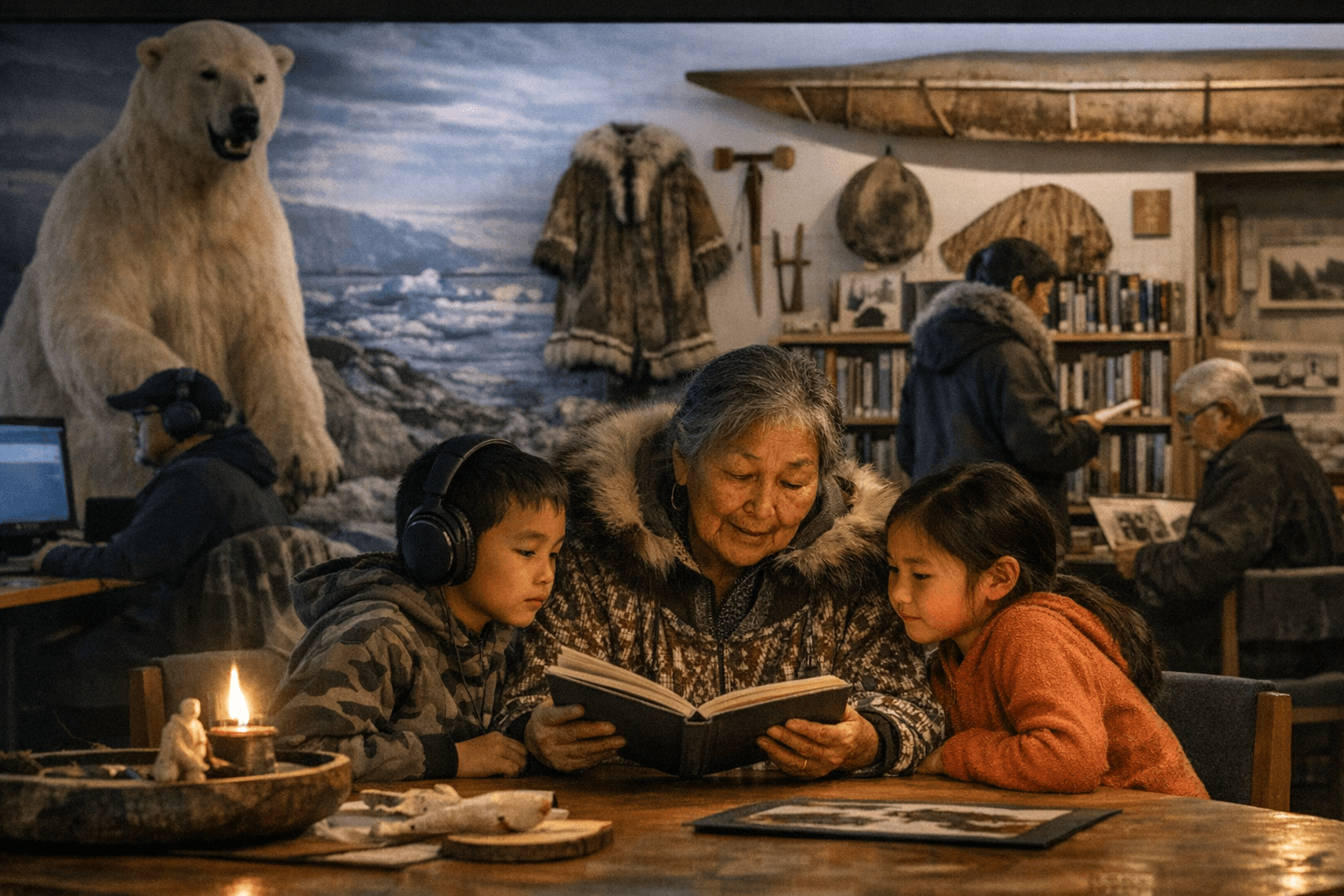
The library also provides 18 public access computers, terminals to the library catalog, a variety of CD-ROM based databases, internet access, and computer applications. Copying, faxing, and scanning services are available for a small fee. The combination of free government document access and public computing infrastructure makes Tuzzy a practical hub for civic participation across the borough, not just a place to borrow books.
Sharing a Building with the Iñupiat Heritage Center
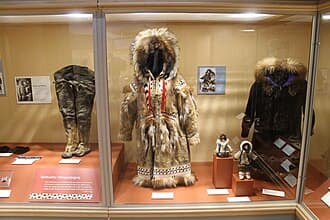
The library's physical home amplifies its cultural role. Tuzzy is located in the same building as the Iñupiat Heritage Center, which opened to the public in early 1999 and is managed by the North Slope Borough Planning Department. The center describes itself as "a place for learning, sharing, remembering, and passing on Iñupiat traditions," with collections in archaeology, art, ethnology, historical photography, and oral history.
The facility includes a gallery, a traditional room for working on arts and crafts, a classroom, and a large conference and performance room. Its permanent exhibit, "People of Whaling," presents Iñupiaq life and values from an Iñupiaq perspective, centering the bowhead whale hunt as the organizing cultural force it has been for nearly two thousand years of North Slope life. In summer months, the Traditional Room hosts demonstrations of Iñupiat dancing, games, and the blanket toss. The center also hosts Iḷisaġvik College classes on Iñupiaq language, sewing, art, and dance, as well as the Barrow Arctic Science Consortium's public lecture series. A gift shop sells baleen baskets, ivory carvings, jewelry, and educational materials.
The offices of both the Iñupiat History, Language and Culture Commission and the Tuzzy Consortium Library are housed within the center, creating a concentration of cultural and educational resources under one roof that would be notable anywhere and is remarkable this far above the Arctic Circle.
Mission Beyond Research
What distinguishes Tuzzy from many Arctic research libraries is its explicit rejection of a purely scholarly identity. As described in the Arctic Centre's Colloquy network profile: "The mission of this little library on the shore of the Chukchi Sea is to provide library services to the inhabitants of the North Slope Borough of Alaska. This includes researchers but primarily the library is concerned with the hearts and minds of the people who live here and their rich culture, language and history."
That orientation shapes programming decisions, collection priorities, and the library's posture toward the broader community. Programming is designed to support community engagement and learning, not just academic research demands.
Looking Ahead: Staffing, Policy, and a New Campus
Staff at Tuzzy and Iḷisaġvik College are thinking carefully about the institution's next chapter. Zoe, one of the library's staff members referenced in a WebJunction profile, looks forward to bringing on a public services librarian whose focus would be outreach: building awareness of what the library offers across Utqiagvik's neighborhoods. The library is also working to establish a policy review committee capable of addressing book and program challenges should they arise, creating a formal governance structure for decisions that currently have no standing body behind them.
On the college side, Iḷisaġvik College is actively working to secure a new campus location that would provide updated facilities for students and staff. Any shift in campus geography will have direct implications for how Tuzzy continues to serve both the college community and the broader public, given that its current positioning between campus and town center is central to its dual role.
For a borough that spans terrain roughly the size of Minnesota, with communities reachable mainly by air, the Tuzzy Consortium Library represents something rare: a local institution with the collections, the technology, the federal designation, and the cultural grounding to serve an entire region from one address in Utqiagvik.
Know something we missed? Have a correction or additional information?
Submit a Tip
