Belmont courthouse marks Nye County’s silver boom-era seat change
Belmont’s courthouse shows how Nye County government chased silver from Ione to Belmont, then to Tonopah, leaving one building to tell the county-seat story.

Beloved by preservationists and useful to anyone trying to understand Nye County, Belmont’s courthouse is not just a relic of a vanished mining camp. It is the clearest physical record of how county government moved with silver, following population, payrolls, and access to the people who were living and working in the Ralston Valley. The building’s story begins with a county seat in motion, and it ends with a reminder that public power in Nye County has never been anchored to one place for long.
A county seat that followed the silver boom
Nye County was established in 1864, with Ione as its first county seat. That arrangement did not last long. After silver ore was discovered in the late 1860s, Belmont grew fast enough to pull the county seat away from Ione, and the move was completed in February 1867. Ione still holds the county’s first courthouse, but Belmont became the center of government as prospectors, businesses, and administrative needs clustered around the boomtown.
The county offices were first scattered around Belmont in different buildings, a practical problem that quickly became a political one. A recent jailbreak from the old jail added to the pressure for a more secure, permanent structure. In that sense, the courthouse was not a decorative afterthought. It was an answer to the day-to-day realities of governing a frontier county that had outgrown temporary quarters.
How Belmont got its courthouse
By 1875, Belmont had been granted $3,400 to build a courthouse, and Carson City architect J.K. Winchell designed the building that was completed in 1876. One historical account also says the county commissioners accepted Winchell’s design in 1875, which fits the broader timeline of the project moving from authorization to construction. Another source gives a different construction history, naming J. T. Benham and placing the cost at $22,000, showing that the building’s paper trail is not as neat as its restored exterior.
What is clear is how the courthouse was made. It was built with locally made bricks and mortar, stone from local quarries, and lumber brought in from the Sierra by train and wagon. That mix of local labor and imported material says a great deal about Belmont itself: isolated, resourceful, and still connected to wider supply lines when mining money made that possible. The building’s original plan included a jail in a rear ell, tying the courthouse directly to the county’s law-and-order function.
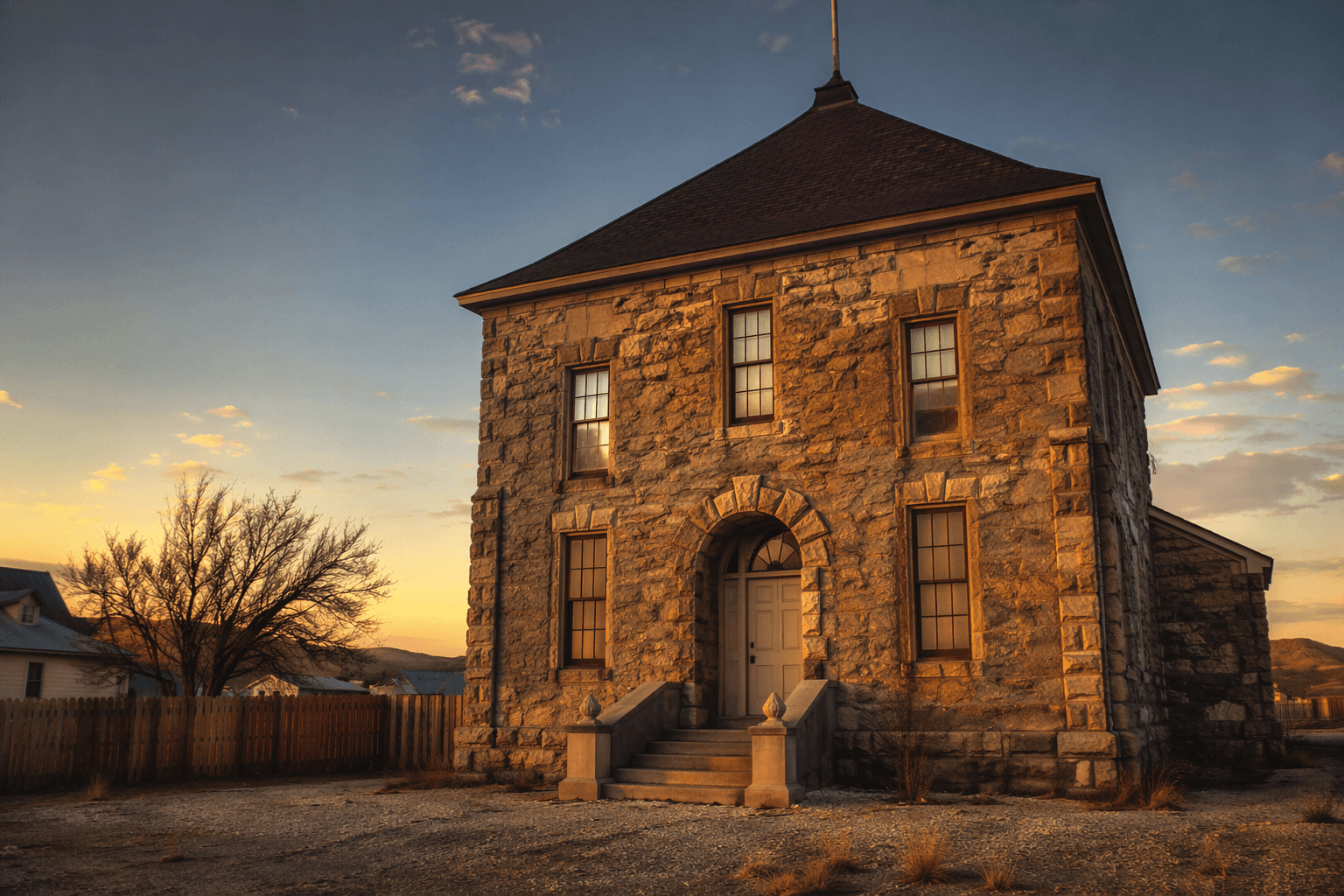
Architecturally, the courthouse is described as Italianate, with a low-pitched hipped roof, cupola, tall windows, rounded arches, corner pilasters, and simple cornices. It is spare, but not plain. The design reflects a county that wanted its seat of government to look permanent even as the town around it was still living at boomtown speed.
What Belmont looked like at its peak
Belmont’s courthouse makes more sense when it is set inside the town that supported it. At its height, Belmont had a population of about 2,000. It also had the institutions that signaled a working civic center in the Nevada mining West: a post office, school, bank, telegraph office, restaurants, several banks, competing newspapers, and the still-serving Dirty Dick’s Belmont Saloon.
The industrial side of the town grew just as quickly. By 1868, Belmont had five sawmills operating to supply lumber. It also had a ten-stamp mill and later a twenty-stamp mill, evidence that the mining economy had moved beyond prospecting and into the infrastructure needed to process ore at scale. That concentration of mills, businesses, and public services is why the county seat landed there at all.
The courthouse stood at the center of that civic landscape. It was the place where official business happened during the height of the silver era, when Nye County’s administrative life was still tightly tied to the extraction economy that was building and financing the town.
Decline, ballots, and the move to Tonopah
When the silver boom faded, the built environment changed with it. Mines closed, timber roofs were stripped from buildings and moved to newer camps, and the county’s center of gravity shifted again. Belmont remained the county seat for 29 years, from 1876 to 1905, before the seat moved to Tonopah. In May 1905, construction began on a new $55,000 Nye County courthouse in Tonopah, marking the next chapter in county administration.

By then, Belmont’s political importance had already shrunk sharply. One source notes that fewer than 100 votes were cast in Belmont in the election of 1900, a stark measure of how little remained of the town’s former civic life. The move to Tonopah was not just a change of address. It was a formal acknowledgment that Nye County’s population and political weight had shifted to a newer mining center.
The distance between the two places still tells its own story. Belmont sits about 43 to 45 miles northeast of Tonopah, depending on the source, along what was once State Route 82. That isolation is part of why the courthouse matters so much. It shows how far county government had to travel, literally and institutionally, to stay near the people and industries that sustained it.
Preservation, restoration, and public memory
Belmont was listed in the National Register of Historic Places in 1972, and the courthouse became a state historic site in 1974. Since then, it has undergone extensive restoration under the Nevada Division of State Parks. Friends of the Belmont Courthouse, a nonprofit, works to preserve, restore, and protect the property, keeping the site from becoming just another ruin in a county full of them.
The building also carries the marks of the years when it was neglected. From the 1930s until 1974, the courthouse was unsecured, and visitors commonly left graffiti on the interior walls. That layer of informal use has become part of the site’s interpretive history, alongside the more formal story of county government and architecture.
Belmont endures because it makes Nye County’s governing history visible. The courthouse shows how power followed silver, how administrative needs forced a county seat to move, and how a remote mining town briefly became the center of public authority before Tonopah took its place.
This article was produced by Prism’s automated news system from verified source data, official records, and press releases, then run through automated quality and moderation checks before publishing. The system is built and supervised by the people who set the standards it runs under. Read our full AI policy.
Did this article answer your question?