Downtown Tonopah walking tour highlights murals, monuments and historic buildings
Tonopah is turning its murals, monuments and restored blocks into a walkable downtown asset. The route links the Belvada, Mizpah and courthouse with local preservation work that aims to drive real visitor spending.
Tonopah’s downtown is being read less like a relic and more like an asset map. The walkable core ties together murals, monuments and restored historic buildings on Main Street and St. Patrick Street, creating a route that pushes visitors past lodging, heritage sites and public landmarks instead of keeping the town’s history trapped in a museum case.
A downtown built to be walked
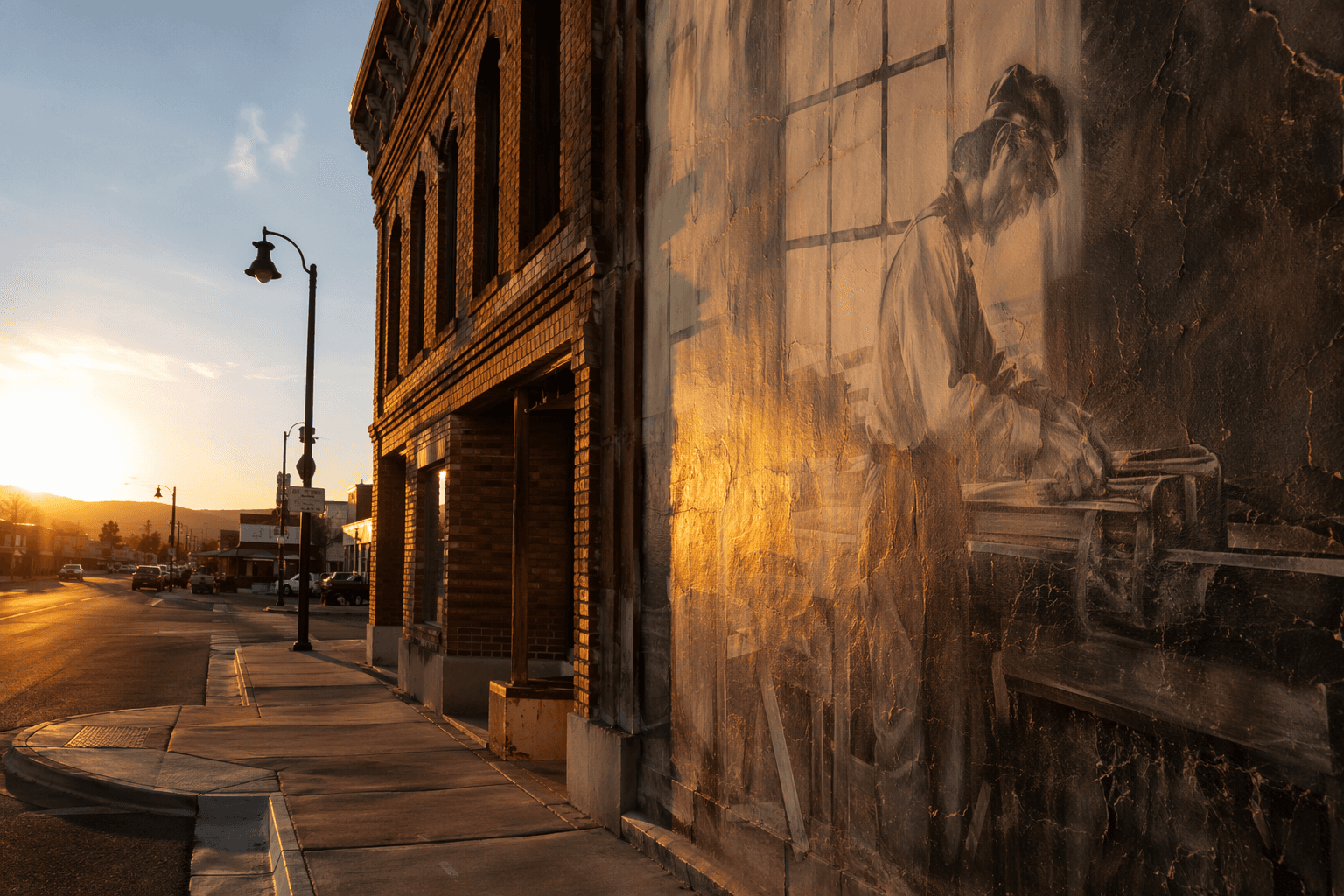
The clearest starting point is the Interactive Nevada Club Mural on St. Patrick Street, on the back wall of the Belvada Hotel. Created by Jamie Vincek in 2021, it is based on a photograph published in the Tonopah Daily Bonanza on Jan. 3, 1908, and it was commissioned by Tonopah Main Street. That combination of a precise location, a dated source image and a local sponsor makes the mural more than decoration: it is a downtown marker designed to pull people into the historic district and keep them moving on foot.
The mural fits into a broader effort to present Tonopah as a place that can be read block by block. Tonopah describes itself as the “Queen of the Silver Camps,” and its historic walking-tour materials say Main Street reflects the town’s boom-and-bust cycles after the 1900 discovery of silver and gold in the surrounding hills. In practical terms, that means the streetscape is doing economic work, not just commemorative work. A visitor who follows the route is likely to encounter a cluster of buildings, then continue toward more businesses and historic stops rather than stopping at a single attraction.
Where the story begins: silver, claims and Main Street
Tonopah’s heritage pitch starts with the original strike. The Tonopah Historic Mining Park says Jim Butler and Belle Butler made the historic silver strike in 1900, on the same ground that helped spark the rush to what became Tonopah. That origin story explains why so much of the town’s preserved architecture is concentrated near the historic center and why Main Street remains the natural spine for a walking tour.
The historic downtown extends beyond one mural or one hotel. Tonopah’s own downtown materials include the Mizpah Hotel, the Belvada and the Tonopah Post Office as part of the historic core, which gives the area a deeper inventory of preserved or repurposed buildings than a casual visitor might expect. The result is a streetscape where the historic assets are close enough together to function as a route, which matters for foot traffic because it gives visitors a reason to linger, compare buildings and move from one stop to the next.
Stops that carry the most weight
Several landmarks anchor the route and help explain how the town is packaging its past for present-day use:
- The Interactive Nevada Club Mural on the Belvada Hotel’s back wall on St. Patrick Street
- The Jim & Belle Butler Monument
- The State Bank and Trust Company Building
- George F. Blakeslee’s Jewelry Store Building
- The Mizpah Hotel and Brougher-Govan Block
- The Nye County Courthouse
- The former U.S.O. Club, now the Tonopah Convention Center
The sequence matters because it turns scattered historic references into a coherent path through downtown. The inclusion of the Nye County Courthouse and the former U.S.O. Club, now the Tonopah Convention Center, broadens the route beyond private buildings and into public and civic space, which is exactly how a heritage district becomes part of the town’s daily circulation rather than a static display.
The buildings show how Tonopah’s economy changed
The Brougher-Govan Block and the Mizpah Hotel tell especially useful stories about reuse and adaptation. The Brougher-Govan Block was built in 1905 and originally housed a bank, while construction of the Mizpah Hotel started in 1907 and was completed in 1908. By 1909, the second and third floors of the Brougher-Govan Block had been annexed and converted into hotel rooms, a detail that shows how quickly Tonopah’s downtown responded to demand during the boom years.
That kind of layered use matters now because it gives modern tourism something concrete to sell. The buildings are not just old; they document a business district that expanded, repurposed and accommodated visitors during a mineral rush. For today’s downtown, that history supports a visitor experience that can feed hotel stays, restaurant visits and local spending around Main Street rather than leaving heritage as a passive backdrop.
Preservation decisions are part of the attraction
The Belvada Hotel is one of the clearest examples of preservation as an economic choice. It was originally built in 1906 as the Nevada State Bank & Trust, and the Belvada history page says the 1907 financial panic led to its closure and the owner’s indictment for embezzlement. The building later became the Nevada First National Bank of Tonopah in 1908, then passed through years of deterioration before Fred and Nancy Cline acquired it for $1 to preserve it after they had already revived the Mizpah Hotel in 2011.
That matters because it shows Tonopah’s downtown is not being preserved by accident. It is being shaped through deliberate ownership decisions, private investment and public-private coordination, with Tonopah Main Street commissioning the mural and local institutions helping interpret the route. The town’s Historic Self-Guided Walking Tour credits the Central Nevada Museum and Historical Society and the Nye County Recorder’s office for assistance, which signals that preservation here depends on a working network of local groups, not a single showcase building.
How to read the route like a downtown economy
A useful way to approach the walk is to treat each stop as part of a commercial and civic corridor rather than a standalone photo stop. The Belvada, Mizpah and Tonopah Post Office sit within the historic downtown, while the courthouse and the former U.S.O. Club extend the route into places where residents and visitors already have reasons to pass. That is how heritage becomes foot traffic: by placing interpretation where movement already exists and by giving people enough landmarks to keep walking.
The strongest downtowns in small Nevada towns often combine memory with utility, and Tonopah is doing that through murals, monuments and restored buildings that are easy to follow on foot. The town’s downtown route does not just preserve what happened in 1900 and the years that followed; it converts that history into a walkable circuit that supports the Belvada, the Mizpah and the civic institutions around Main Street. In Tonopah, the historic streetscape is not a backdrop to the economy. It is part of the economy itself.
This article was produced by Prism’s automated news system from verified source data, official records, and press releases, then run through automated quality and moderation checks before publishing. The system is built and supervised by the people who set the standards it runs under. Read our full AI policy.
Did this article answer your question?