Explore Fergus Falls Downtown History on This Self-Guided Walking Tour
George Wright paid $100 for the Fergus Falls riverfront in 1867; the dam he built there is still the best place to start a downtown walking tour.

In 1867, a young surveyor named George B. Wright walked into the land office in St. Cloud and spotted a lapsed claim on 160 acres of riverfront property. He paid $100 for it. Four years later, Wright built the Central Dam on the Otter Tail River, powered a sawmill with it, and set in motion the commercial and civic growth that shaped the compact, walkable downtown Fergus Falls has today. That dam, still standing on South Cascade Street, is where this walking tour begins.
The Route at a Glance
The core loop runs roughly 1 to 2 miles and can be completed in 60 minutes at a brisk pace, though 90 minutes is more realistic if you stop to read interpretive signage and take in building details. Budget 120 minutes or more if you plan to spend time inside the Otter Tail County Historical Society museum. The route moves from the Central Dam west to Van Dyk Park, then north along Lincoln Avenue's historic commercial strip, past the Otter Tail County Courthouse square, and back.
Spring and summer are the peak seasons for public art walks and heritage events, but the route is walkable year-round. Downtown sidewalks are cleared in winter; wear sturdy shoes in any season, as several stretches of older pavement are uneven.
Start Here: The Central Dam and River Walk
The Central Dam on South Cascade Street, sometimes called Wright Dam in historical records, was completed in 1871 as the first industry on the Otter Tail River, initially powering Wright's sawmill. Today, interpretive signs along the adjacent River Walk explain the river's role in the city's founding and its decades of industrial output. Standing at the cascade, you can see why the site drew settlers: the river drops visibly here, the kind of hydraulic energy that built towns across the Midwest.
The River Walk is a natural starting point because it combines scenic views with readable history. Take a few minutes with the signage before heading west; it gives the rest of the tour context that the building facades alone cannot.
*Don't-walk-past detail No. 1:* Joe Whitford, a scout sent by businessman James Fergus, named this townsite in 1857 and built a log cabin here before he was killed in the 1862 Dakota War. His claim lapsed, Wright bought it for $100 five years later, and the city that now carries Fergus's name was actually built by a man who never lived to see it. That layered origin story is easy to miss without the interpretive panels.
Van Dyk Park and the Otter Tail County Historical Society Museum
A short walk west from the dam brings you to Van Dyk Park and the Otter Tail County Historical Society museum. Inside, the collection spans the county's full arc: exhibits include a recreated printer's shop, an early dentist's office, a general store, an heirloom garden, and the E.T. Barnard Library. The museum hosts rotating exhibits and educational programs, and its staff can provide deeper context on specific buildings and civic growth themes you'll encounter along the rest of the route.
The Historical Society also coordinates occasional guided walking tours of downtown, a good option for first-time visitors or school groups who want narrated context rather than self-guided exploration. Contact their education desk in advance to schedule a structured tour. Strollers and wheelchairs are available at the museum, which makes Van Dyk Park a practical accessibility anchor for the route.
*Kid-friendly stop:* The recreated general store and printer's shop inside the museum hold attention well for younger visitors. The park grounds offer open space for a picnic break before or after.
Lincoln Avenue: A Century of Commerce in Stone
Heading north from Van Dyk Park onto Lincoln Avenue is where the architectural texture of downtown becomes most concentrated. The commercial blocks along this corridor date largely from the late 19th and early 20th centuries, and their masonry facades carry an unusually rich mix of styles: Italianate, Medieval Revival, Victorian Eastlake, and Renaissance Revival all appear within a few blocks of each other. Look up: carved stone eagles and sculpted otters appear on several facades, easy to miss if you're looking at storefront windows rather than cornices and lintels.
*Don't-walk-past detail No. 2:* The words imprinted in granite on several buildings are not decorative; they record the names of original commercial tenants and founding merchants. These inscriptions are some of the most legible primary sources on the street.
*Don't-walk-past detail No. 3:* The architectural variety along Lincoln Avenue is not random eclecticism. It reflects the competitive ambition of merchants building in successive economic booms from the 1880s through the 1910s, each trying to signal permanence and prosperity through a different imported style.
The Sculpture Walk
Lincoln Avenue between Union and Cascade avenues now serves as the home of the Fergus Falls Sculpture Walk, an ongoing public art initiative organized by the city's Public Arts Commission. Six rotating sculptures are installed along this stretch each season; selected artists receive a $2,000 honorarium per piece, and works are available for purchase. The walk pairs naturally with the historic building facades behind the sculptures, making the block a layered experience of 19th-century masonry and contemporary public art side by side.
The Sculpture Walk is part of a larger walkable public art circuit in downtown Fergus Falls that also includes murals celebrating local history and lake culture. The city's arts programming has expanded significantly in recent years, and the downtown corridor is a direct beneficiary.
The Kirkbride: A View Worth Seeking
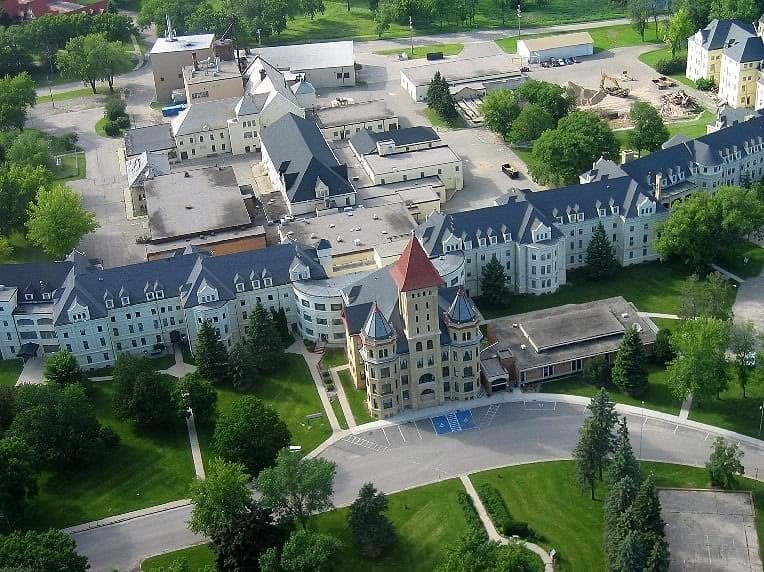
You won't walk through the Fergus Falls Regional Treatment Center campus on this route, but it is visible from several downtown viewpoints and worth a deliberate look. Designed by architect Warren B. Dunnell and constructed beginning in the late 1880s, the building followed the Kirkbride Plan, a 19th-century model developed by Pennsylvania physician Dr. Thomas Story Kirkbride that called for a central administrative structure flanked by long, graduated wings to house patients in therapeutic conditions. The Fergus Falls structure was one of the last Kirkbride buildings constructed in the United States.
The complex was listed on the National Register of Historic Places in 1986 and closed in February 2009 after two decades of gradual transition toward community-based care. Its main building remains one of the most architecturally significant structures in Otter Tail County.
*Don't-walk-past detail No. 4:* Ten of the buildings on the campus are connected by a system of underground tunnels and above-ground corridors, forming a contiguous structure known as the Kirkbride complex. That fact reframes what looks, from the outside, like a collection of separate buildings.
The Otter Tail County Courthouse Square
The Courthouse square functions as the civic centerpiece of the downtown tour: architecturally prominent, set back from the commercial street grid, and surrounded by the kind of open space that allows you to read a public building as it was meant to be read. It anchors the northern end of the core walking route and provides a useful orientation point before you double back south toward the dam or extend to nearby parks and trails.
*Don't-walk-past detail No. 5:* The Courthouse's position relative to Lincoln Avenue reflects a deliberate 19th-century planning decision to separate civic authority from commercial activity, a design principle that modern downtowns rarely follow. The spatial contrast between the dense commercial strip and the open Courthouse square is itself a piece of urban history.
Practical Notes
- Timing: 60 minutes covers the route at a walk with brief stops. 90 minutes is comfortable with interpretive signage. 120 minutes includes a museum visit.
- Parking: Downtown Fergus Falls has street parking and surface lots near the River Walk on South Cascade Street and along Lincoln Avenue. Most spots are free.
- Accessibility: The Otter Tail County Historical Society museum provides strollers and wheelchairs. Downtown sidewalks are generally accessible; a few older stretches are uneven.
- Hours: Many downtown businesses are small and locally owned with staggered hours. Check before you go, especially on weekdays.
- Groups and schools: The Historical Society offers structured walking tours and educational outreach. Contact their education desk to schedule in advance.
- Seasons: Spring and summer offer the fullest experience, including the Sculpture Walk, public art programming, and the farmers market. The River Walk is scenic in fall color as well.
Map-Friendly Stop List (text this to someone coming to town)
1. Central Dam / River Walk: South Cascade Street, Fergus Falls
2. Otter Tail County Historical Society Museum: Van Dyk Park, Fergus Falls
3. Lincoln Avenue Historic Commercial Strip: Lincoln Ave between Union and Cascade
4. Fergus Falls Sculpture Walk: Lincoln Ave between Union and Cascade avenues
5. Otter Tail County Courthouse Square: downtown civic center
6. Fergus Falls Regional Treatment Center (viewpoint): visible from multiple downtown angles
Quick Checklist
- [ ] Read the River Walk interpretive panels at the Central Dam
- [ ] Find a sculpted eagle or otter on a Lincoln Avenue cornice
- [ ] Identify at least two different architectural styles on one block
- [ ] Visit the Historical Society museum and find the recreated general store
- [ ] Spot the Kirkbride building from a downtown viewpoint
- [ ] Pick up a trail or events map from the Visit Fergus Falls visitors' resources
Fergus Falls' downtown is small enough to cover on foot in a morning and layered enough to reward a second visit. The riverfront that George Wright bought for $100 is now a public amenity, and the buildings, institutions, and public art installed around it since 1871 make the case that the $100 may have been the best real estate deal in Otter Tail County history.
This article was produced by Prism’s automated news system from verified source data, official records, and press releases, then run through automated quality and moderation checks before publishing. The system is built and supervised by the people who set the standards it runs under. Read our full AI policy.
Did this article answer your question?