Abe Lincoln Rock in Owsley County blends folk art and local legend
Abe Lincoln Rock is a county-owned folk-art carving in Conkling with a Smithsonian record, hidden up Island Creek and central to Owsley County's heritage story.

Abe Lincoln Rock gives Owsley County something rare: a folk-art landmark with a place in the Smithsonian Institution’s art inventory. Hidden off KY 846 on the right-hand fork of Island Creek, the carving turns a quiet hillside into one of the county’s most distinctive public assets.
A landmark with a national record
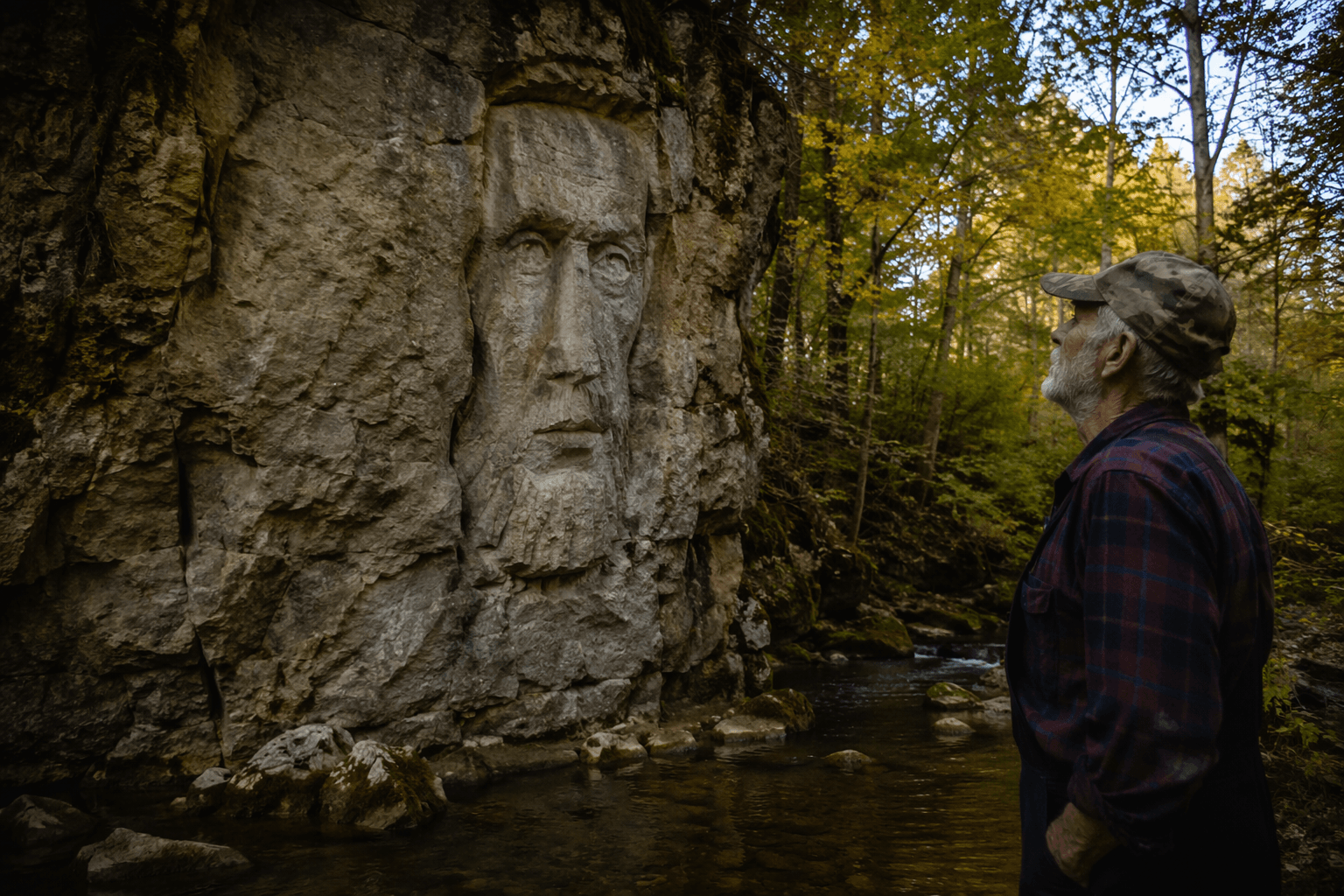
The Smithsonian’s object record describes Abe Lincoln Rock as a relief figure of Abraham Lincoln carved into a large boulder in Owsley County. Lincoln stands in an archway and holds a Bible, details that make the piece more than a roadside curiosity and closer to a documented work of vernacular art. The record places it on KY 846, about a mile from Highway 11 South and the Island Creek Bridge.
The University of Kentucky Extension’s 2026 county report sharpens that picture further. It identifies the rock as a roughly 8-foot-tall sandstone boulder in Conkling, and says the carving is now owned by Owsley County. That matters because it moves the site from private lore into the public realm, where county stewardship, interpretation, and preservation all become part of the story.
What the carving shows up close
The sculpture’s strongest visual feature is its scale. Kentucky Living described it as close to Lincoln’s actual height, about 6 feet 4 inches, and said the likeness is striking enough that Owsley County Judge-Executive Cale Turner singled it out. The figure’s left hand holds the Bible, while the right hand and lower forearm were never finished for reasons that remain unknown.
That incompleteness does not weaken the landmark. It adds to the piece’s character and gives it the uneven, handmade quality that defines much of Appalachian folk art. The carved Lincoln sits in an archway, and the combination of a large sandstone face, unfinished details, and a formal biblical pose makes the rock feel both intentional and mysterious.
Who made it, and why it matters
The University of Kentucky Extension report ties the carving to the 1930s and names the maker as Granville Johnson, a traveler who carved it as a thank-you to the family that cared for him. That origin gives the stone a human scale that is easy to miss if it is treated only as a local oddity. It was a gift before it became a landmark.
That backstory also explains why the site still carries local memory so strongly. The carving was not commissioned as a county monument or built as a commercial attraction. It began as one person’s expression of gratitude, then remained in place long enough to become part of the county’s landscape, its lore, and now its official heritage record.
How to reach the rock
Finding Abe Lincoln Rock is part of the experience, and the route itself helps explain why the sculpture has remained so secluded. Kentucky Living says visitors take State Route 11 to State Route 846 in Owsley County, then turn left on Abraham Lincoln Trail, where a sign marks the way. After passing the house on the right, visitors park and walk roughly 300 to 500 feet uphill to reach the carving.
The Smithsonian record places the rock about a mile from Highway 11 South and the Island Creek Bridge, which helps anchor the site geographically for anyone trying to map it from the main road. FOX 56 also noted how hidden the tribute is, calling it one of Kentucky’s many Lincoln tributes but emphasizing that this one sits nearly out of sight on a mountainside. That isolation has helped preserve its character, but it has also kept it easy to overlook.
A small but telling local detail reinforces that point. FOX 56 reported that a 9-year-old boy who lives at the base of the mountain sometimes guides visitors to the sculpture. That kind of informal guidance says as much about the site’s place in local life as any formal marker could. The rock is known, but it is still known through people, not through a polished visitor center.
Why Owsley County’s version of Lincoln stands apart
Kentucky has no shortage of Lincoln commemorations, but Abe Lincoln Rock stands apart because it sits outside the usual script. It is not a courthouse statue, museum exhibit, or highway plaque. It is a large sandstone boulder in Conkling, carved in the 1930s, preserved on a mountainside, and now owned by the county.
That combination gives Owsley County a cultural asset with practical implications. The Smithsonian record offers institutional recognition. The county’s ownership creates a public responsibility. The difficult access helps protect the site from casual damage, but it also means the story depends on local knowledge, not just signage. For a county looking to strengthen its heritage profile without turning the place into something it is not, the rock is already more than a curiosity.
Its value lies in that balance: a documented work of folk art, a piece of local gratitude, and a landmark that still feels hidden even after its story has been written down. In Owsley County, Abe Lincoln Rock remains both an artifact and a living part of the landscape.
This article was produced by Prism’s automated news system from verified source data, official records, and press releases, then run through automated quality and moderation checks before publishing. The system is built and supervised by the people who set the standards it runs under. Read our full AI policy.
Did this article answer your question?