Booneville Civil War marker highlights Owsley County’s wartime history
Booneville's courthouse lawn holds two Civil War markers, including Kentucky marker #645, and a five-entry marker footprint that turns Owsley County history into public space.
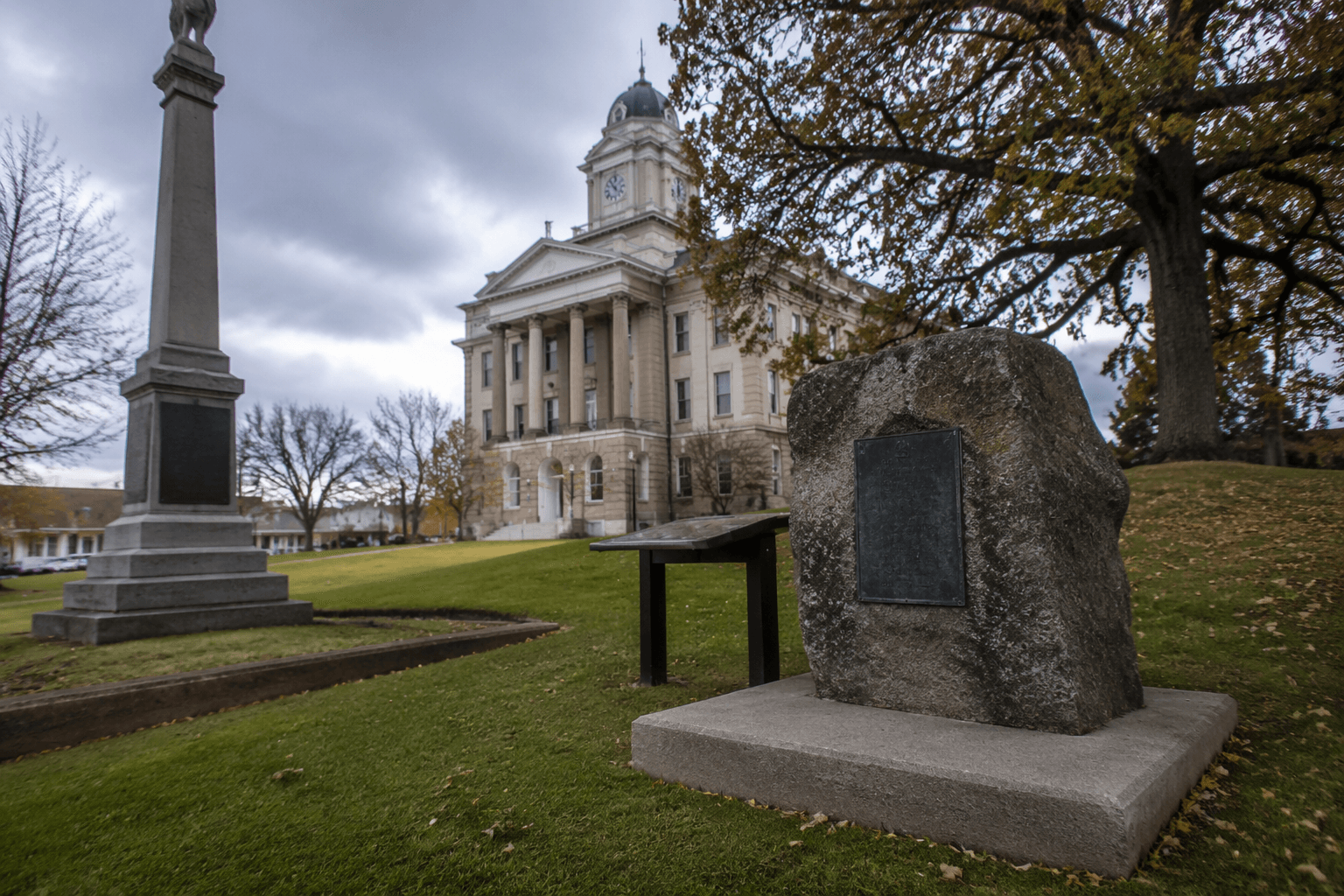
Booneville's courthouse lawn turns Owsley County's Civil War memory into something you can read in a few steps. Kentucky historical marker #645, A Masterful Retreat, stands there alongside Civil War Actions (Booneville), giving the county seat two wartime markers in one compact stop. The Kentucky Historical Society runs the state marker program, and the Owsley County Historical Society gives the place its local frame: Booneville is on the South Fork of the Kentucky River at KY 11 and KY 30, with a history that reaches back long before the markers went up.
What stands on the courthouse lawn
The Historical Marker Database lists five marker and memorial entries in Booneville, which makes the town's public history footprint unusually dense for a small county seat. That footprint matters because it is visible, walkable, and easy to compare from one sign to the next. The Booneville markers do not sit in isolation; they sit in a town that also carries the county's civic buildings, old route lines, and a courthouse square that still organizes daily life.
The state marker program itself is a community project as much as a government one. The Kentucky Historical Society has partnered with community members on historical markers since 1949, and one account says the society took on total management in 1962 while the Highway Department stayed involved. In practice, that means Booneville's markers belong to both state memory and local stewardship, with the Owsley County Historical Society supplying the place-based history that makes the signs legible.
The retreat behind marker 645
A Masterful Retreat is Kentucky historical marker #645, and its subtitle, Confederate Raids and Invasions, and a Federal Retreat, in Kentucky, points straight at the war's moving parts. Historic.one dates the marker to 1964, and the Kentucky Historical Society also lists the retreat story as marker #520 in Greenup, showing that this same wartime movement is remembered in more than one Kentucky place.
The story begins with Union Gen. George W. Morgan's command at Cumberland Gap. Historic.one says Morgan's 9,000-man force occupied the gap from June 18 to Sept. 17, 1862, then began a 200-mile retreat that ended at the Ohio River in Greenup 16 days later. A local-history account on the 14th Kentucky Infantry blog ties the Booneville marker to that retreat from Cumberland Gap to Greenup, and Historic.one adds the route detail: from Manchester, the command moved in two columns seeking supplies on the way to Proctor, all while harassed by Confederate Morgan's Raiders.
That is the Civil War story Booneville's marker tells. It is a story of pursuit, scarcity, mountain roads, and the logistics of retreat through Appalachian Kentucky. The marker makes clear that Owsley County was not a side road to the war. It was part of the operational geography that shaped where armies could move, resupply, and survive.
Civil War Actions and the local timeline
Booneville's second Civil War marker adds a sharper local timeline. The Kentucky Historical Society page for Booneville identifies Civil War Actions (Booneville) as another marker there, and Oak Crest Heritage reproduces its inscription with three dated episodes: on Sept. 21, 1862, retreating Union troops passed through Booneville on the way to Ohio and obtained supplies; on April 14, 1864, 40 local citizens drove off 75 Southern partisan guerrillas; and on June 17, 1864, Col. C. H. Hanson and 300 Union troops pursuing Morgan's Raiders stopped in town for guides and information. Oak Crest Heritage dates that marker to April 17, 1963.
Placed together, the two markers turn Booneville into a short Civil War syllabus. One explains the wider federal retreat after Cumberland Gap. The other names three local episodes that show Booneville as a place where supplies, guides, guerrillas, and passing troops all mattered. That is a different kind of public memory than a battlefield monument. It is a record of movement through a town that had to react to war as it passed.
What the signs leave out
The markers are strongest on military movement and weakest on the wider human cost of the war. They tell readers about raids, retreats, supplies, and partisan conflict, but they do not try to unpack the home front in full, the politics of slavery and emancipation, or the long aftermath for the county's Black and white families. What survives on the signs is a compressed account of wartime traffic, not a full social history.
That selectivity is part of the point. Marker programs are built to be brief, and Booneville's signs show how a few lines can fix a place in memory while leaving other stories to archives, classrooms, and oral history. The result is useful, but it is not complete.
Why Booneville still matters as a history stop
Booneville's local history gives the markers a deeper landing place. The Owsley County Historical Society says the town was once called Boones Station and Moores Station, that Elias Moore donated land for the county seat in 1843, that the courthouse and post office opened in 1844, and that the town was renamed Booneville in 1846. The society also notes that Daniel Boone camped in the area in 1780 and 1781. Those details make the markers easier to place in a longer civic timeline, one that runs from frontier camp to county seat to Civil War waystation.
That is why the markers still carry educational value today. A student, visitor, or local family can stand at the courthouse lawn and see how one small town holds several layers of Kentucky history at once: frontier memory, county formation, wartime retreat, guerrilla conflict, and modern state-level commemoration. Heritage-tourism value follows from that same compactness. Booneville offers a fixed public stop where the county's past is not hidden in a shelf or file box, but set out on the street where anyone can read it.
This article was produced by Prism’s automated news system from verified source data, official records, and press releases, then run through automated quality and moderation checks before publishing. The system is built and supervised by the people who set the standards it runs under. Read our full AI policy.
Did this article answer your question?