Booneville’s Moyers Building stands as county’s oldest commercial landmark
Across from the Owsley County Courthouse, the Moyers Building anchors Booneville’s oldest commercial block. Built in 1888 by merchant B. G. Moyers, it keeps the county seat’s storefront past visible.
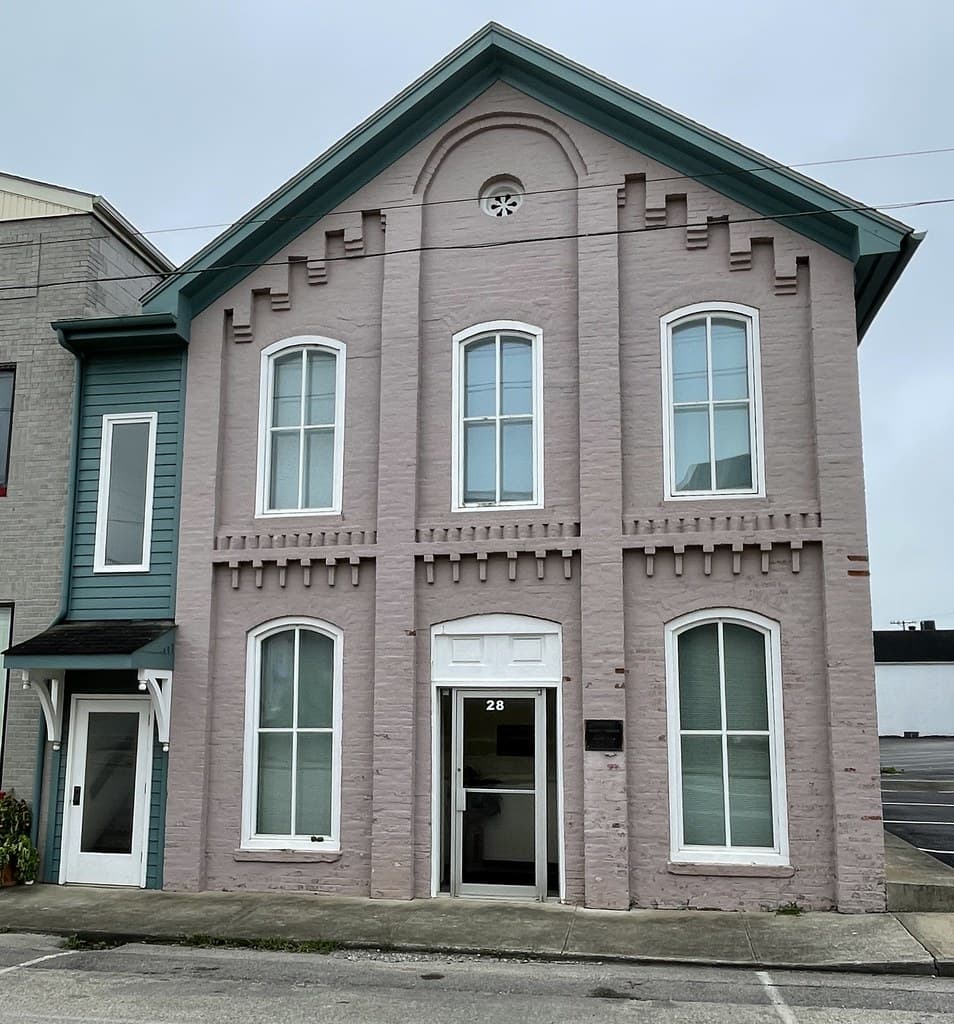
On South Court Street, across from the Owsley County Courthouse, the Moyers Building still fixes Booneville’s downtown to a single, readable point. Built in 1888 by B. G. Moyers, a Booneville merchant, it stands as the oldest commercial building in town and one of the clearest surviving markers of how the county seat first worked. The building matters because it is not distant history sealed behind museum glass. It is part of the street people still use, and that makes its survival a live part of Booneville’s identity.
A storefront built for the county seat
The Moyers Building began life as a general store, which tells you almost everything about Booneville’s commercial core in the late 19th century. A county seat needed a place where farm families, courthouse visitors, and local traders could gather for supplies, conversation, and business, and the Moyers Building sat directly in that exchange. Its location across from the courthouse placed it at the center of everyday movement, where commerce and county government met in the same small district.
That placement matters because downtown Booneville grew around function more than ornament. The courthouse drew traffic, and the store served it. In a place like Owsley County, a general store was not a side business. It was a practical engine of town life, the kind of place where local commerce could take hold because everyone who came to Booneville had a reason to pass by.
Locally made from local ground
The building’s materials tie it even more tightly to the county around it. The National Register description notes that its bricks were burned at a brick kiln on the banks of Buck Creek, a detail that places the structure within Booneville’s own economy of labor, material, and skill. The bricks were not imported from somewhere more prominent. They came from the local landscape and the people working it.
That local origin gives the Moyers Building a different kind of value from a preserved facade or a reconstructed heritage site. It is evidence of how Booneville was built from what the county had on hand. Buck Creek supplied the raw material, local labor turned it into brick, and B. G. Moyers turned the finished structure into a commercial address that helped define the town center. Seen that way, the building is not simply old. It is locally produced history.

What the building says about old Booneville
The 1888 date places the Moyers Building in Booneville’s post-frontier era, when a small Appalachian county seat was still shaping the commercial habits that would hold it together. A single general store across from the courthouse suggests a town where daily life was compact, walkable, and intensely local. People did not need a large business district to make Booneville function. They needed a dependable core, and this building was part of it.
That is why the Moyers Building can be read as a record of endurance as much as age. It shows a time when downtown was organized around a few essential institutions: the courthouse, the store, and the street between them. That arrangement is easy to lose in larger towns, where blocks are replaced and the original layout fades into parking lots and newer facades. In Booneville, the Moyers Building still gives shape to that older pattern.
The structure also helps explain how identity is preserved in a small county seat. Booneville’s past is not carried only in archives or oral history. It is written into a building that remains on the street where that history unfolded. That makes the landmark especially useful for readers trying to understand Owsley County not as an abstract place, but as a town that still shows the trace of its original commercial life.
Why the National Register recognition matters
The National Register record identifies the Moyers Building as Booneville’s oldest commercial building, and that designation gives the structure a public role beyond local memory. Recognition places the building within a documented national framework, which means its importance is not only sentimental or family-based. It is part of a broader historical record that preserves the physical evidence of how Kentucky county seats developed.

For Booneville, that recognition helps turn a familiar building into a readable landmark. Residents already know where it sits. Visitors can see it from South Court Street. The designation explains why it matters. It marks the building as an anchor point for downtown history and a rare survivor from the period when the town’s commercial identity was still being set.
The building’s importance is also practical. Because it still stands in the county seat, it remains useful to anyone looking for a durable introduction to Booneville’s built environment. Heritage travelers can use it as a starting point. Local readers can use it as a reminder of how much of the town’s story is still visible at street level. A surviving structure like this changes the way a downtown is read: it turns history into a location.
What survives in Booneville now
The Moyers Building endures because it still does the most important work a landmark can do in a small town. It makes Booneville’s past visible without forcing it into nostalgia. Across from the courthouse, on a street that remains part of daily life, the building shows how a merchant town grew around a simple commercial need and how local materials and local labor shaped the result.
Its survival says that Booneville’s identity has not been cut free from its origins. The county seat still carries the scale, memory, and practical logic of the place that built it. The Moyers Building is the proof on South Court Street: a brick storefront from 1888 that still teaches, still marks the center, and still makes clear that Booneville’s oldest commercial landmark is also one of its most revealing.
This article was produced by Prism’s automated news system from verified source data, official records, and press releases, then run through automated quality and moderation checks before publishing. The system is built and supervised by the people who set the standards it runs under. Read our full AI policy.
Did this article answer your question?