Cannelton Cotton Mill Stands as Perry County's Defining Industrial Landmark
Built in 1851 to rival Lowell, Massachusetts, Cannelton's sandstone cotton mill once employed 400 workers and still towers over the Ohio River as a National Historic Landmark.
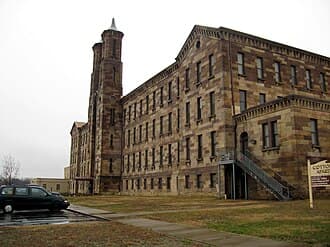
Standing four stories tall on the banks of the Ohio River at Washington Street and 3rd in Cannelton, the Cannelton Cotton Mill is impossible to mistake for anything ordinary. Its twin towers rise over one hundred feet into the Indiana sky, and its rose-colored sandstone walls have prompted generations of passersby to wonder whether they were looking at a courthouse or a capitol building rather than a textile factory. The scale was intentional: when Rhode Island architect Thomas Alexander Tefft designed the complex and construction began in 1849, the investors behind it were thinking in continental terms.
An Ambition to Rival Lowell
The mill opened for business in 1851 with a single defining purpose: to transplant the textile industry out of New England and bring it to the heart of the country. The Cannelton Cotton Mill, also known historically as the Indiana Cotton Mill, was designed to rival the famous mills of Lowell, Massachusetts by connecting northern industrialists with southern cotton growers. Founded by Louisville investors and positioned on the Ohio River for easy access to raw materials and markets, it became, at the time of its construction, the largest industrial building west of the Allegheny Mountains.
Tefft's design broke from Eastern convention in one critical way: rather than relying on water power as most New England mills did, the Cannelton mill ran on steam, burning local coal to drive its machinery. That decision would prove both practical and costly. Coal resources in the region were limited, and technical problems with steam production dogged the mill's early decades. The Ohio River, the primary transport artery for supplies and finished goods during warm months, froze in winter and isolated the town entirely. Cannelton itself was remote and underdeveloped in the 1850s, lacking schools, libraries, and adequate housing for mill workers. As the historian David Nelson noted in Farm and Factory: Workers in the Midwest, 1880-1990, the prosperous state of Midwestern agriculture meant that non-agricultural enterprises faced greater labor constraints and had to attract employees to isolated, rural settings, a problem the Indiana Cotton Mill proprietors knew well.
Despite those obstacles, many Indiana historians credit businessman Hamilton Smith for the company's resilience and its ultimate moderate success over the following century.
The Workforce Behind the Walls
The mill's workforce from its earliest years was predominantly female. When the operation reached its initial capacity, roughly 400 workers filled the building, and women and girls held the vast majority of those positions. Men were always a small minority. By 1890, of 309 workers employed at the mill, only 78 were men. As late as 1900, the payroll still included 35 girls and 19 boys under the age of 18.
The presence of so many children was not incidental. Families in Cannelton and the surrounding region sent their children to work because a single man's wages could not reliably feed a household. Workers and their families arrived at Cannelton by steamboat, catching their first glimpse of the four-story building looming over the Ohio River and the small surrounding town. Inside, conditions were severe. Workers faced machinery that could snag limbs or clothing, and they spent their shifts breathing cotton dust that damaged their lungs over years of exposure.
A historical marker near the building today preserves the 1890 workforce data and makes the gender and age breakdown a matter of permanent public record. The mill stands as one of the most concrete pieces of evidence in Indiana of how extensively women and children powered the state's textile industry through the second half of the nineteenth century.
Cotton, Sheeting, and Civil War Contracts
At full production, the Cannelton Cotton Mill was a significant industrial operation by any measure. It produced more than 200,000 pounds of cotton batting per year and approximately four million yards of cotton sheeting annually. The mill's signature product, marketed under the name Hoosier Sheeting, reached customers in Cannelton, Cincinnati, Louisville, Chicago, and St. Louis, making the operation what one account described as "an important link in the network of goods and services nationwide."
The Civil War transformed the mill's production profile and its labor composition simultaneously. With the mill positioned along the Ohio River, it became an important supplier of material for Union Army uniforms. Wartime demand pushed production higher, but it also accelerated the shift toward child labor as adult men left Cannelton to fight. Families struggling financially during the war years had fewer options, and children stepped into the workforce in greater numbers to keep the looms running.
Architecture and Recognition
The building Tefft designed is approximately 280 feet long, built of local sandstone, and anchored at its entrance by the two towers that have defined its silhouette for over 170 years. Workers historically entered and exited by climbing the winding stairs inside the right-hand tower. The scale and the quality of the stone construction gave the mill an authority that regularly led observers to mistake it for a government building.
That architectural significance has been formally recognized twice over. The Cannelton Cotton Mill was listed on the National Register of Historic Places in 1975. In 1991, it received the higher designation of National Historic Landmark. The Historic American Engineering Record documented the complex thoroughly, producing 42 photographs, 4 color transparencies, 8 measured drawings, and 13 data pages for the main mill building alone, with additional HAER documentation covering the Superintendent's House and two types of worker housing that were part of the original mill complex.
From Factory to Home
The mill ceased production in 1954 after operating for more than a century. For years afterward the building sat empty, its sandstone walls and towers intact but its industrial purpose gone. The transformation came in 2003, when a major renovation converted the structure into seventy senior apartments. The adaptive reuse preserved the landmark exterior and brought the building back into active use for Perry County residents.
Today the mill stands at 310 Washington St in Cannelton and can be viewed from the exterior. Tours of the interior may be arranged by contacting the property at 812.547.3435. For anyone in Perry County with an interest in the region's industrial past, the building at the corner of Washington and 3rd is not simply a historic site to note in passing. It is the physical record of how one river town once held the ambition to reshape American manufacturing, and of the women, girls, and children whose labor made that ambition real for over a hundred years.
Know something we missed? Have a correction or additional information?
Submit a Tip