Perry County rock shelters reveal 10,000 years of prehistoric occupation
Perry County’s Rockhouse Cliffs shelters hold at least 8 feet of deposits and a 10,000-year record, but the National Register listing keeps the exact site off public maps.
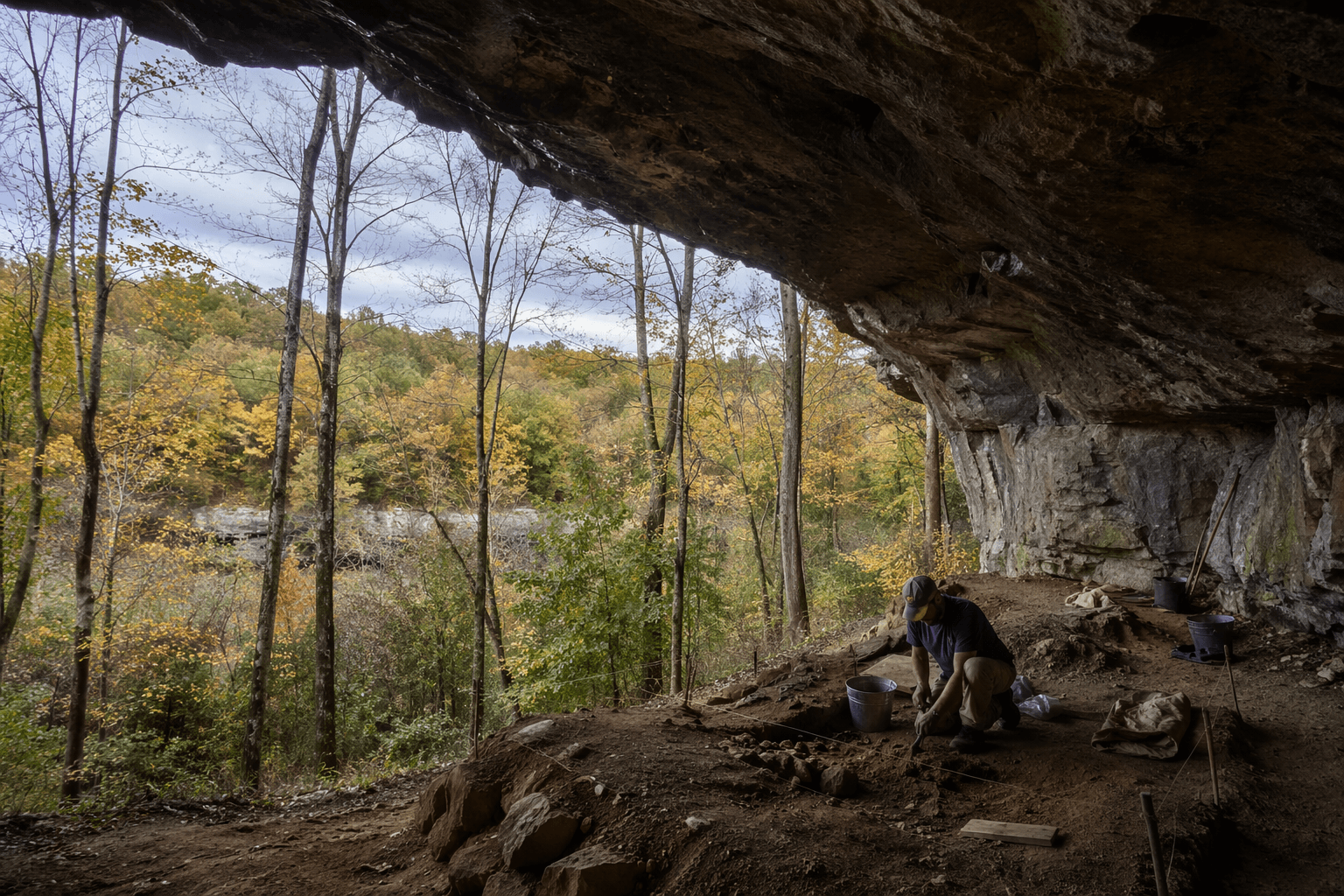
The Rockhouse Cliffs Rock Shelters near Derby are a National Register-listed, address-restricted archaeological site in Perry County, not a roadside attraction. The National Park Service classifies the shelters, recorded as 12PE98 and 12PE100, under the criterion of information potential, with prehistoric significance spanning multiple eras from 7000-8999 BC through the 1600s.
A Forest Service history of prehistory in the Hoosier National Forest says the deposits are at least eight feet deep, and excavations there in 1961 by James H. Kellar, conducted with a Forest Service permit, showed the occupation began during or before the Early Archaic period. The shelter preserves a prehistoric occupation sequence spanning 10,000 years and has produced artifacts from every prehistoric cultural time period except the Paleoindian Period.
In 2014, researchers reopened the units to better understand the stratigraphic context and test whether Paleoindian-aged sediments might still be preserved. The 1961 dig by Dr. James Kellar and a team of students and volunteers generated an especially large artifact assemblage spanning 10 millennia.

Rockhouse Hollow was first recorded during the first scholarly archaeological survey of Perry County in mid-1953, when James H. Kellar led the work under sponsorship from the Indiana Historical Bureau and with guidance from Glenn Black. The National Register entry, published April 25, 1986, places the shelters in Perry County near Derby and lists the site’s area of significance as prehistoric.
Indiana keeps archaeological records tightly controlled. The Department of Natural Resources Division of Historic Preservation and Archaeology keeps SHAARD as the state repository for archaeological information, and public access is restricted.
This article was produced by Prism’s automated news system from verified source data, official records, and press releases, then run through automated quality and moderation checks before publishing. The system is built and supervised by the people who set the standards it runs under. Read our full AI policy.
Did this article answer your question?