Bowdoinham wins $750,000 federal grant for Merrymeeting Trail planning
Bowdoinham secured $750,000 to finish planning the Merrymeeting Trail, a route that could reshape commuting, downtown traffic and regional travel.
Bowdoinham has won a $750,000 federal grant to move the Merrymeeting Trail into final engineering, design and public engagement, a step that could determine whether a long-discussed corridor becomes a practical transportation link between downtown Bowdoinham and downtown Richmond. The award gives the town planning money with no local match, reducing the immediate cost to taxpayers while the project advances toward the next approvals and funding decisions.
The grant stands out because it was highly competitive. The U.S. Department of Transportation selected 49 projects from 799 applications in the Rural and Tribal Assistance Pilot Program round, including 31 rural awards and 18 tribal awards. Bowdoinham’s project was the only one chosen in New England. Town officials say the first funded segment is an approximately 8.5-mile stretch between the two downtowns, a piece that could change how residents, workers and visitors move through the lower Kennebec region.

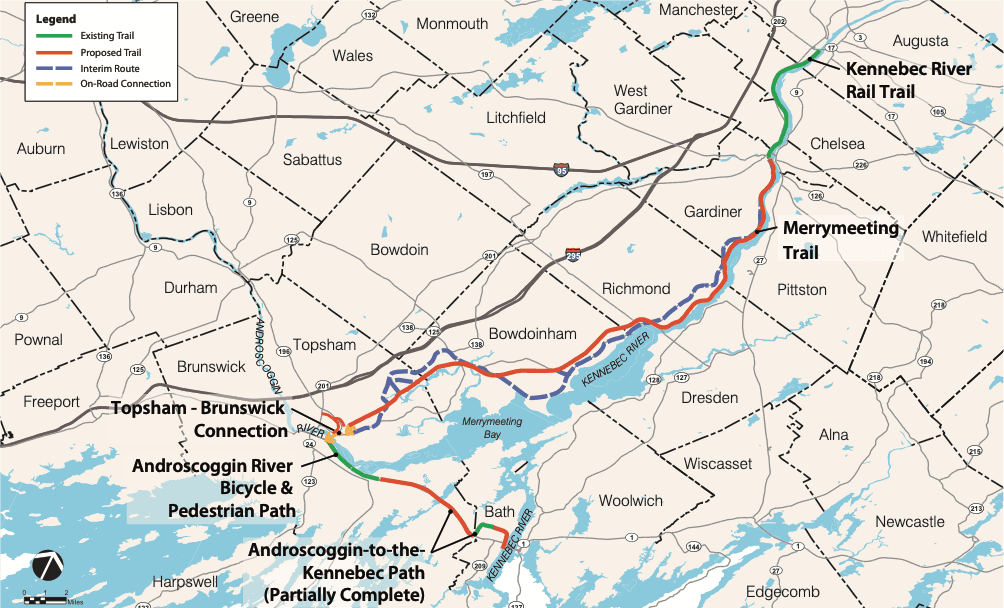
Supporters describe the trail as more than a recreation path. The broader concept reaches 26 miles through Topsham, Bowdoinham, Richmond and Gardiner, linking the Kennebec River Rail Trail in the north with the Androscoggin River Bicycle and Pedestrian Path to the south. If built, the corridor could offer short neighborhood trips, a safer route for cyclists and walkers, and a new option for people making local errands or commuting without a car. It is also expected to matter to downtown businesses by drawing foot traffic, visitor spending and easier access to storefronts, while public health advocates see it as a way to support active transportation in a region where car dependence is still the norm.
The trail plan sits inside a larger rail corridor policy question. MaineDOT says the Lower Road rail corridor runs about 34 miles from Rockland Junction in Brunswick to the east side of the railroad bridge over the Kennebec River in Augusta, and that any non-rail use must be treated as interim because the corridor must remain preserved for future rail use. In August 2023, the Rail Corridor Use Advisory Council voted 11-3 to support interim trail use, but the corridor’s long-term status remains a central obstacle for the project.
Bowdoinham says the idea dates to 2008, when municipal staff and community leaders first began discussing the corridor. By 2009, Bowdoinham, Topsham, Richmond and Gardiner had signed a memorandum of agreement, and Bowdoinham town meeting later authorized an interlocal agreement on June 10, 2014 to help with planning, construction and maintenance. The corridor itself has shaped the region for generations: Friends of Merrymeeting Bay says the Kennebec and Portland Railroad built a depot at Cathance Landing in 1850, and the first train ran from Brunswick to Richmond on December 30, 1850, tying local farmers, fishermen, wood cutters and ice cutters to wider markets.
Bowdoinham’s project materials list backing from town governments, land trusts, health groups and regional advocates, including Mid Coast Hospital, the Midcoast Public Health Council, the Bicycle Coalition of Maine and the East Coast Greenway Alliance. The new grant moves the project closer to a buildable plan, but the trail’s next chapter will still depend on corridor approvals, design work and the far larger task of financing construction.
This article was produced by Prism’s automated news system from verified source data, official records, and press releases, then run through automated quality and moderation checks before publishing. The system is built and supervised by the people who set the standards it runs under. Read our full AI policy.
Did this article answer your question?