How Fort Baldwin guarded the Kennebec River from Sabino Hill
Fort Baldwin turns Sabino Hill into a quiet lookout over the Kennebec, where concrete gun batteries, trail access, and river views still connect Phippsburg to national defense history.
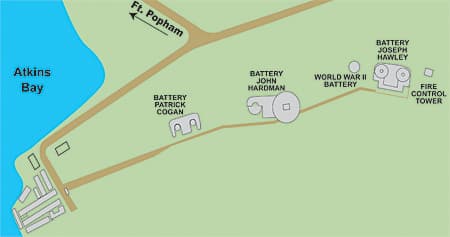
From Sabino Hill in Phippsburg, Fort Baldwin looks out over the Kennebec River. What visitors find now is a compact state historic site with ruined batteries, a World War II fire-control tower, and some of the best views of the river mouth, Fort Popham, and Popham Beach.
A hill built to disappear
Fort Baldwin State Historic Site occupies about 8 acres on the northernmost summit of Sabino Hill. Built between 1905 and 1912, the fort was named for Jeduthan Baldwin, an engineer for the Continental Army during the Revolutionary War, tying the site to an older American military tradition even as its concrete works reflected newer technology.
The fort originally had three batteries: Cogan, Hardman, and Hawley. Battery Cogan held two 3-inch guns, Battery Hardman held one 6-inch disappearing gun, and Battery Hawley held two 6-inch pedestal guns. The batteries were built of massive concrete, sunk below ground on the ocean-facing sides and raised above grade in the rear, a design meant to make the fort invisible to approaching ships.
The fort was built to blend into the hill, protect the Kennebec River entrance, and strike from a position that approaching ships would struggle to spot in time.
What the fort was designed to guard
The Kennebec River mouth has been a strategic point since the earliest English effort at colonization in New England. The Popham Colony was planted there in the summer of 1607, and the colonists built the first ship ever constructed in North America before abandoning the site in 1608. Long before Fort Baldwin took shape, the river already mattered as a gateway, an approach route, and a place where control of the coast had national consequences.
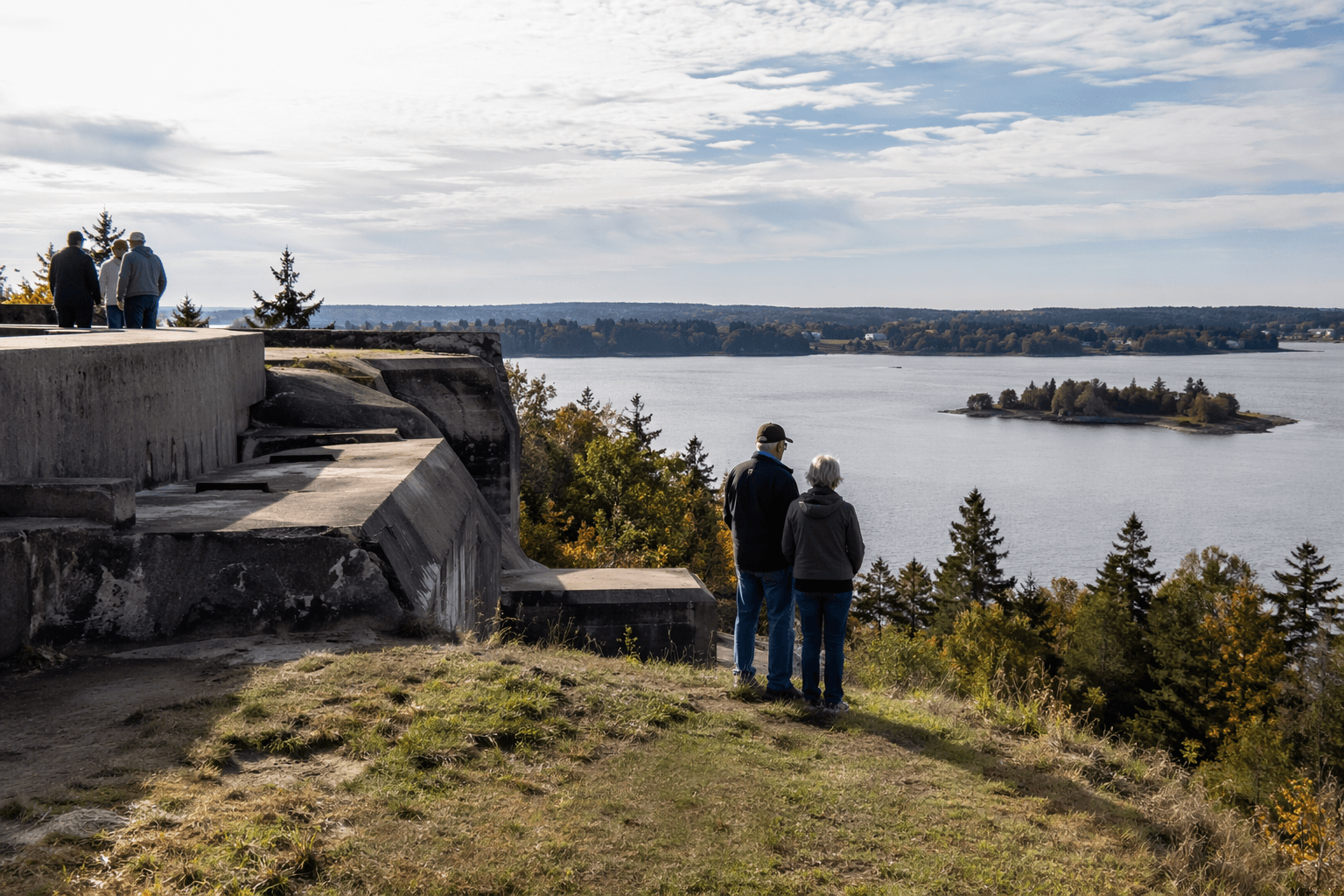
Fort Baldwin did not stand alone. Fort Popham, across the water on the peninsula, had already been built in 1861 for the Civil War and later used again in the Spanish-American War and World War I. Together, Fort Baldwin and Fort Popham formed a layered defense system at the mouth of the Kennebec.
The fort’s administrative area on Sabino Head makes that military life feel more immediate. It once included a guardhouse, administration building, hospital, bath house, storehouse, two mess halls, a bakery, and two barracks blocks. That part of the site was dismantled and removed shortly after 1924, leaving the batteries and landscape as the most visible reminders of the installation’s original scale.
War, removal, and what survived
Fort Baldwin’s wartime history stretches across both world wars. During World War I, Fort Baldwin and Fort Popham together held a garrison of 200 soldiers, including the 13th Coast Artillery and the 29th Coast Artillery. The fort’s guns were part of a broader defense network meant to monitor and protect the river entrance.
The Army removed the remaining guns in 1924, and the fort was sold to the State of Maine that same year. One gun from the Hardman Battery was sent to France during World War I. All of the guns were removed in July 1942.
Even after the guns disappeared, the military use of the site did not vanish overnight. During World War II, D Battery, 8th Coast Artillery manned Fort Baldwin from 1941 to 1943, and a World War II fire control tower was built on the site as coastal defense evolved. The National Register of Historic Places nomination calls Fort Baldwin a well-preserved example of military engineering and architecture.
What visitors can actually experience now
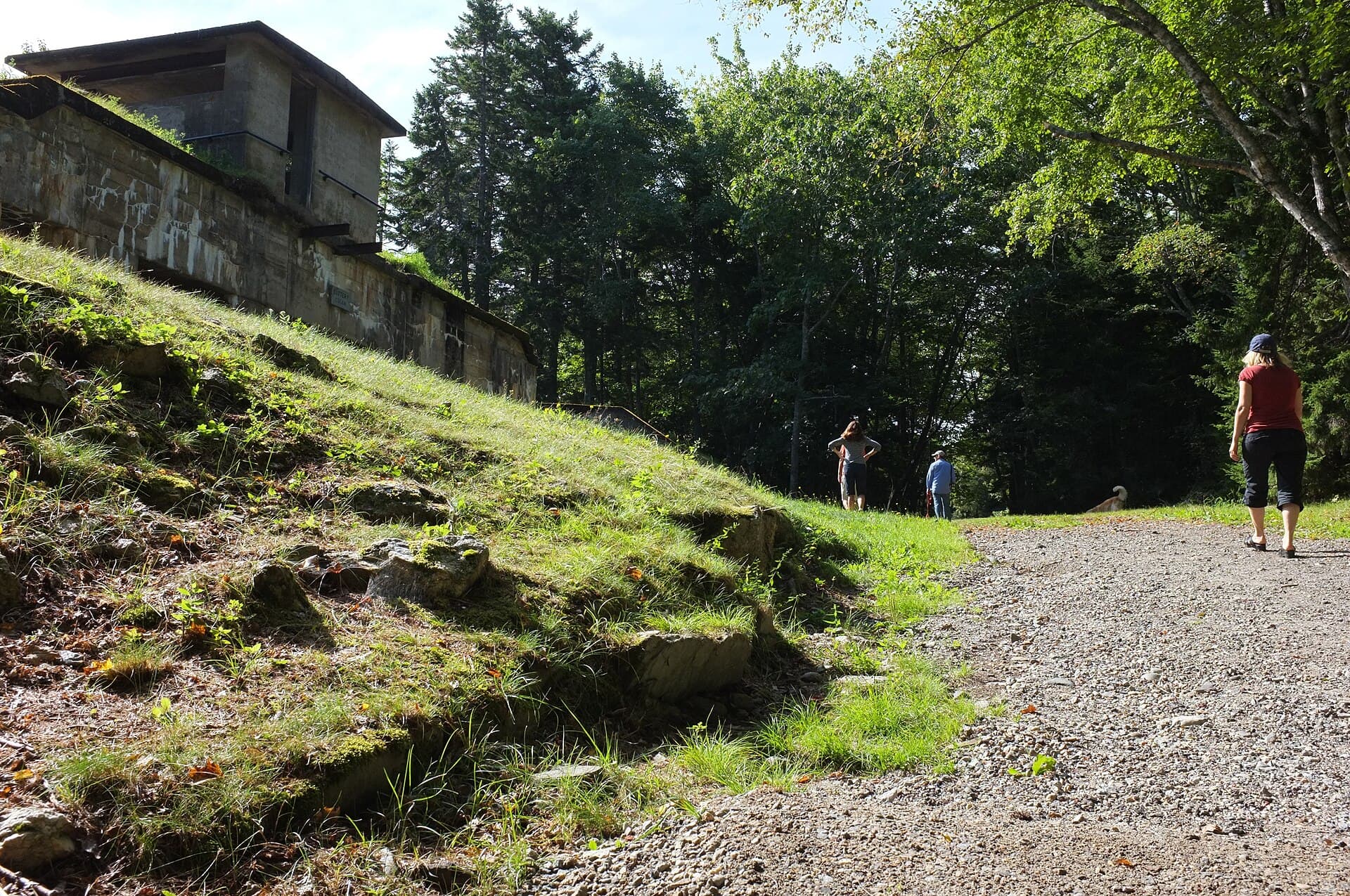
Fort Baldwin is not a polished museum with heavy exhibits. The concrete batteries are the main draw, especially because their siting still shows how the fort was engineered to hide from sea approach and command a view over the river.
Fort Baldwin sits on Sabino Hill above the mouth of the Kennebec River near Popham Beach, with access from the parking area by way of the Perkins Farm Trail. The hike is roughly 1.2 miles on that route, or about a 10-minute uphill walk depending on how you approach it. The fire-control tower is now closed to the public, but the hilltop still gives you a direct look at the river corridor, Fort Popham, Popham Beach, and Pond Island Lighthouse.
Fort Popham State Historic Site is the better-known landmark, with its broad granite form and easy association with the beach. Fort Baldwin requires a short climb and offers a quieter look at the defense system that once covered the river mouth.
Why it still matters in Sagadahoc County
A visit to Fort Baldwin can be paired with Fort Popham State Historic Site, Popham Beach State Park, and the river views around the Popham Colony site, creating a compact day trip that shows how military and settlement history overlap at the edge of Sagadahoc County.
This article was produced by Prism’s automated news system from verified source data, official records, and press releases, then run through automated quality and moderation checks before publishing. The system is built and supervised by the people who set the standards it runs under. Read our full AI policy.
Did this article answer your question?