Patten Free Library room helps residents trace Sagadahoc County history
A Bath house can be traced from an 1888 number change to 1902 directories, Sanborn maps from 1890 to 1950, and room files that link names to parcels.
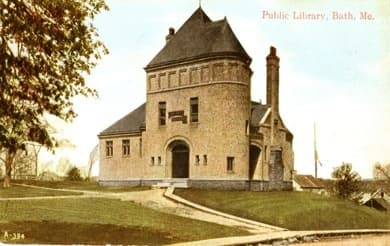
An old map inside Patten Free Library’s Sagadahoc History & Genealogy Room can tie a Bath family story to a specific parcel. The room gives Sagadahoc County residents a way to answer the questions that matter most: who lived there, how old the building is, where the lot lines once ran, and whether the story handed down in the family is actually true.
A local history room built for real questions
The room sits at Patten Free Library, 33 Summer Street in Bath, and serves Arrowsic, Bath, Georgetown, West Bath and Woolwich. It preserves and makes available published and original materials on Maine and Sagadahoc County, including records that help with research, instruction and public programming.
Genealogists and historians from across the country and Canada use the room’s materials in person or by research request, but the collections also help local residents untangle a house history, track a surname through a neighborhood, or connect a street address to an earlier parcel. The Bath Historical Society provides financial and volunteer support for the room, adding another layer of local backing to the collection.
Start with the house, then work backward
For a Bath property, the starting point is often the house-history guide and the SPI surveys. Sagadahoc Preservation, Inc. produced those surveys between 1974 and 2004 to document Bath’s historic districts, and the set includes one survey sheet for each building in Bath built before 1920, plus additional research on South End houses.
The surveys are especially useful if you are looking at an older cottage, a triple-decker, or a shipyard-era house in Bath’s older neighborhoods. The survey can give you a first verified description of the property, then the room’s other records help fill in the names, dates and changes that followed.
1. Match the property to the old numbering system.
Bath house numbers were formally adopted in 1888, so an address may not have looked the same in earlier records.
2. Check city directories.
Street numbers appear in Bath directories beginning in 1902, which helps connect a family name to a specific house at a specific time.
3. Compare maps.
The room’s map holdings show Bath properties from about 1835 to 1898, and Sanborn fire insurance maps run from 1890 to 1950, making it possible to see lot shapes, building footprints and neighborhood changes over time.
4. Verify with supporting records.
Deeds and tax materials can connect a surname to a parcel, while newspapers can show when a house changed hands, burned, expanded or appeared in local news.
If a family says a home stayed in one line for generations, the map and directory trail can confirm or complicate that claim.
What the room can answer for a family or a street
The collection is broad enough to solve several different kinds of questions. City and town reports, family histories, vital records, cemetery records, town histories, newspapers, federal census records, passenger lists, tax records and vertical files all sit under the same roof, along with property surveys for Bath and the South End of Bath.

That mix helps with very specific tasks:
- Who owned the house in a given year, using directories, tax records and deeds.
- How old the structure is, using the SPI survey sheets, Sanborn maps and early property maps.
- What the original lot lines looked like, using the historical maps and tax material.
- Whether a family story holds up, using newspapers, cemetery records, vital records and census listings.
- How a neighborhood changed, using street files arranged by house number and subject files that track people, businesses and places.
The room also holds the archival collections of the West Bath Historical Society, which extends the paper trail beyond Bath proper and into surrounding communities.
The paper trail reaches well beyond one shelf
The room’s newspaper holdings are one of its most valuable tools. Patten Free Library’s archive includes the Bath Daily Times from 1869 to 1909 and the Daily Sentinel and Times from 1862 to 1869, giving researchers more than 67,000 pages of local news coverage to cross-check names, property changes and neighborhood stories.
Researchers can use the archive to date a house photo, confirm a death notice, or learn when a business moved onto a street. Combined with the room’s photographs, letters, postcards and publications, it can also place a family in a wider civic timeline.
The Maine State Archives also lists material tied to the room’s work, including period photographs, ledgers, letters, postcards, publications, Morse High School yearbooks, Bath regional directories, maps, cemetery records, and microfilmed local newspaper and real-estate tax records.
A county resource with statewide reach
The room focuses on the member communities of Patten Free Library, but its reference collection reaches across Maine. The library’s research page points users to thousands of magazines, newspapers and reference books through Digital Maine Library, which broadens the search when a question starts in Bath but leads elsewhere.
This article was produced by Prism’s automated news system from verified source data, official records, and press releases, then run through automated quality and moderation checks before publishing. The system is built and supervised by the people who set the standards it runs under. Read our full AI policy.
Did this article answer your question?