Bay Area Apartment Fire Linked to Lithium-Ion Batteries, Raising Safety Concerns
An e-bike battery killed a San Jose resident Friday after igniting an apartment fire; SF logged 41 battery fires in 2023 alone and passed strict new rules one year ago.
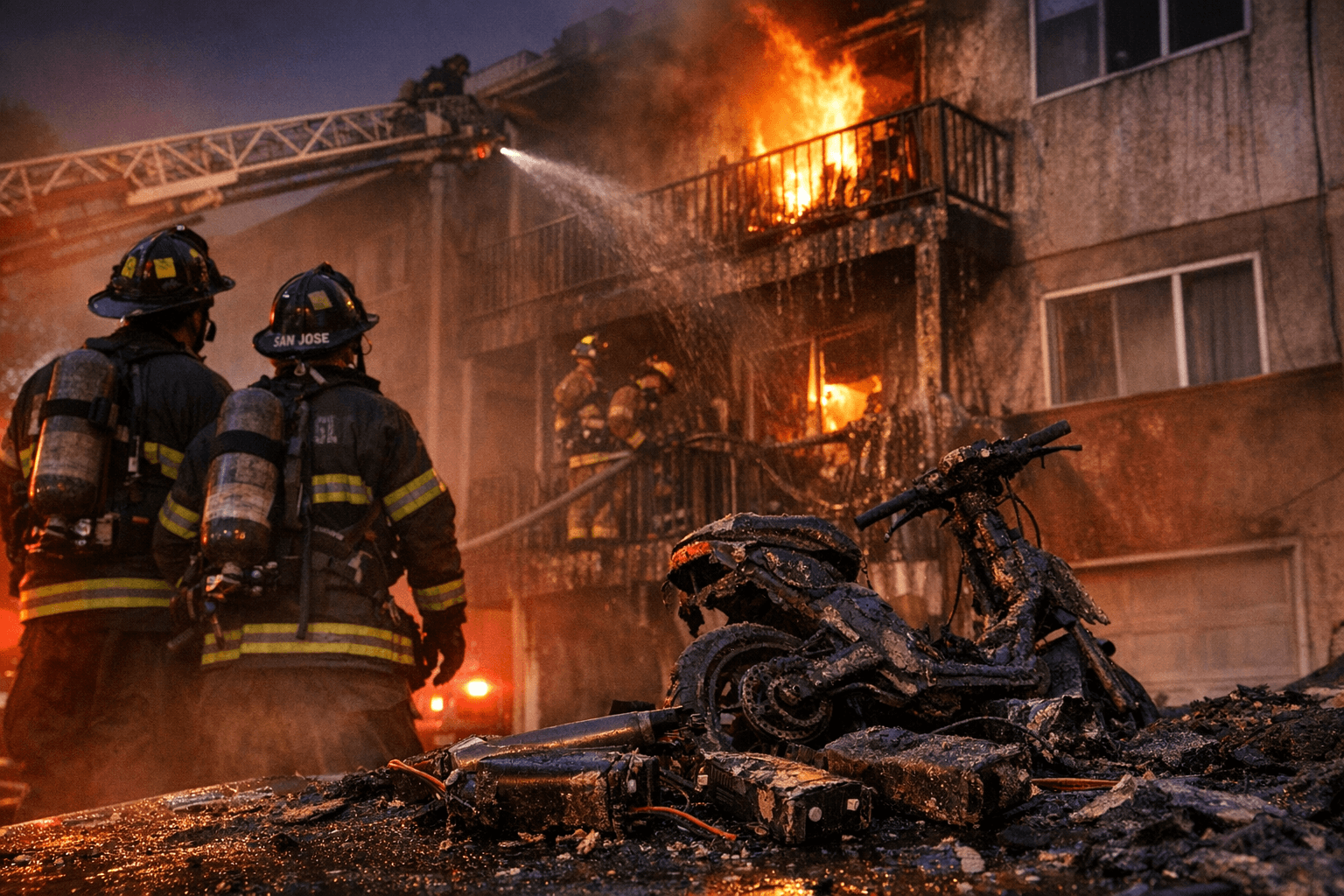
Just after 8:30 on the morning of April 4, inside an apartment on the 4200 block of Norwalk Drive in San Jose, a rechargeable lithium-ion battery in an e-bike began to spark. Within minutes, one resident was dead.
Two people were home when the battery ignited. One resident made it out safely, while the other stayed inside to try to extinguish the fire. The adult eventually exited the apartment but collapsed outside. A neighbor began CPR before firefighters arrived. That neighbor's intervention was not enough. The San Jose Fire Department pointed directly to battery chemistry as the reason the situation turned fatal so quickly.
"Lithium-ion battery fires produce thick, toxic smoke within seconds, which can contain carbon monoxide and other highly irritating gases," the department said. "Even trained firefighters do not enter smoke-filled environments without proper protective gear and self-contained breathing apparatus."
The San Jose death is part of an accelerating pattern that San Francisco has been tracking with alarm. A month earlier, on March 4, a fire at the Seneca Hotel in San Francisco's Tenderloin, sparked by a lithium-ion battery, sent one person to the hospital. The incidents bracket a city that has watched battery-related fires multiply for over a decade. The San Francisco Fire Department reported a tripling of battery-related fires between 2013 and 2023. In 2023 alone, the department responded to 41 such fires, after a record-high 58 in 2022. Fires started by rechargeable devices have caused more than $10.6 million in property damage, 13 injuries, and one death over the past ten years in San Francisco.
Former Board of Supervisors President Aaron Peskin, who championed the city's legislative response, captured the stakes plainly when the ordinance advanced: "Last year, over 60 fires were caused by lithium-ion batteries in San Francisco with, sadly and tragically, our first death. This is really a public safety piece of legislation."
The physics behind these fires begins with what engineers call thermal runaway: a self-reinforcing chain reaction in which an overheating battery cell vents flammable gas, that gas ignites, and the heat then triggers neighboring cells to do the same. Thermal runaway can be triggered by physical damage, overcharging, manufacturing defects, or exposure to extreme temperatures. Because e-bike battery packs carry far more stored energy than a phone or laptop, the reaction can engulf a room in under a minute, far faster than most apartment residents expect.
San Francisco's new fire code, which took effect March 7, 2024, requires that all powered mobility devices in San Francisco must be safety-certified, defined as compliance with Underwriters Laboratories standards UL 2849 or UL 2272. The legislation also limits residents to storing and charging a maximum of four powered mobility devices per dwelling unit. If a household has more than five, stricter fire safety measures are required, including sprinkler systems and designated charging areas with three feet of space between devices. The ordinance also prohibits use of damaged or reconditioned batteries entirely.
SFFD Lieutenant Mariano Elias, who has worked on the department's public outreach on the issue, said the underlying pattern was clear long before the law was enacted: "I've been around fires that have happened due to mostly scooters."
For San Francisco apartment residents and landlords, the ordinance translates to immediate, concrete obligations. Devices carrying no UL or EU certification mark are non-compliant and should be pulled from service. Charging should never occur unattended, overnight, or in a hallway or stairwell that blocks an exit. Batteries showing swelling, unusual heat during charging, or discoloration must not go into household trash or curbside recycling bins, where they can trigger fires at sorting facilities. SF Environment's Household Hazardous Waste program accepts lithium-ion batteries for safe disposal; locations and drop-off hours are available through sfenvironment.org.
The guidance from both San Jose and San Francisco fire officials on what to do when a battery does ignite is unambiguous: leave the unit immediately, close the door behind you, and call 911. Fire officials warn that lithium-ion battery fires produce toxic smoke within seconds and urge people to evacuate immediately instead of trying to extinguish them. The Norwalk Drive death is a precise illustration of what happens when someone does the opposite.
This article was produced by Prism’s automated news system from verified source data, official records, and press releases, then run through automated quality and moderation checks before publishing. The system is built and supervised by the people who set the standards it runs under. Read our full AI policy.
Did this article answer your question?