Coit Tower murals helped shape New Deal art nationwide
Coit Tower is more than a skyline marker: its New Deal murals turned Telegraph Hill into a national template for public art, labor tension, and civic memory.
The first surprise inside Coit Tower is that the landmark most visitors come to photograph also holds a sharp-edged political argument on its walls. The murals were meant to celebrate public life, but they also captured labor tension, social protest, and Depression-era unease, which is why this compact tower on Telegraph Hill reads like serious civic history hiding in plain sight.
A San Francisco monument built on local myth and civic ambition
Coit Tower stands at 1 Telegraph Hill Boulevard in Pioneer Park, on a hill that San Franciscans had already treated as a civic prize long before the tower rose. Telegraph Hill was bought and donated to the city in 1876 to preserve the old telegraph station landmark, so the site already carried a memory of communication, visibility, and public use. The tower itself came from the bequest of Lillie Hitchcock Coit, the wealthy and unconventional Telegraph Hill figure who adored firefighters and helped shape the city’s early public mythology.
The structure is an Art Deco work designed by Arthur Brown Jr., with Henry Howard also credited in National Register documentation. That design pedigree, combined with its hilltop setting above North Beach and the waterfront, helps explain why the tower became one of San Francisco’s most recognizable silhouettes. It was designated a San Francisco landmark in 1984 and listed on the National Register of Historic Places in 2008, formal recognition for a building that had already become part of the city’s visual shorthand.
Why the murals mattered far beyond San Francisco
Coit Tower is not just an architectural stop. The National Park Service describes it as the first publicly funded art project in the United States, which places it at the center of New Deal cultural policy rather than at the edge of tourist history. The Public Works of Art Project began in December 1933 and produced more than 15,000 works of art in about six months, an output that shows how aggressively the federal government used art to put people to work and to define what public culture could look like.
The tower’s murals became one of the best-known expressions of that effort. National Register documentation says the themes established at Coit Tower, including agriculture, education, rural life, social protest, and New Deal idealism, were copied by other social realist artists working for the government around the country. In other words, the tower helped set a visual vocabulary that traveled well beyond San Francisco, into the murals and public buildings commissioned during the 1930s and 1940s by federal programs such as the PWAP, the Civil Works Administration, and later the Works Progress Administration.
What to look for on the walls
The murals are best understood as a series of arguments about how ordinary life should be pictured. The tower’s own history frames the work around agriculture, education, urban and rural life, social protest, and New Deal idealism, and those themes show up in scenes crowded with workers, classrooms, farms, streets, and public institutions. The project was not decorative wallpaper. It was a statement about who belonged in public art and what kind of society the city wanted to imagine.

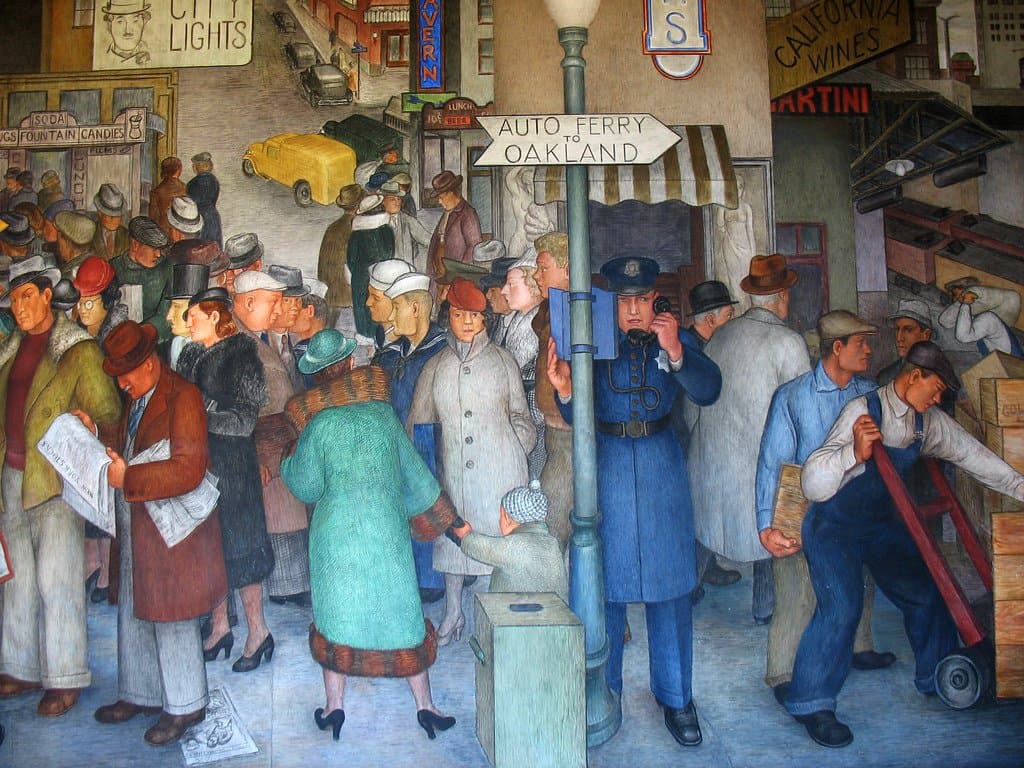
One of the most recognizable murals is Victor Arnautoff’s City Life, a busy downtown San Francisco scene built as a pastiche of locations around Montgomery and Washington streets. Look closely and the mural gives you workmen, traffic, an auto accident, a holdup, a razor vendor, and a fire ladder truck labeled No. 5, a detail that nods to Lillie Hitchcock Coit’s affection for firefighters and to the city’s working-class street life. The mural turns a specific local intersection into a snapshot of Depression-era urban pressure, where commerce, danger, labor, and spectacle all share the same frame.
The mural project was also a carefully organized labor effort. Documentation identifies 25 muralists, including four women and 21 men, working in true fresco technique. Victor Arnautoff, a Diego Rivera-trained muralist, supervised the project, which links Coit Tower directly to the larger international mural tradition that Rivera helped popularize. Living New Deal identifies the tower’s murals as PWAP-funded, placing them squarely inside the federal art machine that turned San Francisco into one of the New Deal’s most visible studios.
Controversy was part of the story from the start
Coit Tower’s murals were controversial when they were completed, and that reaction is part of why the site remains so important. One account says the tower was padlocked and its windows painted over for more than three months after completion, a sign that the imagery inside was unsettling enough to prompt an effort to hide it from public view. That kind of response makes sense when you see how directly the murals engage labor, class, and social conflict rather than offering a neutral civic fantasy.
The controversy also explains why the tower keeps returning in scholarship and preservation debates. Robert W. Cherny’s work on the murals places them within New Deal art and political conflict in San Francisco, and public-history institutions have continued to treat the tower as a touchstone for how cities preserve difficult public art. San Francisco’s art institutions, including the San Francisco Art Commission and the San Francisco Fine Arts Museums, have helped keep that conversation alive as the murals move between tourist attraction, historical artifact, and political text.
How to read Coit Tower like a local
A visit to Coit Tower becomes more rewarding when you treat the building as a civic archive rather than a scenic overlook. Start with the hill itself: Pioneer Park and Telegraph Hill carry the memory of the old telegraph station, the 1876 land donation, and the way San Francisco repeatedly reinvents shared space. Then move inside and look for the tension between everyday labor and public idealism that runs through the frescoes.
The key details to notice are not abstract. They are the workmen, fire ladders, street crossings, and rural scenes that tie the tower to Depression-era life in San Francisco and beyond. That is why Coit Tower still matters in the city today: it shows how a local landmark, funded by one woman’s bequest and built on a historic hill, became a national model for public art that was never afraid to show politics on the wall.
This article was produced by Prism’s automated news system from verified source data, official records, and press releases, then run through automated quality and moderation checks before publishing. The system is built and supervised by the people who set the standards it runs under. Read our full AI policy.
Did this article answer your question?