Golden Gate Park’s improbable survivors, bison, glasshouse and Japanese garden
Golden Gate Park hides three unlikely survivors: bison, a Victorian glasshouse and the nation’s oldest public Japanese garden. Each still carries the park’s history of fire, reinvention and civic use.
Golden Gate Park can feel like a place built on improbable odds. It started in 1870 on 1,013 acres of windswept sand dunes in the Outside Lands, grew into 1,017 acres, and then absorbed one of the city’s darkest chapters in 1906, when about 200,000 homeless residents camped there after the earthquake and fire. That history is still visible if you know where to look: in a herd of bison grazing at the west end, in a 19th-century glasshouse packed with tropical plants, and in a Japanese garden that has outlived expositions, restorations and changing civic priorities.
A park that grew out of sand and emergency
Golden Gate Park’s origin story matters because it explains why the place still feels so unlike the rest of San Francisco. The land began as exposed dunes at the city’s edge, not as a manicured civic square, and its early size already signaled ambition. When disaster struck in 1906, the park became shelter on a massive scale, with roughly 200,000 displaced residents camping there in the aftermath of the earthquake and fire.
That role gives the park a civic history that is larger than recreation. It has functioned not just as open space, but as refuge, gathering ground and public inheritance. The attractions that endure inside it are part of that same story: each survived because San Francisco kept returning to the park as a place worth preserving, even when the city around it changed.
The Conservatory of Flowers, a surviving Victorian greenhouse
The Conservatory of Flowers is the oldest building in Golden Gate Park, opening in 1879, and it still feels like a deliberate act of optimism. The 12,000-square-foot glasshouse holds mostly tropical plants and rare species, including orchids, giant water lilies and carnivorous plants. From the outside, the building reads as a relic; inside, it works more like a living archive, with humidity, glass and plant life stacked together under the same roof.
What makes it worth a stop is that it is not just old, it is specific. The Conservatory gives the park a museum-like interior without losing its botanical purpose. Visitors can stand in one room and see the same kind of spectacle that made 19th-century greenhouse culture a public attraction, only now anchored in Golden Gate Park rather than a private estate or fairground.
If you are trying to experience the park’s odd history in a single visit, the Conservatory is the easiest place to feel how decorative ambition and scientific collecting overlap here. It is one of the few places in the city where a glasshouse itself is the exhibit, while the orchids, lilies and carnivorous plants do the rest of the work.
The bison paddock and the city’s living western edge
At the park’s west end, the Bison Paddock carries a different kind of survival story. American bison have been kept there since 1892, and the herd was moved to its current meadow in 1899. That makes the enclosure one of the park’s most durable features, not a temporary novelty but a century-plus commitment to keeping a large, unusual animal in plain view in the middle of San Francisco.

The care arrangement is part of the point. San Francisco Zoo staff care for the animals, while Rec and Park gardeners maintain the enclosure. That split tells you the paddock is not a decorative afterthought. It is a managed public habitat, maintained through a civic partnership that keeps the herd visible and the site functional.
For a local visitor, the bison paddock offers the clearest visual surprise in the park. The animals belong to the American West, but the setting is unmistakably San Francisco: lawns, fog and the city’s park system holding them in place. The result is one of Golden Gate Park’s strangest achievements, a landscape where a large mammal associated with prairies and national myth has become part of neighborhood routine.
The Japanese Tea Garden and its long restoration
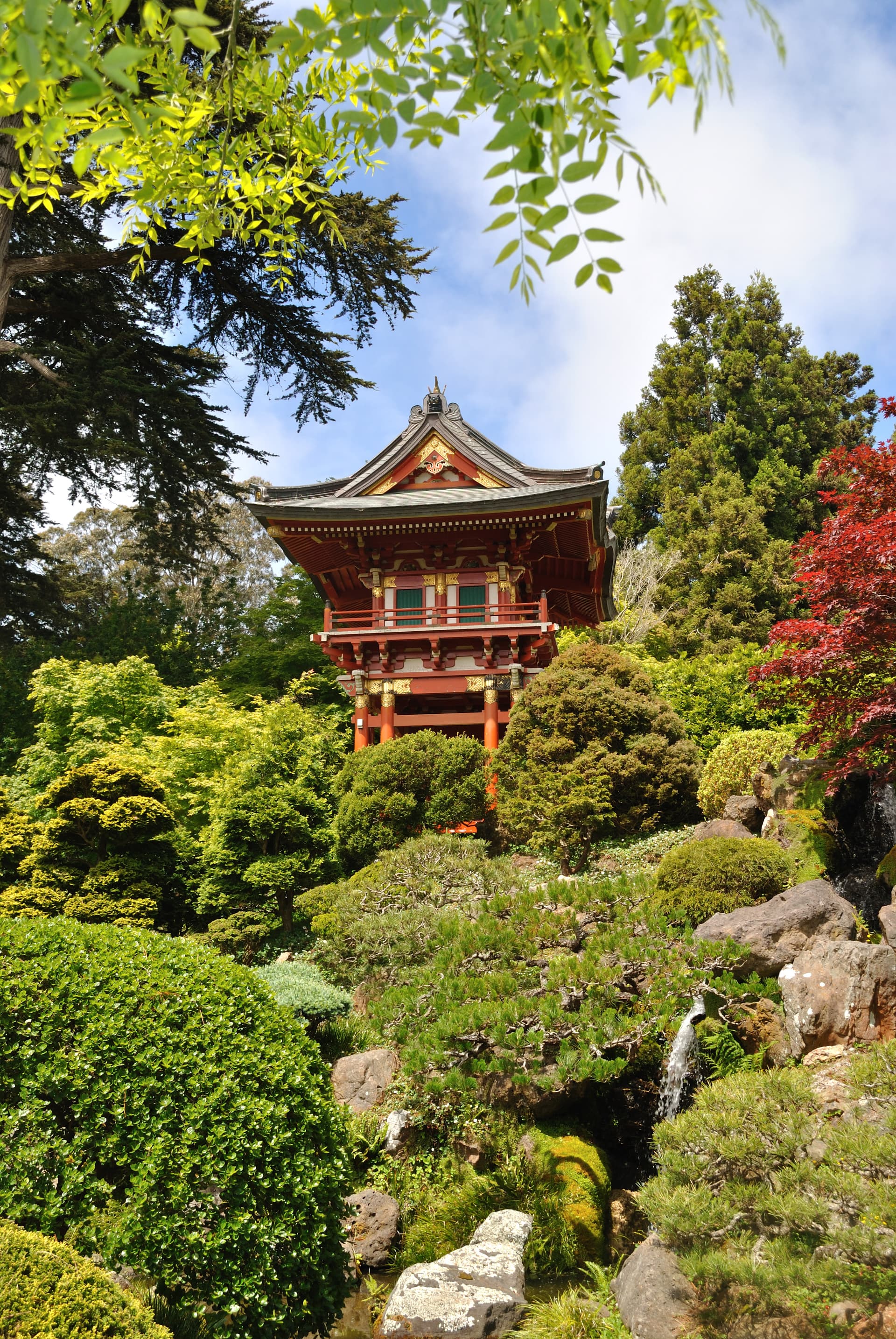
The Japanese Tea Garden adds a different layer again. Rec and Park calls it the oldest public Japanese garden in the United States, and its built history stretches back to the 1915 Panama-Pacific International Exposition, when the pagoda was constructed as a temporary structure. The pagoda was moved to the garden in 1916, where it stood for more than a century before its full restoration.
That arc, from temporary fair architecture to restored landmark, is exactly what makes the garden one of the park’s essential stops. It is not preserved as a frozen relic. It has been rebuilt, relocated and reimagined while remaining public and open to ordinary parkgoers. The garden’s longevity comes from adaptation, not stillness.
A 2024 Rec and Park update adds another layer of current use: the redesigned Pagoda Plaza is built for cultural programming, including taiko performances and bonsai demonstrations. The redesign involved Japanese garden designer Hoichi Kurisu and materials sourced from Japan, which keeps the site connected to both tradition and active programming. That means the garden is still doing what a public garden should do in San Francisco: hosting beauty, ceremony and neighborhood use at the same time.
How to see the park’s strange history in one visit
The most satisfying way to take in Golden Gate Park is to treat it as a sequence of surviving objects rather than a single green expanse. Start with the bison at the west end, where the herd makes the park’s scale feel immediate. Move on to the Conservatory of Flowers for the city’s most concentrated burst of Victorian horticulture, then finish at the Japanese Tea Garden, where the pagoda and plaza show how a public space can carry more than a century of change without losing its identity.
What ties these places together is not just age. It is the park’s habit of keeping difficult, beautiful and eccentric things alive in public view. Golden Gate Park began as sand, became shelter in a crisis, and now holds a herd, a glasshouse and a Japanese garden that each tell a different version of San Francisco’s civic stubbornness.
This article was produced by Prism’s automated news system from verified source data, official records, and press releases, then run through automated quality and moderation checks before publishing. The system is built and supervised by the people who set the standards it runs under. Read our full AI policy.
Did this article answer your question?