Juneteenth on the Waterfront brings music, food and Black vendors to San Francisco
Black vendors, family activities and live music will fill the Ferry Building and Fillmore as San Francisco marks Juneteenth with free, neighborhood-rooted celebrations.

San Francisco’s strongest Juneteenth gatherings do more than mark a holiday, they put Black history, entrepreneurship and neighborhood life on the city’s most visible stages. At the Ferry Building and in the Fillmore, residents can spend the day with Black vendors, live music, family activities and community partners that make the commemoration feel local rather than ceremonial.
Why Juneteenth still matters in San Francisco
Juneteenth became a federal holiday in 2021, but its meaning reaches back to June 19, 1865, when Union troops in Galveston, Texas, announced that enslaved people in Texas were free, more than two years after the Emancipation Proclamation. That gap between legal declaration and lived freedom is why the holiday remains both a remembrance and a civic reckoning.
KQED’s Bay Area event guide makes clear that San Francisco is part of a wider regional calendar built around that history, with celebrations that mix gospel, jazz, artwalks and neighborhood gatherings. In a city where Black communities have long fought for visibility and permanence, Juneteenth has become a way to connect public celebration with places that still carry the weight of Black history.
Juneteenth on the Waterfront turns the Ferry Building into a Black marketplace
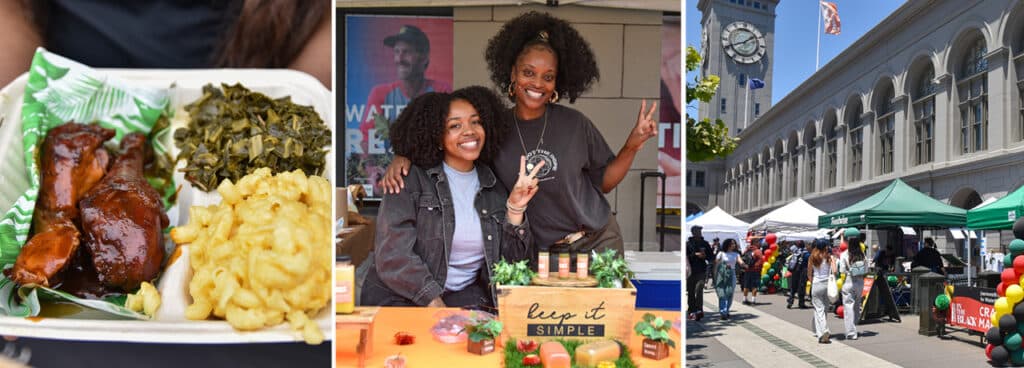
The most prominent city event is the 6th annual Juneteenth on the Waterfront, set for Sunday, June 7, 2026, from 11 a.m. to 4 p.m. at the Ferry Building front plaza, also described as Embarcadero Terminal Ferry Plaza. Foodwise says admission is free and open to the public, with food and drink available for purchase, making it one of the easiest ways to take part without a ticket or advance planning.
What sets this gathering apart is its emphasis on Black entrepreneurship. Foodwise says the event celebrates Bay Area BIPOC entrepreneurs and names 27 Black-owned businesses taking part, including 9 new vendors and 18 returning ones. The broader event lineup includes nearly 30 Black vendors offering food, drinks and other goods, along with live music, food demonstrations and hands-on craft making.
That mix matters for San Francisco because it places Black business directly in one of the city’s most recognizable public spaces. Foodwise describes Juneteenth on the Waterfront as part of its Pop-Ups on the Plaza series, with support from the San Francisco Human Rights Commission and additional backing from the Ferry Building and the Port of San Francisco. For residents looking to celebrate in a way that also supports local economic activity, this is the city’s clearest buy-local Juneteenth stop.
The Fillmore celebration brings the holiday into the street
If the waterfront is about commerce and culture in a civic setting, the Fillmore District celebration is about neighborhood scale and memory. Organizers say the Juneteenth Freedom Celebration stretches across 8 city blocks and is expected to draw thousands, with community leaders, performers, vendors, exhibitions, inflatables, games and family activities filling the street.
Other event listings describe it as California’s largest Juneteenth celebration and the nation’s 2nd-longest-running Juneteenth event. That combination of size and longevity gives it a different feel from the waterfront gathering: this is a block-by-block public festival built around parade energy, children’s activities and a dense mix of local participation.
The Fillmore’s history helps explain why the event carries such symbolic force. The district was once a thriving Black cultural center, widely known as the Harlem of the West, before urban renewal and displacement transformed the neighborhood. Holding a Juneteenth celebration there is not just festive programming, it is also a public recognition of a district that remains central to San Francisco’s Black memory.
For families, the Fillmore event is the most obviously kid-friendly of the two. The mix of a kids zone, fashion show, free carnival rides, music concert, retail and food vendors, along with games and inflatables, makes it a full-day street outing rather than a single performance or lecture. The holiday’s educational purpose is still present, but it is embedded in a setting where children can move between play, music and community history.
City support gives the holiday a broader footprint
San Francisco’s Human Rights Commission is backing Juneteenth activations across the city through grant funding for nonprofit partners including Foodwise, Livable City, SFHDC and the African American Arts and Cultural District. That matters because it shows Juneteenth is not being treated as a one-off festival, but as part of a wider civic infrastructure that supports Black cultural programming and neighborhood events.
The grant-backed network also helps explain why the month feels larger than a single date. A Bay Area Juneteenth calendar can include gospel performances, jazz concerts and art-centered gatherings alongside the marquee city events, giving residents multiple ways to participate depending on whether they want history, food, music or a family outing. In practice, that means Juneteenth in San Francisco is spread across institutions, from the waterfront to the Fillmore and into nonprofit cultural spaces.
For anyone deciding where to go, the choice comes down to the kind of celebration you want. The waterfront is the best fit if you want to support Black-owned businesses, shop for food and crafts, and spend a few hours at a free public marketplace. The Fillmore is the better choice if you want a full neighborhood street festival with kids’ activities, performances and the strongest connection to San Francisco’s Black cultural history.
Taken together, the two events show how Juneteenth has matured in San Francisco into something both celebratory and rooted. The holiday now lives in the city’s public squares, in a historic Black district and in the institutions that help keep those traditions visible, accessible and worth returning to each year.
This article was produced by Prism’s automated news system from verified source data, official records, and press releases, then run through automated quality and moderation checks before publishing. The system is built and supervised by the people who set the standards it runs under. Read our full AI policy.
Did this article answer your question?