Meet the District 4 candidates: Mission Local’s voter guide ahead of the Board of Supervisors race
Joel Engardio's recall over the Great Highway closure created one of the Sunset's most unusual supervisor races. Five candidates compete June 2 for a seat they'd have to win again in November.
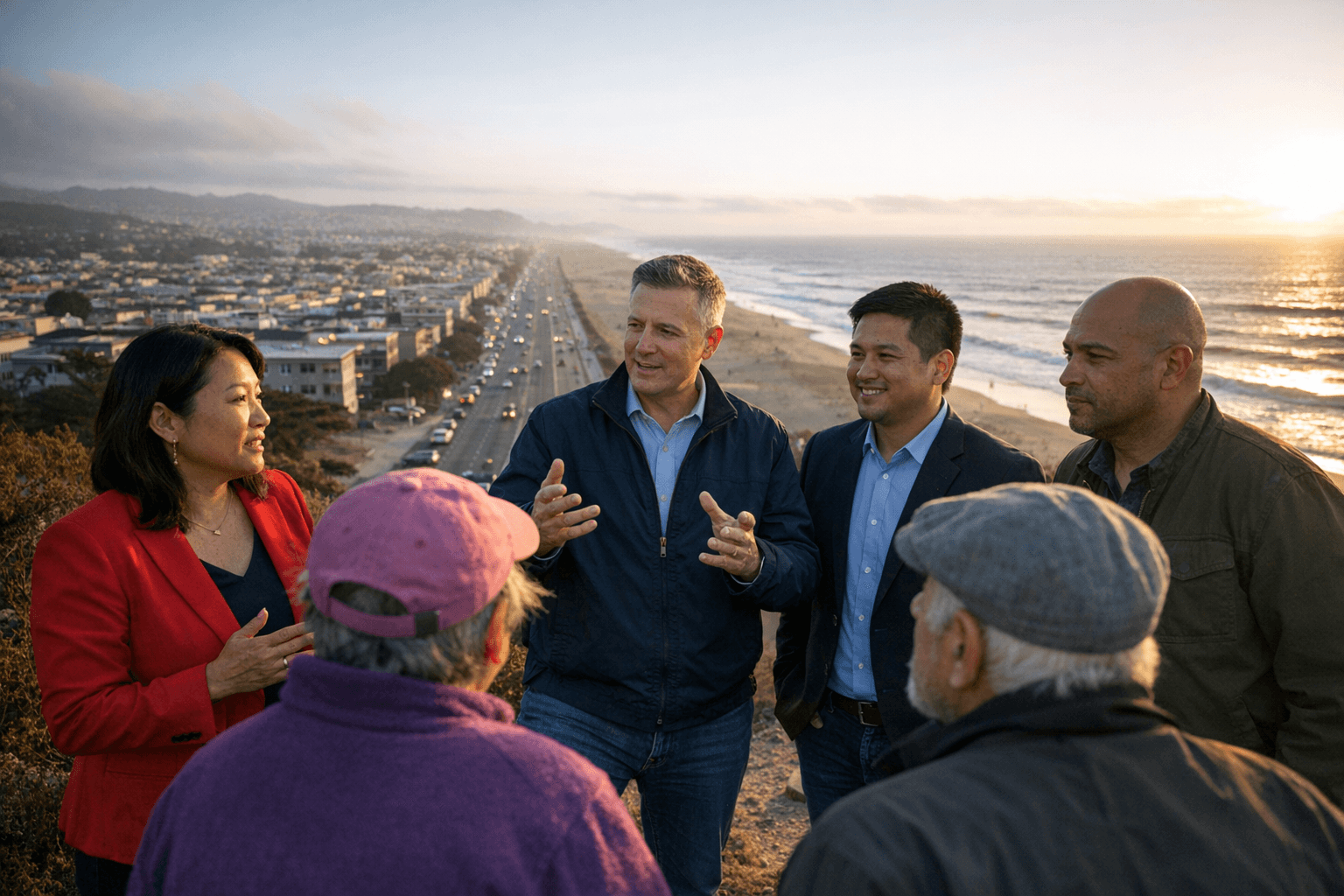
The stretch of oceanfront road at the center of all this connects Sloat Boulevard to Lincoln Way along the edge of the Pacific. Whether cars should travel it cost Joel Engardio his seat on the San Francisco Board of Supervisors, created a vacancy that Mayor Daniel Lurie has since filled by appointment, and set up one of the city's most closely watched supervisor contests of 2026. Five candidates now want to represent District 4, a broad swath of the city running from 19th Avenue to Ocean Beach and from Golden Gate Park to Lakeshore.
How the seat came open
On September 16, 2025, 64.6% of District 4 voters approved Proposition A, the recall measure targeting Engardio, with just 35.4% voting to keep him. The trigger was Proposition K, a 2024 ballot measure Engardio championed that permanently closed a portion of the Great Highway to automobile traffic to create the Sunset Dunes park. His critics organized swiftly: a petition submitted May 22, 2025, gathered 10,523 valid signatures, clearing the required threshold of 9,911, and by September the recall was a certified, lopsided result. Engardio himself stood by the project even after the vote, comparing the creation of Sunset Dunes to the building of the Golden Gate Bridge. Mayor Lurie then appointed Alan Wong to fill the seat on an interim basis. Wong, notably, had previously served as an education policy advisor to former Supervisor Gordon Mar, who held District 4 before Engardio, giving the seat's current occupant a direct link to the district's pre-Engardio political era.
Two elections, one term
District 4 voters head to the polls on June 2, 2026, in a special election held alongside a parallel District 2 race. The June 2 winner, however, does not earn a full term. They will serve only through January 2027, completing the remainder of Engardio's original term, before District 4 holds a second election in November 2026 for the full four-year seat. The candidate who wins in June must effectively launch a second campaign almost immediately, an unusual dynamic that rewards strong fundraising infrastructure and broad coalition appeal from the start.
The candidates
Alan Wong
The appointed incumbent grew up in the Sunset and holds one of the more layered civic resumes in the race. Wong served on the City College of San Francisco Board of Trustees and held a rank as a military commander before becoming policy director at the Children's Council of San Francisco. He was previously a legislative aide for District 4 and completed both the SFPD's Community Police Academy and the San Francisco Fire Department's Neighborhood Emergency Response Team training. He also served on the board of Stop Crime SF, whose co-founder Frank Noto has called him the "most qualified candidate" in the field. On the central housing question of the cycle, Wong voted in favor of Mayor Lurie's Family Zoning plan, which promotes denser residential development to meet state housing mandates, and said he would seek amendments as needed. Lurie's broader political network has backed Wong heavily, and as of early 2026, he led in endorsements from the mayor's orbit.
Natalie Gee
The race's leading progressive candidate entered with the strongest fundraising numbers of any District 4 contender as of early 2026. A longtime chief of staff and former campaign manager for District 10 Supervisor Shamann Walton, Gee is a member of IFPTE Local 21, the International Federation of Professional and Technical Engineers. She opposed Proposition K and has made clear she intends to fight Mayor Lurie's Family Zoning plan, pledging to work to amend it. She is the only woman among the top three contenders, a distinction some observers note could shape her coalition in a district where supervisor contests draw deeply engaged neighborhood voters.
Albert Chow
Chow's candidacy is inseparable from the recall that created this election. The owner of Great Wall Hardware on Taraval, a Sunset institution his family started in 1978, Chow also served for 14 years as president of People of Parkside Sunset (POPS), a neighborhood advocacy group, and was one of the lead organizers of the Engardio recall campaign. His hardware store was destroyed by an arsonist in 2024; he has spent the intervening months rebuilding it while simultaneously running for office, with a reopening planned for 2026. Like Gee, he opposed Proposition K, and he has positioned himself as a candidate who places district concerns ahead of the mayor's citywide agenda. As of early 2026, he had raised approximately $6,151.
David Lee
A lifelong San Franciscan and Sunset homeowner, Lee brings a distinct civic biography to the race. He has taught political science at San Francisco State University and other public institutions for many years, and since 1993 has served as volunteer executive director of the Chinese American Voters Education Committee, a nonprofit that organized hundreds of voter registration drives and reached more than 100,000 voters across the Bay Area. He previously ran for the District 1 supervisor seat in 2012, 2016, and 2020, and contested the District 19 state Assembly seat in 2024. He has also served on the San Francisco Recreation and Parks Commission. His background in Asian American civic engagement and voter empowerment gives him a distinct lane in a district with a large Chinese American population.
Jeremy Greco
A longtime Sunset resident and former worker-owner of the grocery co-op Other Avenues, Greco brings a cooperative economics perspective that sets him apart from the rest of the field. As of early 2026, he had not reported any campaign contributions, a sharp contrast with the race's better-funded contenders.
The key fault lines
Two issues have defined candidate positions more than any others. The first is Proposition K and the Great Highway. The permanent closure of the road to cars, and the creation of Sunset Dunes park, remain live controversies in a district where residents have strong views on coastal access and recreational use. Gee and Chow both opposed the measure; Wong's position is shaped by his alignment with Mayor Lurie, who backed the broader policy direction Engardio championed. The second is the mayor's Family Zoning plan, designed to increase residential density throughout San Francisco in compliance with state housing mandates. Wong voted for it; Gee has pledged to fight it. The plan functions as a proxy for a wider debate between candidates who see the mayor's agenda as aligned with district needs and those who argue neighborhood character should anchor housing policy.
Forums and the ranked-choice conversation
Four of the five candidates appeared before dozens of Sunset residents at a March 18, 2026, forum at Holy Name of Jesus Parish, moderated by Jade Tu. A second forum hosted by Mission Local is scheduled for later in April 2026, giving voters another opportunity to compare the field in person before ballots go out.
Ranked-choice voting strategy has already become a public conversation. At a February 26, 2026 forum, Sunset activist Heather Davis, a lead volunteer in the Engardio recall who strongly opposes upzoning, stood outside with a handmade sign promoting a ranking strategy that placed Chow and Gee in the top slots. No formal ranked-choice alliance between the two campaigns has been confirmed, but the informal signaling reflects how tactically some of the district's most engaged voters are already thinking about the June ballot.
What's at stake
The Board of Supervisors seat for District 4 carries votes on citywide budget decisions, land use, zoning, Muni infrastructure, and neighborhood services across the Sunset, Parkside, and Lakeshore. The district's political story has a recursive quality worth noting: Gordon Mar held the seat, Engardio unseated him, Engardio was recalled, and Wong, who once advised Mar, now occupies the seat on an interim basis while the district awaits its verdict. Wong, Chow, and Gee led the field in endorsements and fundraising as of February 2026. With a special election drawing a smaller, more engaged electorate than a typical November race, the contest remains genuinely open. And whoever wins in June will need to be ready to do it all again before the year is out.
Know something we missed? Have a correction or additional information?
Submit a Tip