Pfizer Closes South San Francisco Lab, Shifting 164,000 Square Feet to Remote Work
Pfizer's 164,000-square-foot South San Francisco lab closed last April, and with regional biotech vacancy hitting 35%, the corridor faces its deepest contraction in a generation.
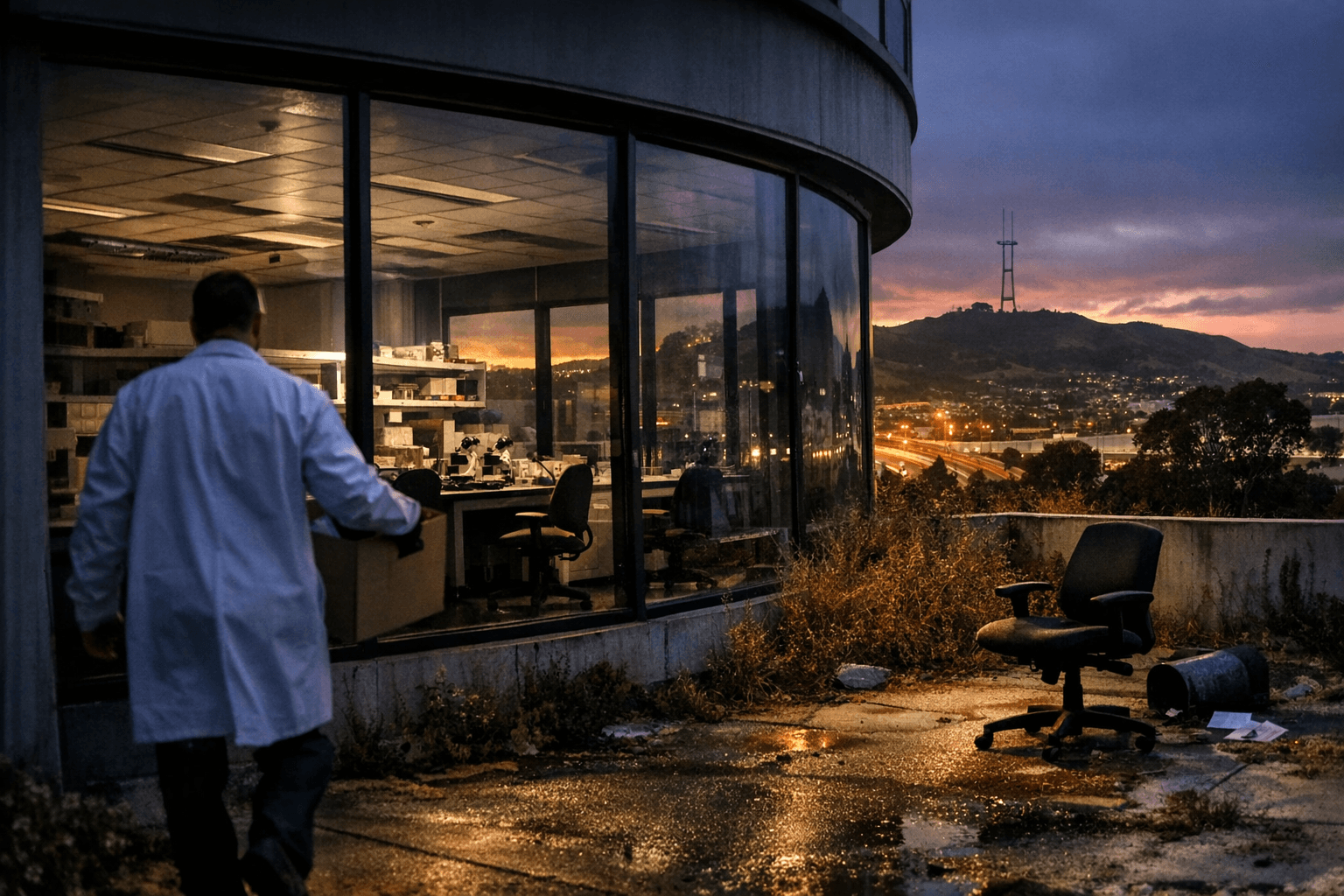
At 181 Oyster Point Blvd, where Global Blood Therapeutics once housed its sickle-cell research before Pfizer paid $5.4 billion to acquire it, the five-story building sat dark by the end of April 2025. Pfizer shuttered the site after less than three years as its Bay Area anchor, vacating more than 164,000 square feet of lab and office space and converting whatever workforce remained there to fully remote roles rather than issuing pink slips.
A company spokesperson offered a blunt explanation: "After careful evaluation, Pfizer has decided to close its South San Francisco office as the office space is currently underutilized." The transition to remote work spared employees from immediate layoffs, a notable contrast to earlier cuts at the same address. In January 2024, Pfizer filed a Worker Adjustment and Retraining Notification disclosing plans to lay off 52 employees at the Oyster Point facility by mid-February of that year.
The closure is a chapter in a much larger financial story. Pfizer launched its Cost Realignment Program in October 2023, targeting $4 billion in savings by end of 2024. It exceeded that goal, reporting $4.5 billion in net savings, and has since raised the bar to $7.7 billion through 2027, with an additional $500 million targeted for 2025 alone. Across 2024, more than 1,500 Pfizer jobs were eliminated globally, touching sites from Pearl River, New York, where 285 vaccine R&D positions were cut, to Everett, Washington, where 120 more were lost. The company reported 7% operational growth in 2024 despite the reductions.
Rather than simply contracting, Pfizer has been rerouting. It consolidated its Southern California oncology research into 230,000 square feet at the new Torrey Heights life sciences campus in the San Diego area, developed by Breakthrough Properties, and is separately laying off 100 workers from the former Seagen headquarters in Bothell, Washington. Chris Boshoff, who replaced Mikael Dolsten as head of Pfizer's R&D organization at the end of 2024, now leads a leaner, more geographically concentrated research enterprise.
For South San Francisco's "Biotech Beach" corridor, the departure lands on already bruised ground. Life sciences vacancy in the South San Francisco area reached roughly 35% in the fourth quarter of 2025, according to a CBRE report, a figure that reflects a cascade of reductions across the cluster. Genentech, the largest biotech employer in the city and a Roche subsidiary, laid off 489 workers in 2025 across multiple WARN filings, bringing its total cuts over roughly 15 months to more than 700 positions. Arsenal Biosciences and Sutro Biosciences have also reported staff reductions. Broader Bay Area life sciences have absorbed the bankruptcies of 23andMe, Invitae, and Amyris, while venture capital has grown sharply more selective.
The Oyster Point closure raises an unanswered question that state and city officials have yet to publicly address: what becomes of a 164,000-square-foot biotech facility in a market where a third of comparable space sits empty? With no announced buyer, redevelopment partner, or workforce retraining pipeline tied to the site, the building risks joining a growing list of life sciences properties caught between a sector that overbuilt during the pandemic boom and an investment climate that has yet to recover. South San Francisco has not had a formal economic response plan for the corridor's contraction, and the compounding losses at Genentech, Pfizer, and smaller neighbors suggest the window for a proactive intervention is narrowing. Pfizer has closed South San Francisco operations before, most recently in 2003 following its Pharmacia merger. The corridor recovered then; whether it can absorb a 35% vacancy rate and a wave of simultaneous departures without a coordinated public-sector response is the defining economic question facing the region's most iconic biotech address.
Sources:
Know something we missed? Have a correction or additional information?
Submit a Tip