Record Store Day draws overnight crowds to San Francisco’s Haight Street
A line of collectors stretched outside Amoeba on Haight Street, where more than 150 people camped out last year for Record Store Day. The rush has turned a shop day into a test of San Francisco’s vinyl economy.
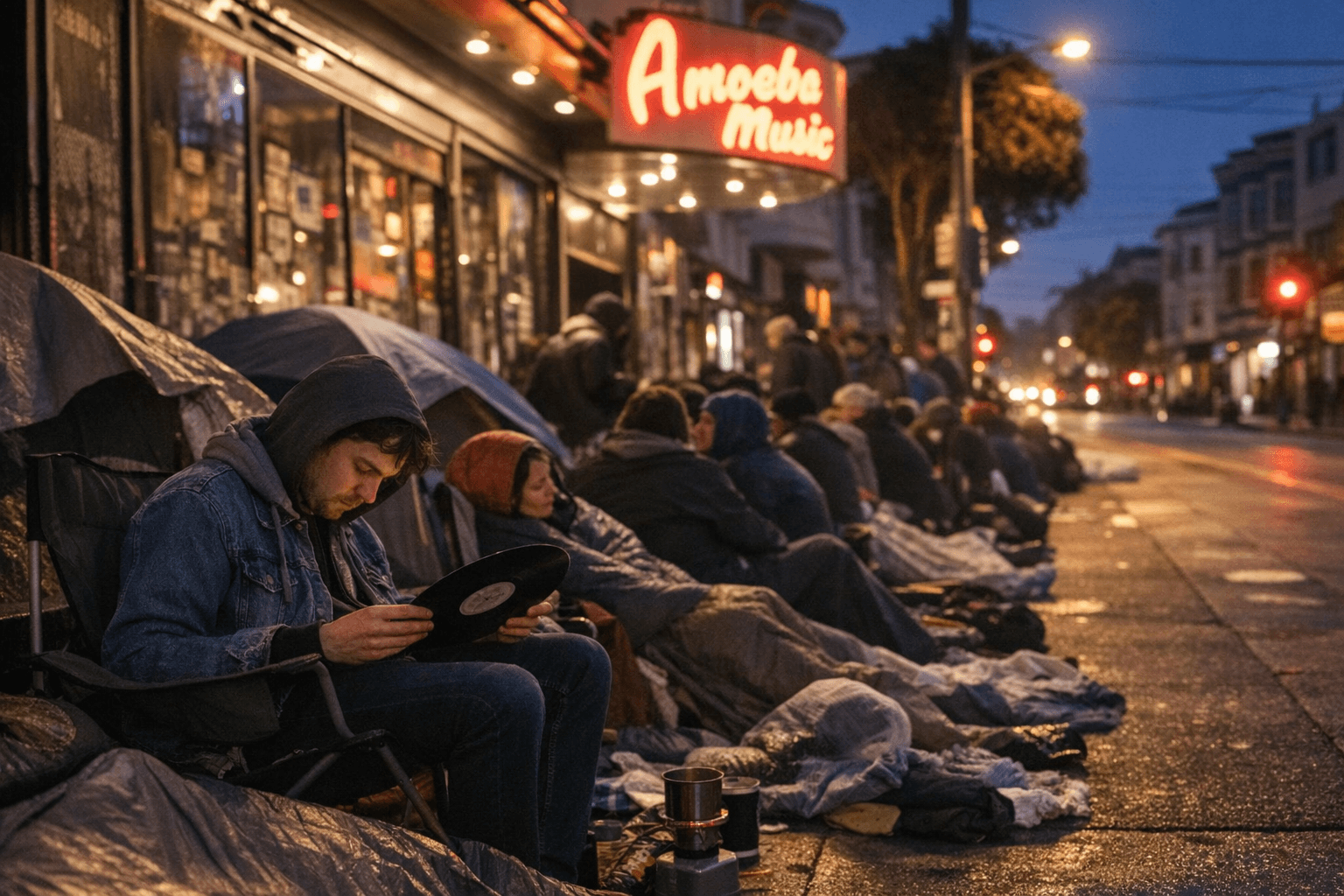
A line of collectors stretched outside Amoeba Music on Haight Street before dawn, turning the block near Golden Gate Park into one of San Francisco’s loudest retail scenes. Manager Tony Green said Record Store Day is the store’s biggest day of the year, and more than 150 people camped outside last year waiting for the doors to open.
That kind of turnout matters on a corridor where several independent record shops sit close together in a stretch some call Record Alley. Amoeba opened its San Francisco store in 1997 in a converted bowling alley at the eastern edge of Golden Gate Park, and the chain says its Haight-Ashbury location stocks hundreds of thousands of titles. On a day built around scarcity, that inventory makes the shop a destination for buyers from across the city and beyond.
This year’s release list mixed collector frenzy with pop-star pull. Record Store Day listed Taylor Swift’s Elizabeth Taylor as a 7-inch “Cry My Eyes Violet Glitter” vinyl release with two tracks, “Elizabeth Taylor” and “Elizabeth Taylor (So Glamorous Cabaret Version).” Bruno Mars served as the 2026 ambassador, and Record Store Day also listed his The Collaborations as an RSD 2026 LP, a reminder that the event now depends as much on marquee names as on crate-digger rarity.
Record Store Day’s footprint has grown far beyond Haight Street. The organization says the idea was conceived in 2007 by independent store owners and employees, and the first event was held on April 19, 2008. Nearly 1,400 independently owned record stores in the United States and thousands more internationally now take part. The annual release day has become a fixed point on the music calendar, even as streaming remains the dominant format.
The numbers behind the vinyl revival help explain why shops still stage for the day. RIAA’s year-end report put U.S. recorded-music revenue at a record $15.9 billion in 2022, the same year vinyl sales surpassed CDs. Shop owners say younger buyers still respond to the format’s physical appeal, from holding an album jacket and reading liner notes to dropping a record onto a turntable.
Not every independent owner sees the holiday as pure upside. Some smaller shops say Record Store Day has become more corporate, in part because stores must stock packages that can include titles they do not want. Even so, shops such as Groove Merchant Records still use the event to stash especially desirable inventory, and on Haight Street the result is a one-day surge of foot traffic that gives the neighborhood a rare burst of commercial life.
This article was produced by Prism’s automated news system from verified source data, official records, and press releases, then run through automated quality and moderation checks before publishing. The system is built and supervised by the people who set the standards it runs under. Read our full AI policy.
Did this article answer your question?

