Aztec’s Main Avenue showcases 78 historic structures and local history
Aztec’s Main Avenue puts 78 listed structures in a walkable downtown district that still pulls foot traffic, memory, and preservation decisions.
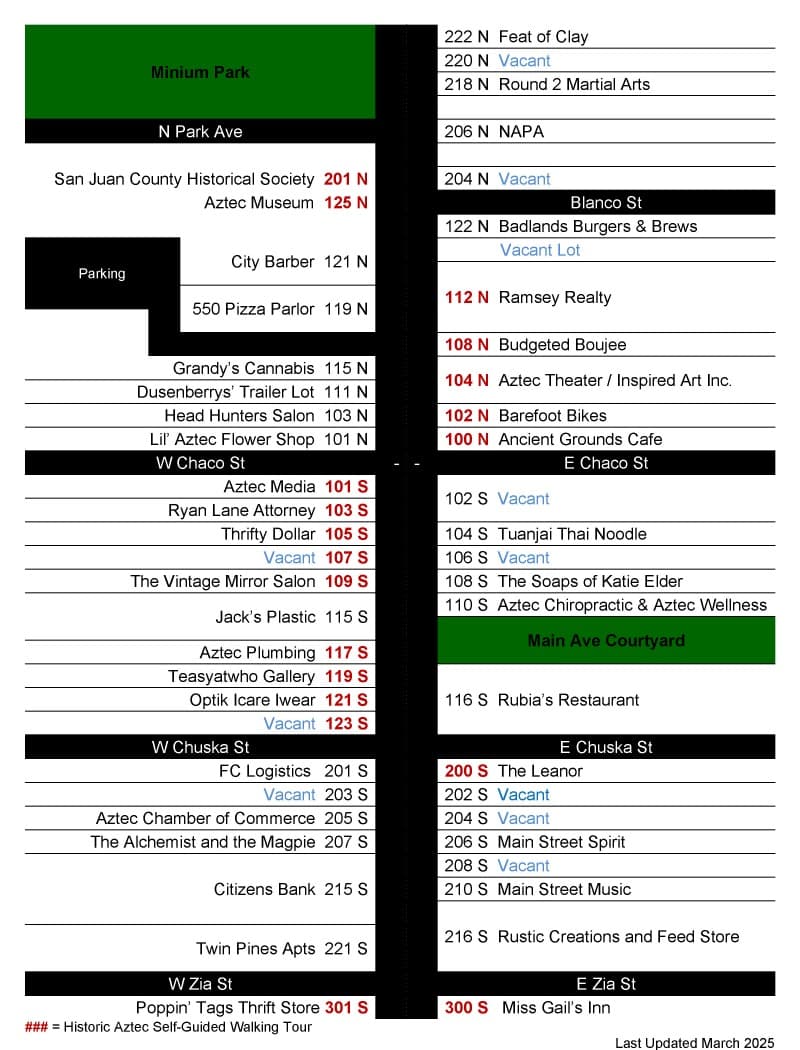
Aztec’s historic Main Avenue is more than a preserved streetscape. It is a compact downtown district where 78 structures are listed on both the National Register of Historic Places and the New Mexico Register of Cultural Properties, and where a self-guided walk still connects heritage to the life of the town center. The route begins at Aztec Museum & Pioneer Village at the north end of Main Avenue, follows the street south through downtown, and continues into a historic neighborhood east of the avenue.
Why Main Avenue matters to Aztec now
Main Avenue’s historic district status gives the area a clear civic weight, not just a nostalgic one. The state designated it a historic district in 1982, and it was added to the National Register in 1985. The district is only 1.5 acres, with 11 buildings total and eight contributing buildings, bounded by Main E., Chuska S., the alley between Park and Main W., and Chaco N.
That small footprint is part of what makes the district important to preserve carefully. In a downtown this compact, the condition of one building, one storefront, or one blockface can change how people move, linger, and spend time there. For Aztec residents, the district is not an isolated museum piece. It is part of the town’s working center, where preservation decisions affect foot traffic, local visibility, and the sense of place around downtown businesses.
Start at the north end of Main Avenue
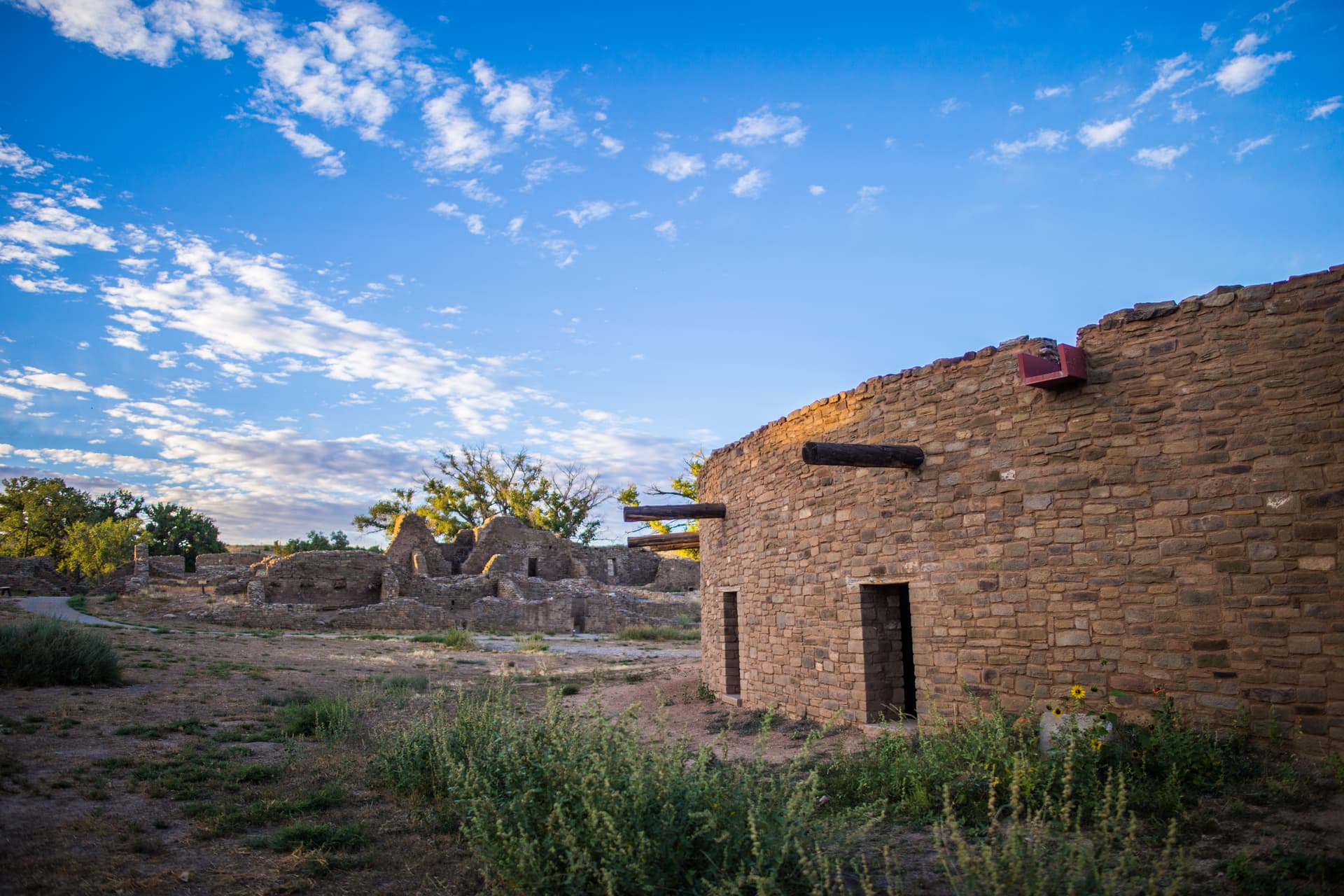
The walk begins at Aztec Museum & Pioneer Village, 125 N. Main Avenue, which functions as the northern anchor of the historic corridor. The museum’s Pioneer Village is a collection of 12 buildings moved or built on site to resemble early-20th-century structures. Among them are the old Aztec Jail, a tinsmith and print shop, a Denver & Rio Grande Railroad caboose, and blacksmith and carpentry shops.
The museum site also describes Pioneer Village as a group of original and replica structures representing 14 businesses, public buildings, and dwellings. That matters because it shows how the museum and Main Avenue work together: one interprets the town’s built history, and the other places that history in the middle of the downtown grid. The result is a route that does not separate heritage from commerce. It folds history into the same blocks people use to get around town.

What the downtown walk shows you
South of the museum, Main Avenue becomes a record of Aztec’s layered civic history. The old firehouse now houses the San Juan County Historical Society, where more than a century of records and images of Four Corners settlers are preserved and presented, along with specialty books about the area. The old city hall became the Aztec Museum, making the district itself a working archive of local institutions.
The 1927 Aztec Theater, originally the Mayan Theater, adds another layer. It long served as an entertainment anchor for county residents, which is exactly the kind of building that turns a historic district into a living downtown rather than a static row of old facades. These structures are not just decorative stops on a walk. They are the physical evidence of how Aztec grew, where people gathered, and which public spaces still carry community memory.
Follow the route beyond the storefronts
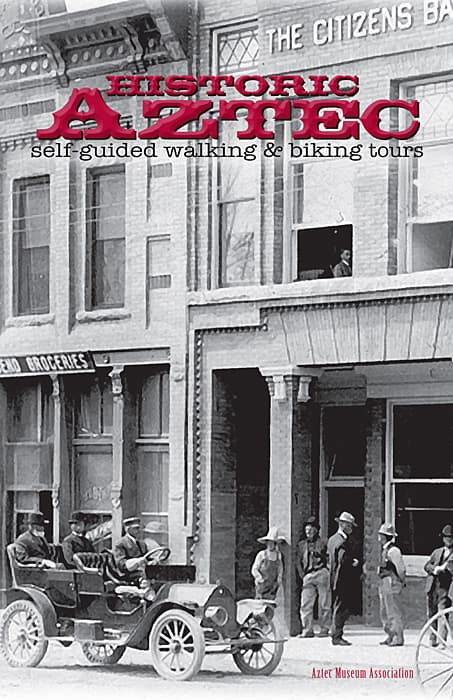
The city’s tourism materials make clear that the walk does not stop at the business district. After moving south through historic Main Avenue, it continues into a historic neighborhood east of the avenue. The walking-tour booklet also broadens the frame by beginning with Aztec Ruins National Monument and then moving into historic downtown before extending to homes, churches, and irrigation ditches built by early settlers.
That wider route places Main Avenue inside a larger settlement story. The booklet notes that New Mexico gained statehood on January 6, 1912, and much of the tour focuses on structures built in the early 1900s. That timeline helps explain why the district matters beyond architecture alone. It shows how Aztec’s downtown connects to the region’s early growth, and why preservation here is also a decision about how much of that era remains visible in everyday life.
A district within a larger preservation landscape
Main Avenue is only one part of a broader historic inventory in Aztec. The museum’s walking-tour material says the town contains four historic districts and 17 individual properties listed on the New Mexico and/or National Register of Historic Places. That larger count shows the district is not an oddity or a single-block attraction. It is part of a townwide preservation landscape that includes multiple sites and multiple eras.
The walking-tour booklet was published by the Aztec Museum Association in 2010, with acknowledgements to the Aztec Museum Association, the San Juan Historical Society, and staff at Aztec Ruins National Monument. That community-backed effort gives the route institutional depth. It also helps explain why the downtown walk has endured: it was built as a shared preservation project, not a one-time promotional brochure.
Why the walk still draws attention
The self-guided route works because it gives residents and visitors a practical way to read the town’s history on foot. The city materials provide maps and histories of the registered structures, and the museum’s broader public programming keeps that history active rather than sealed off. When people walk Main Avenue, they move past the old firehouse, the former city hall, the theater, and nearby homes as part of the same civic landscape.
For downtown Aztec, that matters in a very immediate way. A preserved historic district can help keep people on the street longer, draw attention to nearby businesses, and make the case for protecting buildings that still shape the center of town. Main Avenue’s value lies in that overlap: it is an archive, a corridor, and a public investment all at once.
This article was produced by Prism’s automated news system from verified source data, official records, and press releases, then run through automated quality and moderation checks before publishing. The system is built and supervised by the people who set the standards it runs under. Read our full AI policy.
Did this article answer your question?