Shiprock’s volcanic history and sacred status shape visitor etiquette
Shiprock is a sacred Navajo landmark and a geologic remnant, and the rules are clear: look from the road, don't climb, and treat access as tribal authority.
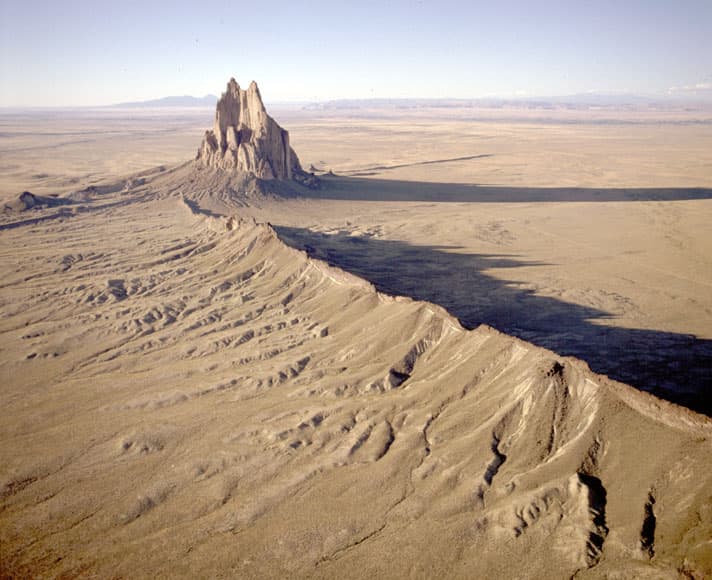
In San Juan County, Shiprock is not a place to approach casually. The base is restricted, tourists are barred from driving onto the dirt road leading to it, and the peak is meant to be viewed from paved roads or with a permitted guide. That practical rule sits on top of a deeper one: Tsé Bit’a’í, the “rock with wings,” is a sacred Navajo landmark as well as one of the most recognizable volcanic forms in the Four Corners region.
A volcanic remnant that still dominates the horizon
Shiprock rises about 1,800 feet, or 549 meters, above the surrounding plains, with a peak elevation around 7,178 feet. The main body is roughly 600 meters high and 500 meters in diameter, and the formation is visible from much of the Four Corners region. It erupted about 30 million years ago, and what remains today is the exposed core of a once-larger volcanic system.
New Mexico Bureau of Geology material describes Shiprock as a volcanic neck, the solidified feeder system of a volcano that has eroded away. Its radiating dikes, which spread from the center like spokes, make that buried structure easier to read from a distance. Some geologists use the volcanic-neck explanation, while Steve Semken has suggested the landform may also be understood as a diatreme, formed when magma interacted explosively with groundwater. Either way, the shape is not random. It is a visible cross-section of deep volcanic history in northwestern New Mexico.
Why the Navajo name matters as much as the geology
The Navajo name, Tsé Bit’a’í, translates as “rock with wings” or “winged rock,” and that language is a clue to how the place is understood in Diné tradition. One legend says a great bird carried the people from the north to their present lands. Another says monster birds lived on Shiprock until the Hero Twins climbed the rock and defeated them, leaving the hatchlings that became today’s raptors.
Those stories explain why Shiprock is not treated as a tourist object in the ordinary sense. It is part of Navajo memory, identity, and place-based teaching. Visitors who reduce it to a backdrop miss the point that the landmark is still living cultural ground, not an empty stage set for photos or recreation.
What responsible access looks like
Farmington’s visitor guidance is unusually direct because the rules need to be. Access to the base is restricted unless you are with a permitted guide, and tourists are prohibited from driving onto the dirt road that leads toward the formation. Overnight camping at Shiprock is not allowed, and climbing the rock is forbidden because it is sacred to the Navajo people.
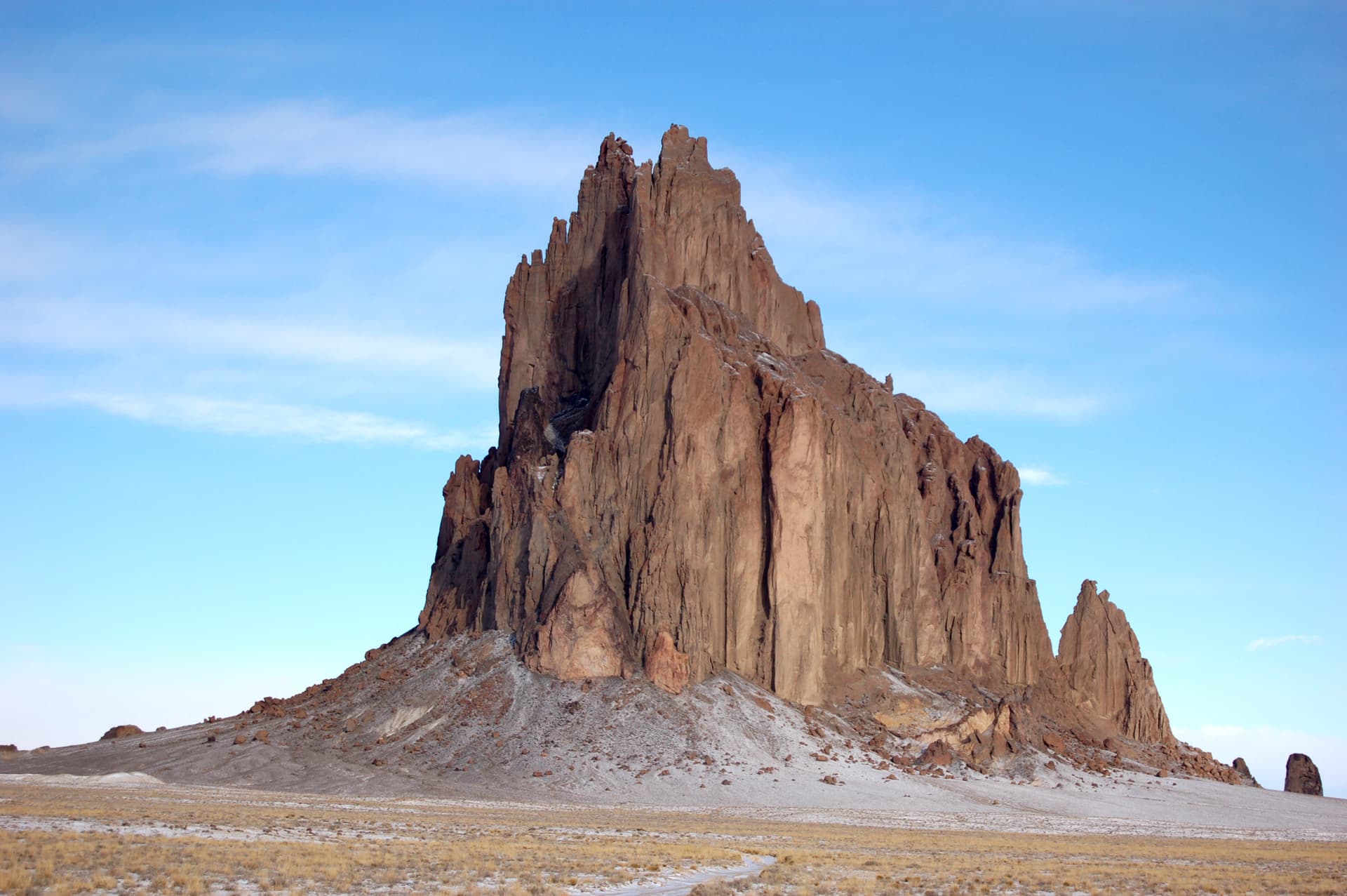
If you want to see Shiprock properly, use the paved roads and stay with the boundaries that are already in place. Viewing areas along Highway 64 west of Farmington and Highway 491 south of Shiprock give clear sightlines to the formation, which can be visible from 30 to 50 miles away. Navajo Tours USA is currently listed as a permitted guide operator for Shiprock Peak tours, and that matters because guided access is one of the few ways to come closer without crossing the line into trespass or disrespect.
- Photograph from paved roads unless you are with a permitted guide.
- Do not drive onto the dirt road leading to the formation.
- Do not climb the peak.
- Do not camp overnight at Shiprock.
- Treat tribal authority over the site as the controlling rule, not as a suggestion.
A simple rule set applies:
Photography, filming, and other uses are not open-ended
Shiprock’s image has traveled far beyond San Juan County. Public listings show it was used as a filming location for The Lone Ranger, which helps explain why the formation appears so often in regional and national imagery. It also shows how easily a sacred place can be converted into scenery if visitors do not know the limits.

The Navajo Nation Parks & Recreation permit system reinforces that access is managed, not assumed. The Nation has permits for backcountry hiking and camping, as well as separate film and photography special-use permits. That structure matters because it places photography and recreation under tribal authority, where cultural protection is part of the permit process rather than an afterthought.
A landmark with public recognition, and a reason for restraint
Shiprock is listed by the National Park Service as a National Natural Landmark, and public references place that designation in 1975. The formation also drew wider popular attention when a tourism source named it America’s Best Geological Formation in 2016. Those labels help explain why the rock is so familiar to travelers, students, and filmmakers across the Southwest.
But public fame does not change the rules on the ground. The name recognition, the dramatic silhouette, and the scientific significance all coexist with a cultural reality that should shape behavior first. In practice, that means seeing Shiprock as a place to observe with care, not a place to conquer, scale, or treat as open terrain. The landmark’s lasting value depends on people understanding that the view belongs to everyone, while the ground itself does not.
This article was produced by Prism’s automated news system from verified source data, official records, and press releases, then run through automated quality and moderation checks before publishing. The system is built and supervised by the people who set the standards it runs under. Read our full AI policy.
Did this article answer your question?