Duluth Cemetery Eroding Into Lake Superior, Human Remains Exposed on Shore
Human bones washed onto the Lake Superior shoreline below Duluth's Scandia Cemetery in summer 2024; St. Louis County is now seeking $2.5 million to stop the 1881 burial ground from continuing to erode.
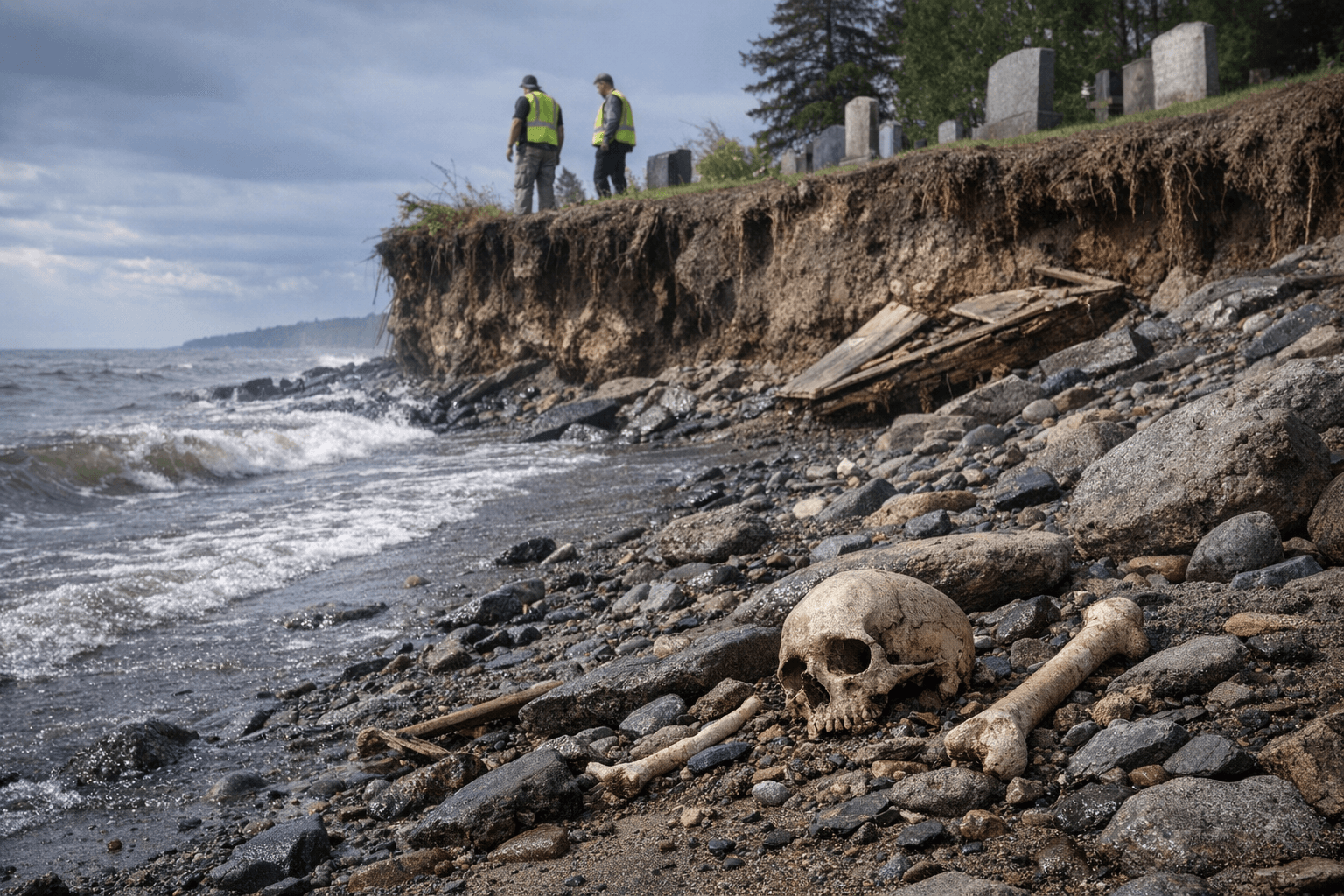
A family visiting Glensheen Mansion in the summer of 2024 wandered down to the beach at Scandia Cemetery and found a human bone. A survey of the site revealed other bones had been protruding through the dirt as well, the result of years of erosion. Now St. Louis County is racing to stop a 145-year-old burial ground from disappearing into the lake entirely.
Scandia Cemetery sits next to Glensheen Mansion on London Road in St. Louis County, where a crumbling clay bank has caused human remains to be unearthed. Erosion eats up to 20 inches of shoreline per decade at that stretch of the shore, and has potentially affected 60 buried bodies. Some are exposed in the dirt; others have been drawn out and lost to Lake Superior.
The first body, a 9-year-old boy, was laid in Scandia Cemetery in 1881 after members of the then First Norwegian Danish Evangelical Lutheran Church acquired the land. In its early years, the site held the remains of those who died in epidemics and were quickly buried, according to history gathered by the Twin Ports Genealogical Society. There are upward of 1,500 graves. St. Louis County Public Works engineer Rachel Gregg offered a blunt explanation for why the cemetery ended up so close to the water: "That was prime real estate. Bury your loved ones near the lake, it's beautiful."
The county's involvement was not automatic. The cemetery's aging caretakers wrote to the county saying they were giving it up, shortly before the bones were discovered in summer 2024. County Commissioner Patrick Boyle said that forfeiture legally left the nonprofit in no one's hands, and the county stepped in. Despite holding no formal legal obligation over private cemeteries, Boyle said the circumstances demanded action. "We want to do what's right for the families and those folks that are buried there, and do it in the right way where we don't have this happen anymore," he said.
In its grant application, county officials proposed "building a concrete retaining wall and nature-based stabilization methods on the cemetery property to prevent continual grave exposure and combat Lake Superior extreme weather events." An engineering firm hired by the county determined the $2.5 million retaining wall would be cheaper than relocating the graves. The county is asking the state for $1.7 million to protect 300 feet of Scandia Cemetery's waterfront, with the full project cost estimated at around $2.5 million. Officials plan to have the project completed by December 31, 2028.
St. Louis County officials applied for a state Legislative-Citizen Commission on Minnesota Resources grant, known as the LCCMR and funded in part by Minnesota State Lottery dollars, after an unsuccessful attempt the prior year. CBS Minnesota reported that the county is also seeking funds from the state's Environment and Natural Resources Trust Fund, because the cemetery's operators cannot afford the fix on their own. Boyle said the current application is stronger. "We know it's a shovel-ready case, and this is exactly what we need. It's at the finish line. So that's, I think, what's changed," he said.
State Sen. Jen McEwen of Minnesota's Democratic-Farmer-Labor Party sits on the LCCMR board and strongly supports the project, but she acknowledged others may have reservations. "I still think that we are going to face some questions from the Legislature about whether these LCCMR funds are appropriate for a use like this," McEwen said. She argued the damage is inseparable from a broader pattern. "We really do need to step up to make sure that we are protecting the public and addressing damage that is a direct result of climate change," McEwen said.
The stakes of a funding rejection are spelled out plainly in the county's own documents. "If a 'No Action' alternative is followed, Scandia Cemetery will indefinitely require routine monitoring, collection and housing of human remains, identification research, and notification to family lineage," according to county documents. The cemetery borders Glensheen Mansion, a historic lakeside property that draws thousands of visitors each year. The county's submission anticipates design and permitting work in 2026 and, if funding comes through, a shift to construction in mid-2027.
This article was produced by Prism’s automated news system from verified source data, official records, and press releases, then run through automated quality and moderation checks before publishing. The system is built and supervised by the people who set the standards it runs under. Read our full AI policy.
Did this article answer your question?