Federal Funds Back Green Infrastructure to Protect Tischer Creek, Lake Superior
St. Louis County and federal partners announced a green infrastructure project at Hartley Park to strip 22,000 pounds of sediment annually from Tischer Creek's urban watershed.
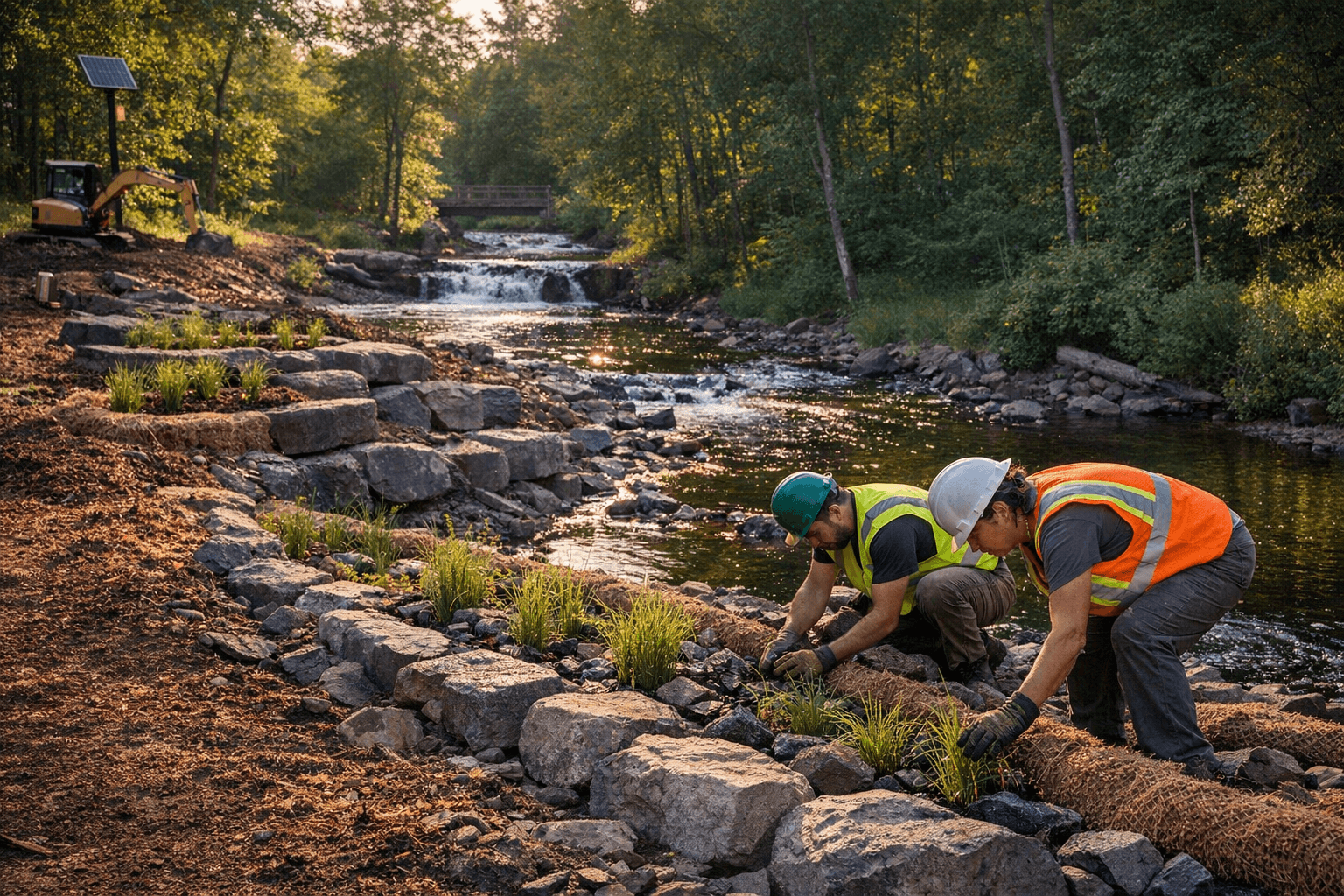
St. Louis County Public Works secured Great Lakes Restoration Initiative funding to build a layered stormwater treatment system at Hartley Park in Duluth, targeting a persistent water quality problem: 110 acres of northeast Duluth sending untreated runoff directly into Tischer Creek.
The project, announced April 1 through a partnership with the City of Duluth, the U.S. Army Corps of Engineers, and the Minnesota Pollution Control Agency, addresses documented impairments in Tischer Creek, a cold-water trout stream that flows through the park before emptying into Lake Superior. State and federal testing has found E. coli bacteria and elevated total suspended solids in the creek tied to urban runoff, erosion, and the "flashy" stormwater flows that scour streambanks after heavy rain along the Woodland Avenue corridor.
The engineered system routes stormwater through a sedimentation vault first, then into a sequence of constructed features: a sedimentation basin, a marsh, and a series of bio-infiltration basins. One of those basins incorporates a biochar-amended sand layer designed specifically to reduce bacterial concentrations. The full system is projected to remove approximately 22,000 pounds of sediment, 202 pounds of nitrogen, and 50 pounds of phosphorus from the watershed each year.
MPCA watershed coordinator Jesse Martus framed the work as a fundamental shift in how agencies treat urban streams. "We need to rethink stormwater," Martus said, arguing that targeted action in city watersheds can produce meaningful ecological gains for Lake Superior as a whole.
The project traces in part to earlier county road reconstruction on Woodland Avenue, which required storm sewer modifications and created a practical opportunity to intercept and treat runoff at scale. Funding combines GLRI dollars distributed through the Army Corps of Engineers with state Clean Water Fund grants, legacy funds, and county stormwater utility revenue.
Native vegetation will be planted across the basins and surrounding uplands and maintained for a minimum of three years. Restoration crews will also clear invasive species, including buckthorn, non-native thistles, and tansy, before establishing the native plant communities that anchor the system's long-term function.
The City of Duluth will operate the infrastructure after construction. Expected downstream results include reduced sediment plumes in Tischer Creek, cooler summer baseflow temperatures for trout, and cleaner water reaching Lake Superior near Glensheen and adjacent shoreline areas.
The MPCA and Army Corps described the Hartley Park installation as a potential model for stormwater intervention at sites where public open space overlaps with sensitive aquatic habitat across the Great Lakes basin.
This article was produced by Prism’s automated news system from verified source data, official records, and press releases, then run through automated quality and moderation checks before publishing. The system is built and supervised by the people who set the standards it runs under. Read our full AI policy.
Did this article answer your question?