Hermantown Restarts Environmental Review for Proposed Google Data Center
Hermantown restarted a seven-month environmental review for Google's proposed $650 million hyperscale data center after a hours-long, divided city council meeting March 16.

Hermantown held its first city council meeting since the public learned Google is the company behind the proposed hyperscale data center, and the hours of testimony that followed made clear the community's fracture is deep. For hours during the March 16 city council meeting, those for and against the project continued to state their case.
Hermantown had conducted an Alternative Urban Areawide Review, or AUAR, which was approved in October. In a letter addressed to the mayor and city council, city officials wrote they are now updating the AUAR as additional details and analysis have become available. The city and developer Mortenson voluntarily agreed to start a new AUAR that will supersede the one adopted last fall. Hermantown expects the process of updating the AUAR to take seven months. Two public comment periods will be held during that time. Permitting cannot move forward until environmental review is complete.
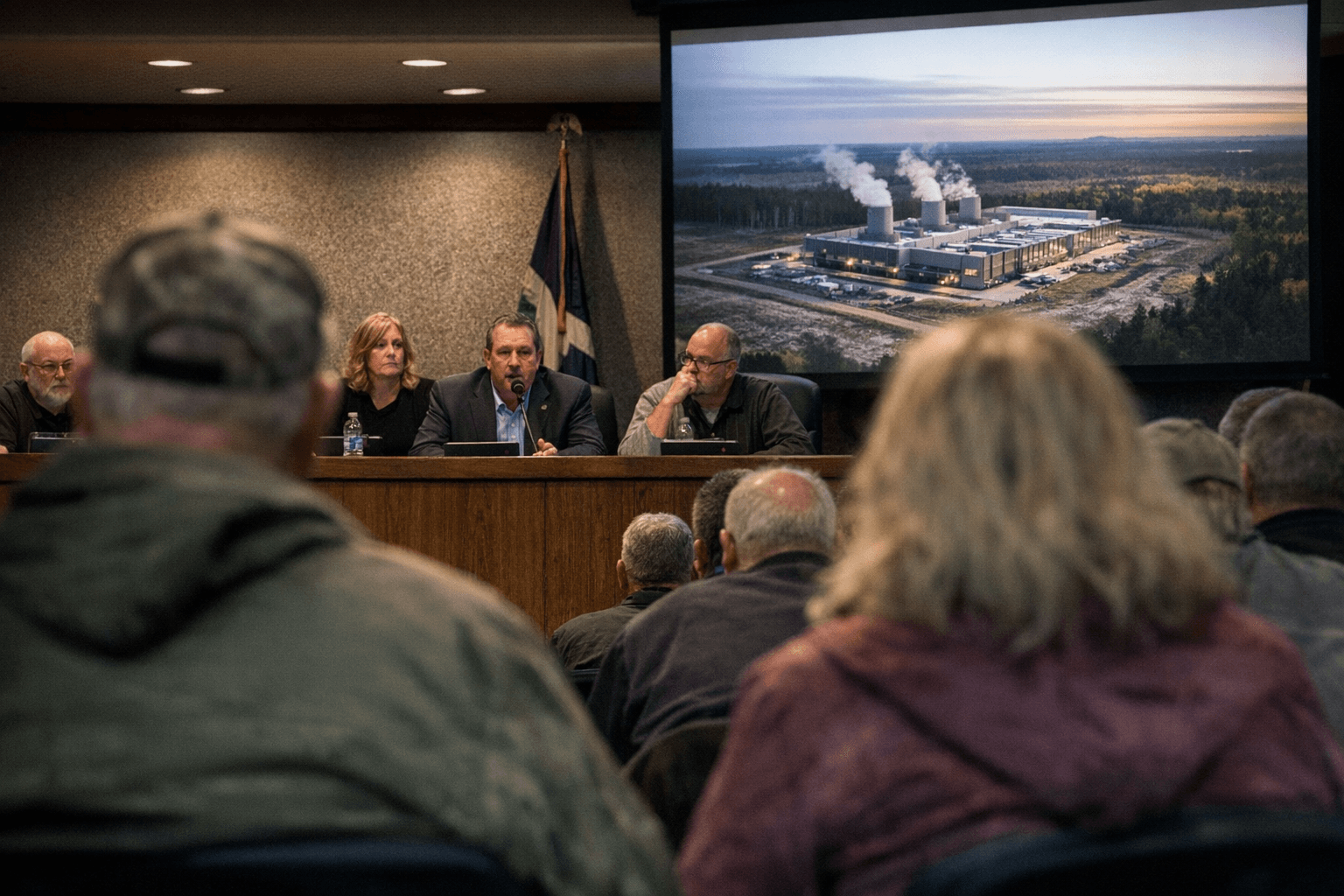
The project at the center of the fight is massive. The data center plans include converting a 400-acre marshy area next to Minnesota Power's Arrowhead substation into a 1.8 million-square-foot campus with at least four buildings to house the data center's servers. The proposal carries an estimated price tag of $650 million.
The identity of the developer was kept secret for months under the internal codename "Project Loon." Hermantown residents spent most of 2025 in the dark about "Project Loon," and last September the Minnesota Center for Environmental Advocacy supplied news outlets with public records it had obtained through data requests. Public records show the city had known since September 2024 that a data center was proposed. Three of St. Louis County official Ashley Grimm's colleagues had been muzzled by Project Loon NDAs, a fact she only learned about after overhearing comments from a staffer.
Google went public with its involvement on March 3, the same day Minnesota Power announced its electric service agreement to power the facility. The collaboration will reportedly enable the development of 700 megawatts of new, clean energy resources, from 300 MW of wind energy and 400 MW of battery storage. Minnesota Power Vice President Frank Fredrickson said, "We believe this agreement supports job creation, tax revenue and economic development in the region," and under Minnesota law, the costs of required grid upgrades will not be passed on to ratepayers.
In late January, Google shell company Harmony Group LLC paid $6 million to acquire land from three Hermantown residents, a steep premium over the combined $1.9 million value St. Louis County records show for those parcels.
The council chamber on March 16 split visibly along battle lines. It was a crowd split between green and red. Members of the grassroots group "Stop the Hermantown Data Center" wore red, voicing concerns about the residential location of the project. "No, no data center on this site," said Hermantown resident Jeffery Donahue. On the other hand, trade union members under "YesMN" wore green to show their support. "Work like this provides families with a steady means of income," said Duluth Building and Construction Trades Council President Jack Carlson.
The dispute over which type of environmental review is appropriate has become its own fault line. Many opponents are calling for an environmental impact statement, or EIS, instead, which they view as more rigorous. Critics contend the AUAR already conducted for the data center proposal was insufficient because it did not mention the data center and did not match the rigor of an EIS. City officials counter in their letter to the mayor and council that the project "includes rapidly evolving technological elements" that will likely alter the data center's design during the eight-to-ten-year construction project, making the more versatile AUAR the appropriate choice, noting that "the AUAR was designed by state statute to save time and resources for the city, developer, and reviewing agencies by being a living-document that provides versatility."
The Minnesota Environmental Quality Board has weighed in on the debate procedurally. The EQB emphasizes that neither review is a regulatory document. In both cases, Hermantown has the final call. "It is up to the responsible governmental unit, the RGU, for all levels of environmental review to make those decisions about the potential for significant environmental effects, whether the documents are done correctly," said EQB's Neuschler.
On November 5, the Minnesota Center for Environmental Advocacy and Stop the Hermantown Data Center sued Hermantown, alleging that the city's environmental review is insufficient and that city officials lack transparency. MCEA has sued five Minnesota cities that are advancing data center proposals. Aaron Klemz, strategy officer for MCEA, said residents who sought information before Google's announcement were met with a "wall of secrecy," and that "the public should have had a chance to ask questions, make comments and get answers to their questions, and now they're just being presented with a bill of goods at the end of it, and expected to accept it."
Hermantown city administrator John Mulder struck a supportive tone in a statement, saying Google's "commitment to meeting Minnesota's strong environmental standards, their desire to invest in local infrastructure in ways that do not raise rates for our residents and businesses, and their efforts within the local labor market will be incredible." Hermantown Mayor Wayne Boucher said the city is restarting the AUAR review to address concerns like light, noise, and traffic. "We are updating the environmental documents associated with this project in order to provide greater transparency, clarity, and detail," Boucher said, promising that public concerns will drive the next review; but the group suing the city says an AUAR isn't enough and is pushing for a full EIS.
For Donahue, the core objection has never changed: "We're not talking about being against data centers. We're talking about no data center in a residential community. It's simple.
This article was produced by Prism’s automated news system from verified source data, official records, and press releases, then run through automated quality and moderation checks before publishing. The system is built and supervised by the people who set the standards it runs under. Read our full AI policy.
Did this article answer your question?