Minnesota Moose Population Stabilizes Around 4,470, But Risks Remain
Minnesota's moose population climbed to an estimated 4,470 in 2026, but St. Louis County sits at the center of a major habitat push as scientists warn the species remains at risk.
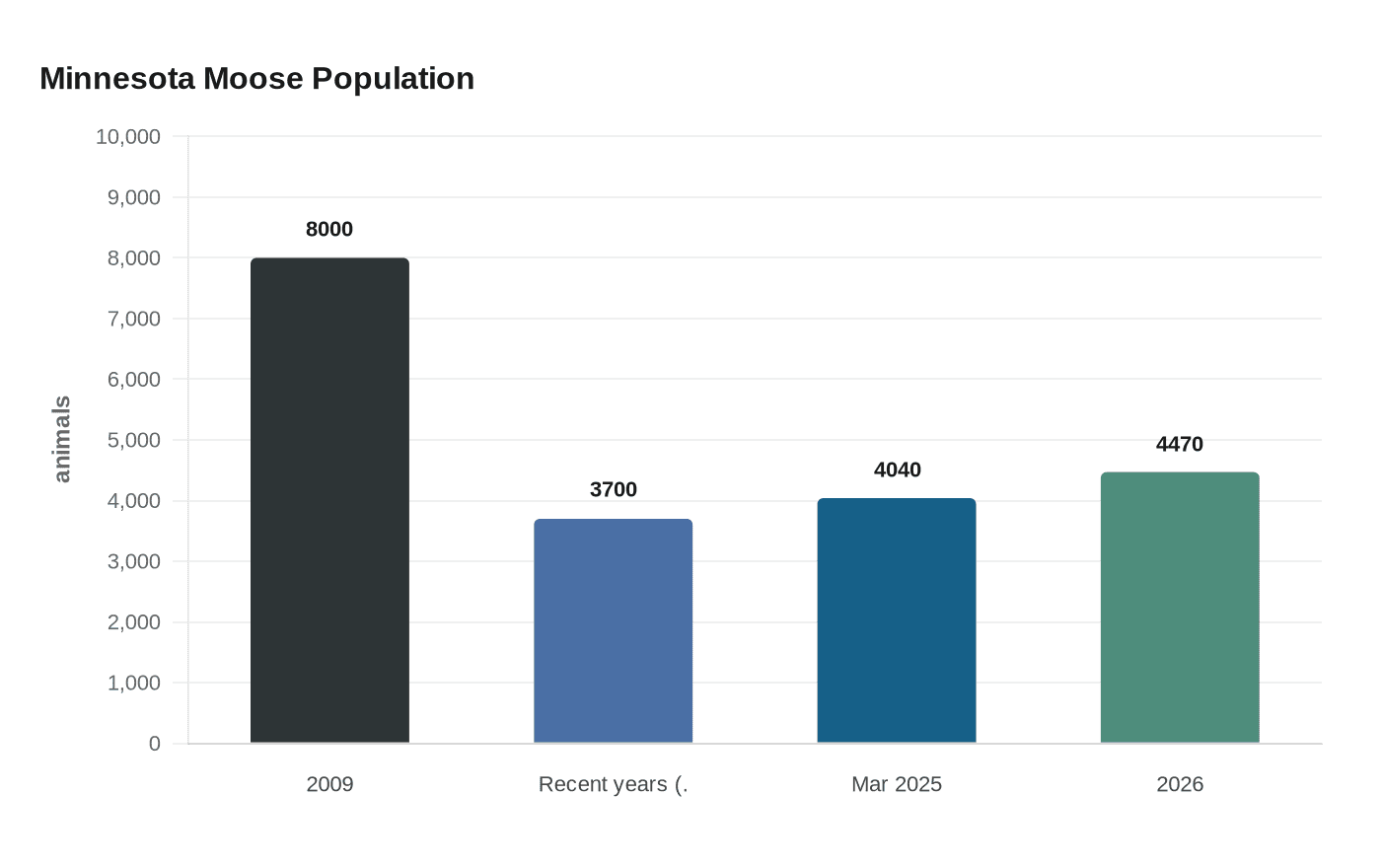
Minnesota's most recent moose population estimate came in at approximately 4,470 animals, according to the Minnesota Department of Natural Resources' 2026 population survey. The figure arrives as welcome news for wildlife managers who spent years watching numbers crater, but scientists are not ready to declare the species recovered.
Results suggest that after a steep decline from a population estimate of 8,000 in 2009, Minnesota's moose population appears to have somewhat leveled, fluctuating around 3,700 animals in recent years. The 2026 estimate tracks above that recent-year band. A DNR estimate reported in March 2025 by CBS Minnesota put the population at about 4,040 animals, and CBS characterized the long-term arc as a decline of roughly 60% since the mid-2000s.
Despite recent estimates suggesting relative stability in the population and reproductive success, Minnesota DNR researchers point out that Minnesota moose remain at risk. Climate change, parasites, habitat loss and predator impacts on calf survival all play a part in the long-term survival of the moose population.
Several factors impacting moose populations include habitat loss, predator impacts on calf survival, parasites such as the transmission of brainworm from deer to moose, and winter ticks. This winter, a collaborative tribal-state research project launched to study survival rates and reproduction of juvenile moose.
St. Louis County sits squarely at the center of the conservation response. Partners are currently completing the planning phase funded by the National Fish and Wildlife Foundation America the Beautiful Challenge, and will be transitioning into the implementation phase where the goals are to address barriers to habitat management and implement habitat work within three core areas of approximately 50,000 acres each in St. Louis, Lake, and Cook counties.
Ongoing research by the DNR, 1854 Treaty Authority and Grand Portage Band of Chippewa aims to better understand reproduction and survival. Funding for the research is provided by the Environment and Natural Resources Trust Fund, as recommended by the Legislative-Citizen Commission on Minnesota Resources.
The 2026 survey itself reflected a broad tribal-state partnership. Both the Fond du Lac Band of Lake Superior Chippewa and the 1854 Treaty Authority are full partners on the moose survey and contributed funding and personnel for the 2026 annual survey.
Collaborative landscape-level habitat work with state, tribal, federal, county and non-governmental organization partners also continues. With the planning phase nearing completion and implementation targeting roughly 150,000 combined acres across the three northeastern counties, the next several years will test whether stabilized numbers can translate into a genuine, durable recovery.
The full 2026 survey is available at mndnr.gov/moose.
This article was produced by Prism’s automated news system from verified source data, official records, and press releases, then run through automated quality and moderation checks before publishing. The system is built and supervised by the people who set the standards it runs under. Read our full AI policy.
Did this article answer your question?