North Dakota cropland values flatten, cash rents rise faster than prices
Stutsman County cropland is holding near $751 an acre as rents climb faster than prices, tightening the squeeze on tenants and young buyers.

Stutsman County cropland is still valuable, but the market has stopped surging. The state’s latest land analysis showed cropland values rising just 0.88% from 2025 to 2026, a sharp slowdown after four straight years of double-digit gains. In a county where farming drives most of the local economy, that pause matters to landowners in Jamestown, renters trying to renew leases, and younger producers hoping to buy their first tract.
The 2026 agricultural value assessment puts Stutsman County cropland at $751.31 per acre, well above the statewide average agricultural value of $644.22 per acre. That figure carries extra weight in a county that was organized in 1873, spans 2,298 square miles, and had 21,593 residents in the 2020 census. USDA’s 2022 farm census profile counted 829 farms here, 1,201,132 acres in farms, and an average farm size of 1,449 acres. Cropland made up 926,595 acres, and crop sales accounted for 87% of the county’s agricultural sales.
The broader state map was uneven. North Central North Dakota posted the biggest gain, with land prices rising more than 8%. The Northwest climbed nearly 6%, South Central rose just under 5%, and East Central gained about 2%. At the same time, Southeast North Dakota cropland values fell nearly 7.5%, Southwest slipped just over 3%, and Northeast dropped almost 1%. That spread shows how local sales, soil quality and farm income can pull values in different directions even within one state.
Bryon Parman, the NDSU agricultural finance specialist, said the statewide average has essentially flattened, and thin farm profits can reduce the number of land sales while giving each transaction more influence over the average. That is especially relevant now, when NDSU’s 2026 crop budget projections show projected profitability is low or negative in most regions and for most crops. For landowners, that can mean less upside. For renters, it may create a tougher lease conversation even as sales prices level off. And for younger producers trying to buy in Stutsman County, the pause in land values may help only if tighter profits do not push lenders and sellers to hold the line.
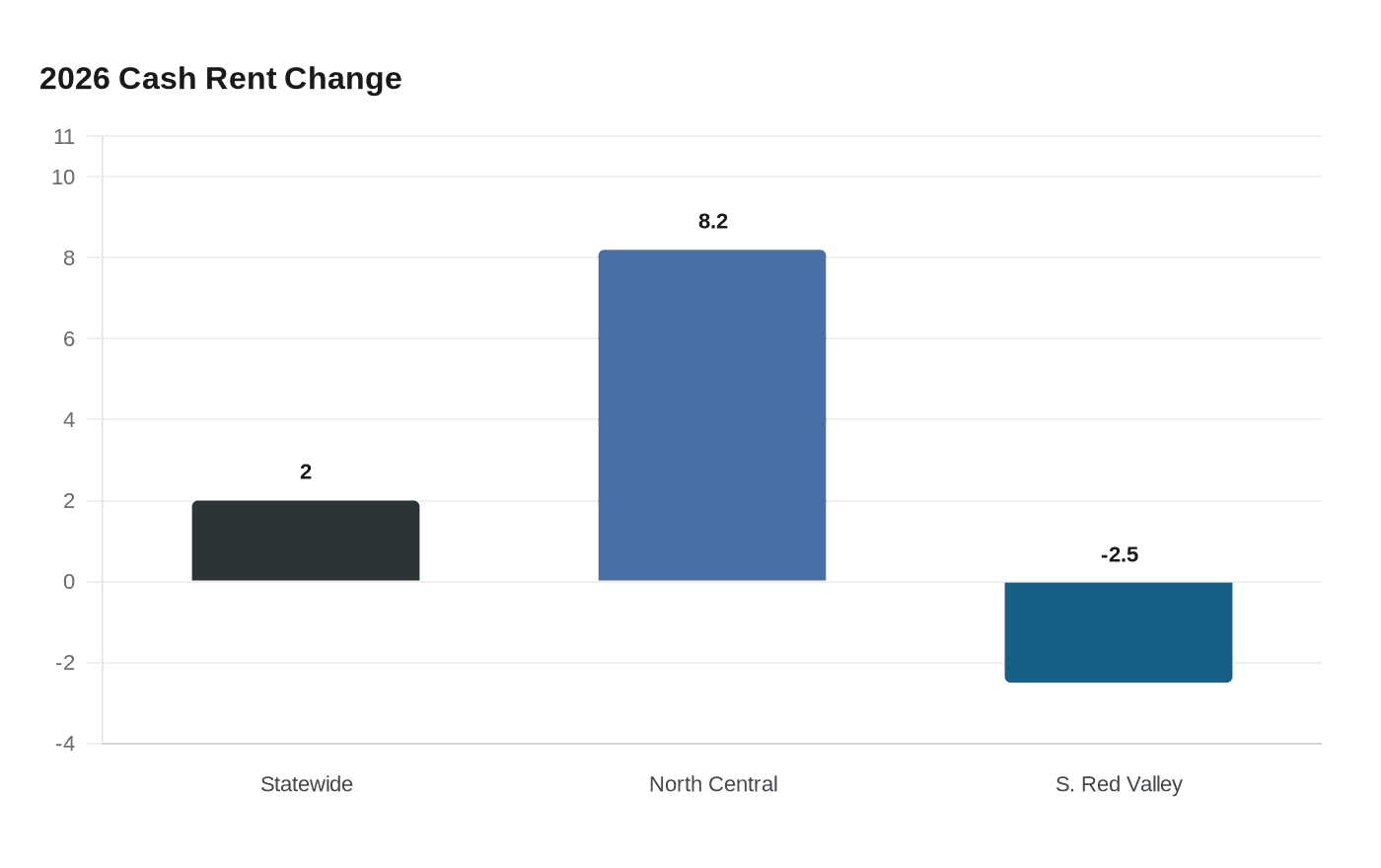
Cash rents are moving in a different direction. Statewide rents rose 2% in 2026, outpacing land prices for the first time in several years. North Central North Dakota saw the biggest rent increase at 8.2%, while the South Red River Valley recorded the steepest decline at 2.5%. In a county as farm-heavy as Stutsman, that gap signals a new negotiating dynamic: the land market is no longer racing ahead, but the cost to use the land is still climbing.
This article was produced by Prism’s automated news system from verified source data, official records, and press releases, then run through automated quality and moderation checks before publishing. The system is built and supervised by the people who set the standards it runs under. Read our full AI policy.
Did this article answer your question?