Stutsman County Memorial Museum lets visitors step into local history
The Lutz Mansion is the exhibit and the artifact, showing how Jamestown grew from a 1907 Craftsman home into Stutsman County’s memory keeper.
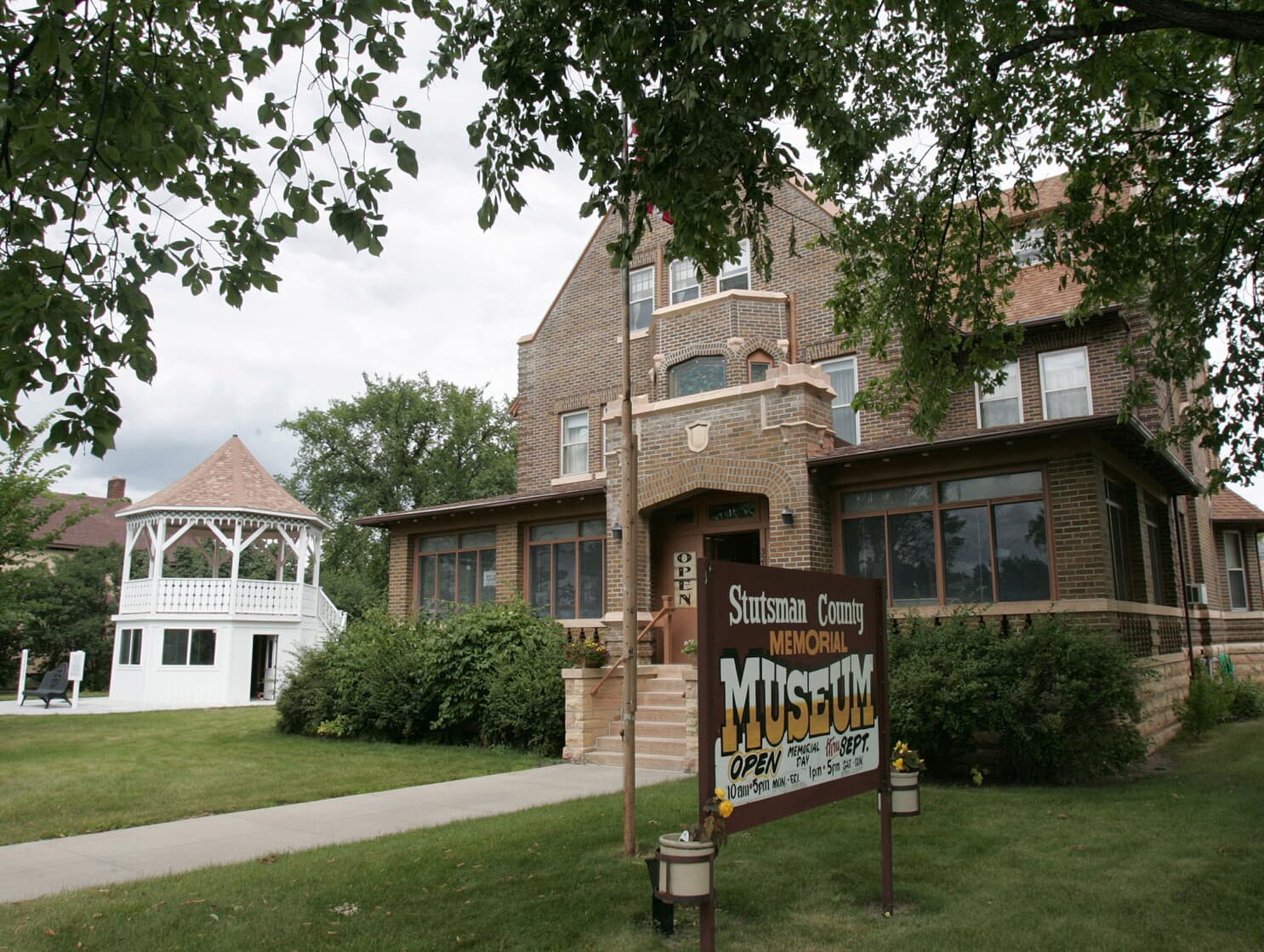
The Stutsman County Memorial Museum does not just display local history. It sits inside it, in the Lutz Mansion, a 1907 Jamestown home built in the American Craftsman style and now preserved as part of the county’s story.
A historic home that tells its own story
The building itself is the first exhibit. A house from 1907 in the American Craftsman style says as much about Jamestown’s early growth as any display case, because its scale, materials and domestic layout point directly to the lives of the people who lived and worked in the county seat. The Jamestown Sun has described the Lutz Mansion as historic in its own right, which is exactly what makes the museum unusual: visitors are not stepping into a neutral gallery, they are entering a historic residence that has been kept part of public memory.
That matters in Stutsman County because the museum connects architecture and local identity in one stop. Many places preserve papers, photos and tools, but a house museum lets people see how history was lived day to day. The Lutz Mansion turns Jamestown’s early 20th-century domestic life into something visible, and that gives the museum a different weight than a courthouse or monument alone.
What the mansion adds to the museum experience
A house like this changes how history is read. The American Craftsman style, associated with practical design and visible workmanship, helps explain how families in Jamestown lived during a period when the county was still defining itself after its formation on June 20, 1873. Jamestown has served as the county seat since that same year, so the mansion also sits in the center of the county’s civic story, not at its edges.
That is why the museum works room by room as a guide to local memory. Instead of treating the county’s past as something abstract, the building makes it tangible through a preserved home environment that reflects the scale and habits of an earlier era. Visitors can learn about local families, domestic architecture and civic history in the same place, and the setting itself reinforces that history was made in ordinary rooms as much as in public buildings.
A building with more than one life
The mansion’s biography did not end with the Lutz family era. An online family-history account says the Lutz Mansion served as the Lutheran Home for the Aged from about 1930 until the early 1960s, then became the Stutsman County Memorial Museum in 1965. That later chapter adds another layer to the house’s value, because the building was not simply saved and frozen in time, it was adapted for a succession of community uses before becoming a museum.
That kind of multi-era history gives the house a strong preservation case. The mansion is not only notable because it is old, but because it has already served Jamestown in several forms: private home, care facility and public museum. In preservation terms, that makes the structure a record of changing community needs, and it helps explain why the building still carries meaning beyond its original construction date.
Why Jamestown lists it alongside its most recognizable landmarks
The museum’s place in local tourism listings shows that Jamestown treats it as more than a niche stop. North Dakota Tourism includes the Stutsman County Memorial Museum as a Jamestown attraction, and Discover Jamestown places the Lutz Mansion in its arts-and-architecture framing alongside the 1883 Stutsman County Courthouse and the Basilica of St. James. Those pairings matter because they position the mansion within a small but important heritage corridor in town, where architecture itself becomes part of the visitor experience.
That broader setting helps explain why the museum remains useful to the county. Jamestown’s historic landmarks tell different parts of the same story: the courthouse reflects civic authority, the basilica reflects religious and architectural presence, and the mansion shows how private life and public memory intersect. Together, they give visitors a more complete picture of how Stutsman County developed around Jamestown as its seat and how the community chose to preserve that history.
Planning a visit
The museum’s address is listed as 321 3rd Ave SE, Jamestown, ND 58401-4208, placing it squarely within the town’s historic core. The Jamestown Area Chamber of Commerce identifies the Stutsman County Memorial Museum as a nonprofit, which fits the role the house plays as a community preservation site rather than a commercial attraction.
Visitor information has also listed free admission, with hours of Monday through Friday from 10 a.m. to 5 p.m. and Saturday and Sunday from 1 p.m. to 5 p.m. That access matters because a house museum works best when people can come through the door and see how the building itself helps tell the county’s story. In Jamestown, the Lutz Mansion remains one of the clearest places where architecture, preservation and local history meet in the same set of rooms.
This article was produced by Prism’s automated news system from verified source data, official records, and press releases, then run through automated quality and moderation checks before publishing. The system is built and supervised by the people who set the standards it runs under. Read our full AI policy.
Did this article answer your question?