Big Duck marks Suffolk County’s duck-farming past in Flanders
The Big Duck began as a 1931 duck shop and still stands in Flanders as a bright reminder of Suffolk’s once-dominant duck industry.
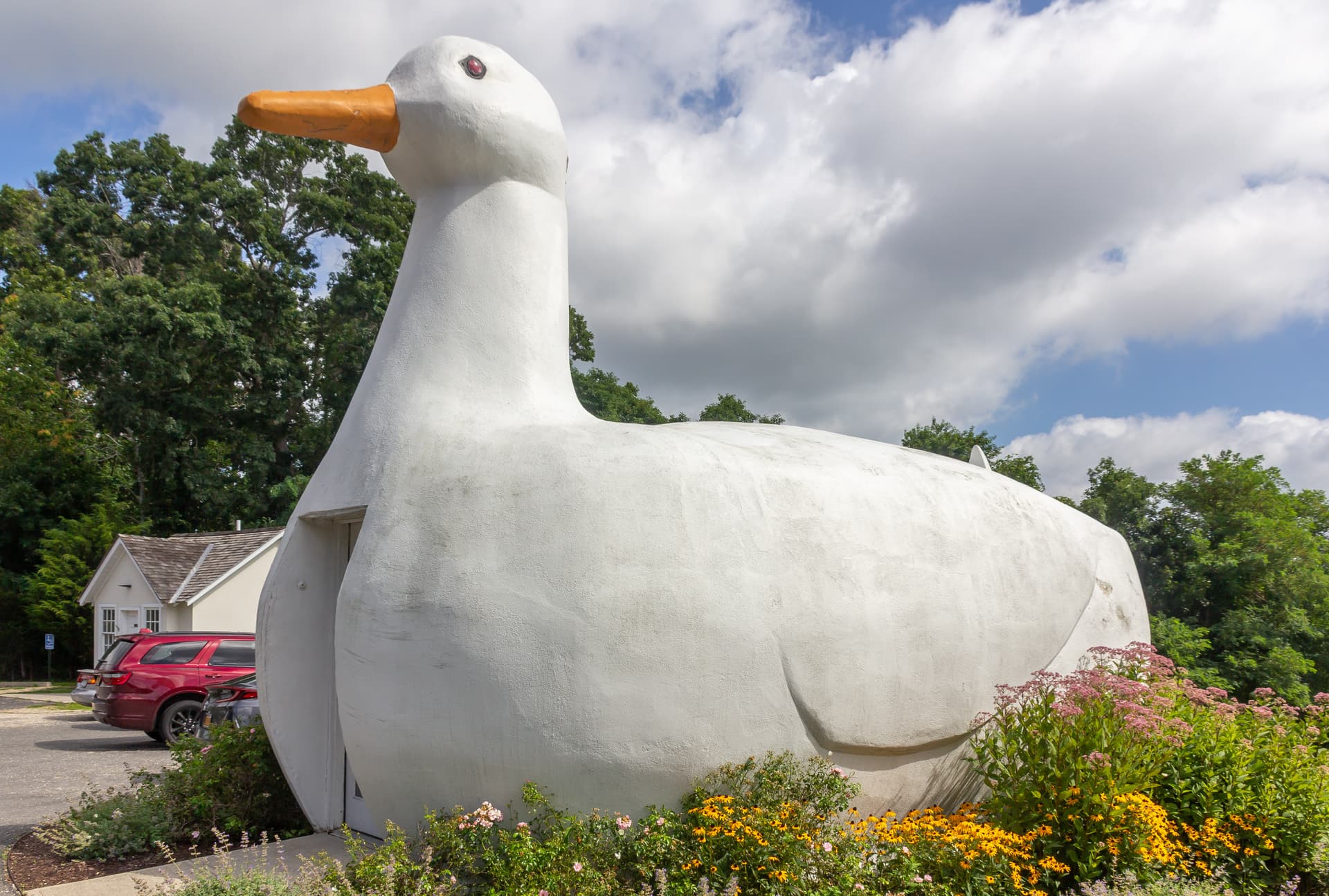
The Big Duck looks whimsical from the road, but it was built for a very practical purpose: selling Pekin ducks and duck eggs to motorists in Riverhead. What began as a roadside shop in 1931 has become one of Suffolk County’s best-known symbols, a building that captures both the novelty of Long Island’s rural past and the scale of an industry that once defined the East End.
From Riverhead novelty to Flanders landmark
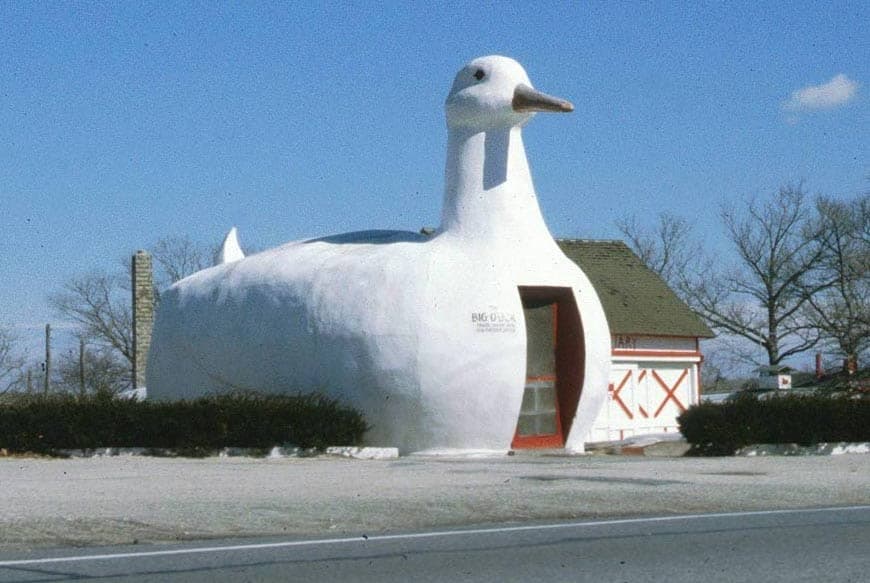
Martin Maurer and his wife, Jeule, built the original duck-shaped shop on West Main Street in Riverhead to catch the eye of passing drivers. They hired local craftsmen, used a live duck as the model, and finished the building with Model-T taillights for eyes that glowed at night. That detail matters because the building was not simply designed to look unusual, it was engineered to sell a product in an era when road travel was changing the way local businesses reached customers.
The structure itself is part of the appeal. It measures 30 feet from beak to tail, 15 feet from wing to wing, and 20 feet tall. Those proportions make the building large enough to be unforgettable, but small enough to feel like an object from another era, when a single roadside attraction could define an entire business identity.
In 1936, after the shop had proved successful, the Maurers moved the Big Duck to Route 24 in Flanders, where it still stands today. Suffolk County now treats it as Long Island’s most famous landmark, and the building is listed on the National Register of Historic Places. It continues to function as a gift shop and tourist-information stop, so the structure remains active rather than frozen as a display piece.
What the Big Duck says about Suffolk County history
The Big Duck is memorable because it points to a much larger story. Suffolk County’s duck industry peaked during the 1940s, 1950s and early 1960s, but the business had already reached extraordinary scale before then. By the end of the 1930s, roughly six million ducks were being produced on about 90 farms in Suffolk County alone.
That scale helps explain why the building has such resonance across Long Island. The Big Duck is not just a quirky photo stop on Route 24. It is a surviving piece of the commercial landscape of an era when duck farming was one of the region’s signature industries, with farms spread across the county and production high enough to leave a lasting imprint on the local economy.
The landmark also shows how quickly that world faded. What once supported a dense network of farms, workers, transport routes, and poultry sales has mostly disappeared from view, leaving behind a single building that now carries much of the memory. The Big Duck gives visitors a visible shorthand for a county that was once far more agricultural than suburban.
The environmental legacy behind the poultry boom
Suffolk County’s own restoration materials make clear that duck farming left more than a business legacy. The industry altered bay and creek hydrology and contributed to oxygen-depleted bay bottoms, damage that still shapes open-space and restoration planning today. Former duck-farm sites are now part of that planning, which ties the county’s agricultural past directly to modern environmental work.
That connection gives the Big Duck a second meaning. It preserves the memory of an economy that once produced millions of birds, but it also stands at the front end of a wider local conversation about land use, water quality, and the aftereffects of intensive farming on coastal systems. In that sense, the landmark is as much about what Long Island was as it is about what it became.
For Suffolk County, the building works because it compresses several histories into one object. It recalls the family business of Martin and Jeule Maurer, the ingenuity of local craftsmen, the heyday of duck farming, and the later effort to reckon with the environmental cost of that growth. Few landmarks do all of that while still looking like a duck.
What to notice when you stop in Flanders
A visit to the Big Duck is brief, but the details are the point. The duck’s size, the taillight eyes, and the exact shape of the building all reflect its original purpose as advertising with personality. The move from Riverhead to Flanders in 1936 also explains why the structure feels rooted in the county rather than in one town alone.
The site’s current uses add to its local value. As a gift shop and tourist-information stop, it still serves travelers on Route 24, and its annual holiday lighting, held the first Wednesday after Thanksgiving, gives the landmark a seasonal role in county life. That combination of utility and spectacle is why the Big Duck endures, not just as a roadside curiosity, but as one of the clearest reminders of Suffolk County’s duck-farming past.
This article was produced by Prism’s automated news system from verified source data, official records, and press releases, then run through automated quality and moderation checks before publishing. The system is built and supervised by the people who set the standards it runs under. Read our full AI policy.
Did this article answer your question?