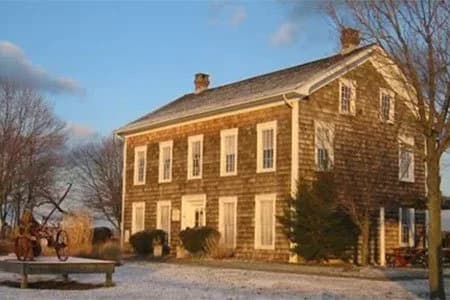
Central Pine Barrens shape Suffolk County’s land use and conservation
The 106,000-acre Pine Barrens are Suffolk’s planning line, protecting groundwater while shaping where growth can go. Their rules still steer Brookhaven and beyond.
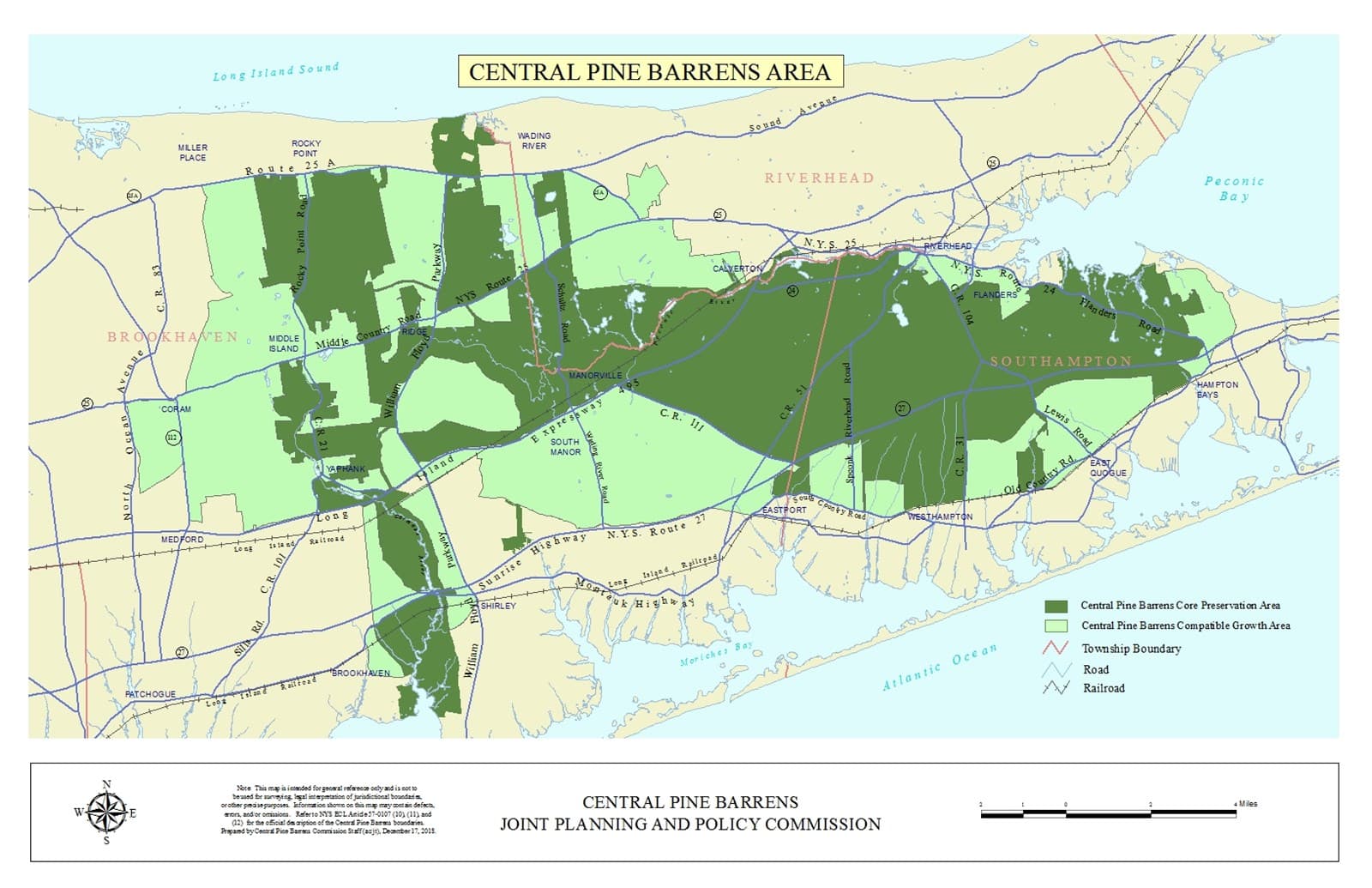
The protected landscape covers about 106,000 acres on Long Island’s central and eastern end, making the Central Pine Barrens one of Suffolk County’s most consequential planning boundaries. In Brookhaven, that boundary is not abstract: it shapes what can be preserved, what can be developed, and what local boards must weigh every time land use changes.
A preserve built from law, not accident
The modern Pine Barrens were created by statute. The New York State Legislature approved the Long Island Pine Barrens Protection Act in 1993, and Governor Mario Cuomo signed it into law that year, establishing the Central Pine Barrens as a protected natural and cultural resource. The law is formally titled the Long Island Pine Barrens Maritime Reserve Act and the Peconic Bay Region Watershed Protection Act, and it is Article 57 of New York State Environmental Conservation Law.
The preserve is not simply a park or a woods patch but a land-use system that covers a large part of Suffolk and helps decide where growth belongs and what must be protected for the public good.
Why the land looks the way it does
The Central Pine Barrens began thousands of years ago during the Ice Age, when massive glaciers formed Long Island’s moraines and outwash plains. The terrain that followed was built from sand, clay, gravel, and the conditions that support the region’s distinct plant communities. That is why the preserve includes pitch pine and pine-oak forests, coastal plain ponds, marshes, and streams instead of the dense suburban landscape found elsewhere on Long Island.
The region came into focus in the 1970s and 1980s because of its value to Long Island’s future, especially its potable groundwater, vast forests, and other natural resources. The preserve was protected before the county built out completely. The land is treated as infrastructure as much as scenery: what grows there, and what is kept out, affects the water and habitats beneath and around it.
Where Suffolk sees the preserve most clearly
The Pine Barrens sit in Suffolk County, on the central and eastern end of Long Island, and the Central Pine Barrens contain more than 900 square miles of terrestrial and aquatic resources. NOAA maps the Long Island Pine Barrens-Peconic River Complex in Brookhaven, Riverhead, and Southampton, which gives the preserve a real map in the towns that border and contain it.
Brookhaven is a useful place to understand the tradeoffs. The town was central to the legal fight that helped set the stage for protection, and the New York Court of Appeals decided In the Matter of Long Island Pine Barrens Society, Inc. v. Planning Board of the Town of Brookhaven on November 24, 1992. Inside the broader landscape, Brookhaven Pine Barrens State Forest, listed by NYSDEC, is a 34.7-acre undeveloped parcel of pine barrens habitat.
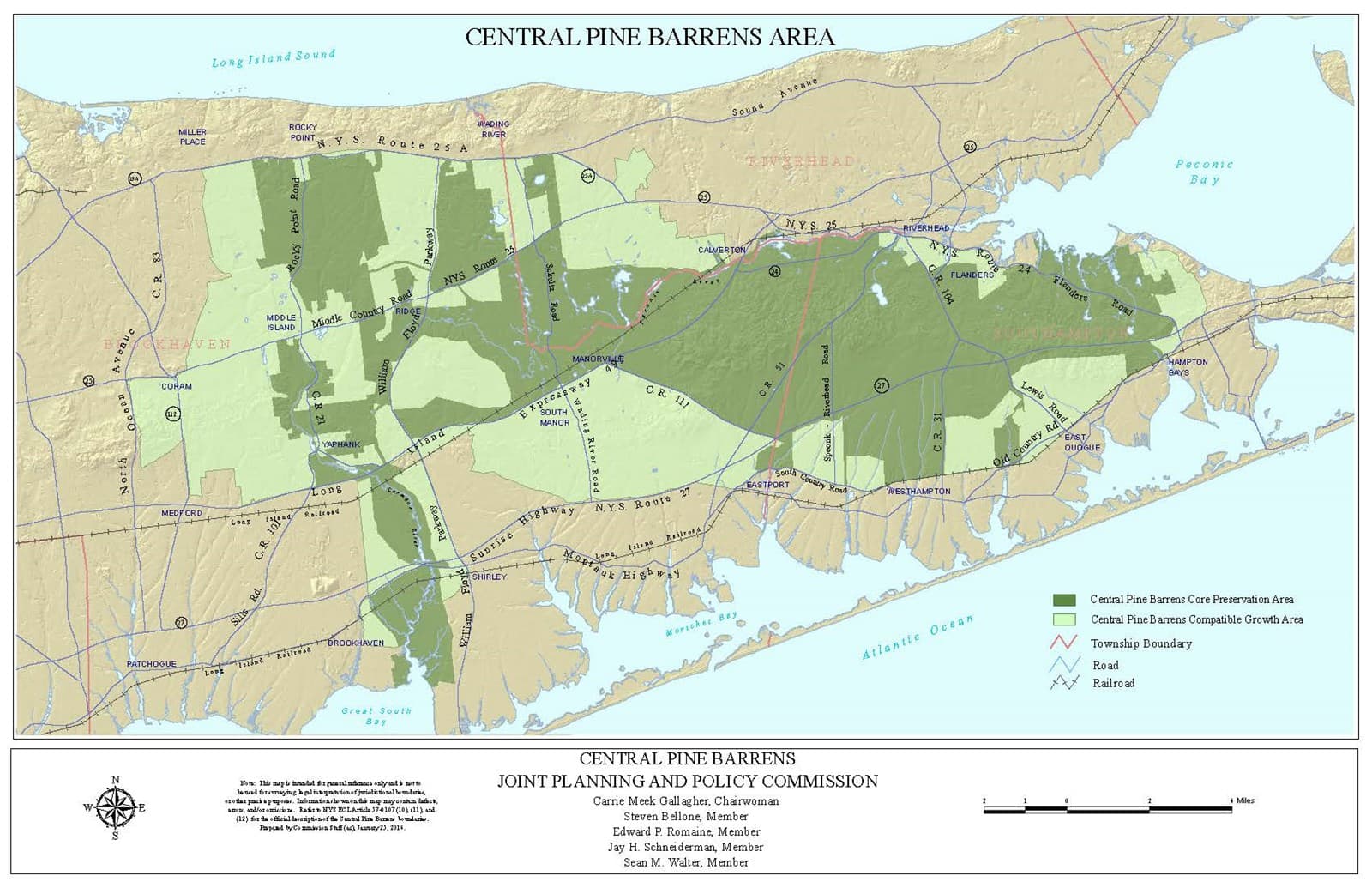
Keeping land in the preserve limits conventional development, but it also protects the sandy soils and groundwater recharge areas that help support homes, schools, and businesses across Suffolk. The public cost is ongoing planning, review, and enforcement, because every parcel near the preserve has to be measured against water, habitat, and open-space needs.
A fight that predated the law
The preservation push did not begin in Albany. The Long Island Pine Barrens Society’s effort began in November 1989, and the legal and political work continued through the early 1990s. In 1993, the debate over whether the Pine Barrens would become a future source of drinking water for Long Island sat at the center of the preserve’s public purpose. In 1995, a legal analysis called the Long Island Pine Barrens Protection Act a new model of land-use control in New York.
The law did not end the argument over how Suffolk should grow. It gave the county a formal structure for deciding that some land should remain open.
Recreation is part of the policy
The Central Pine Barrens are also a public landscape, not just a regulated one. The official overview has an explore section and names Walt Whitman as an admirer of the region’s natural beauty. The Long Island Pine Barrens Society publishes trail guides and education materials for hikers, birders, students, and anyone looking for quiet public access.
The preserve protects land that residents can experience, but it also limits how that land can be used.
The planning system still changes
The preserve is not frozen in 1993. An updated Central Pine Barrens Comprehensive Land Use Plan took effect on July 19, 2024, showing that the reserve continues to be managed through an active planning system. On the Central Pine Barrens Commission’s scientific research page, very few additional studies appear beyond the pre-1993 research base, leaving the county relying heavily on the original science and on updated planning to manage change.
This article was produced by Prism’s automated news system from verified source data, official records, and press releases, then run through automated quality and moderation checks before publishing. The system is built and supervised by the people who set the standards it runs under. Read our full AI policy.
Did this article answer your question?