Melville raccoon tests positive for rabies, first Long Island case this year
A Melville raccoon near Cranberry Court tested positive for rabies, the first Long Island case this year and a sharp warning for pet owners.
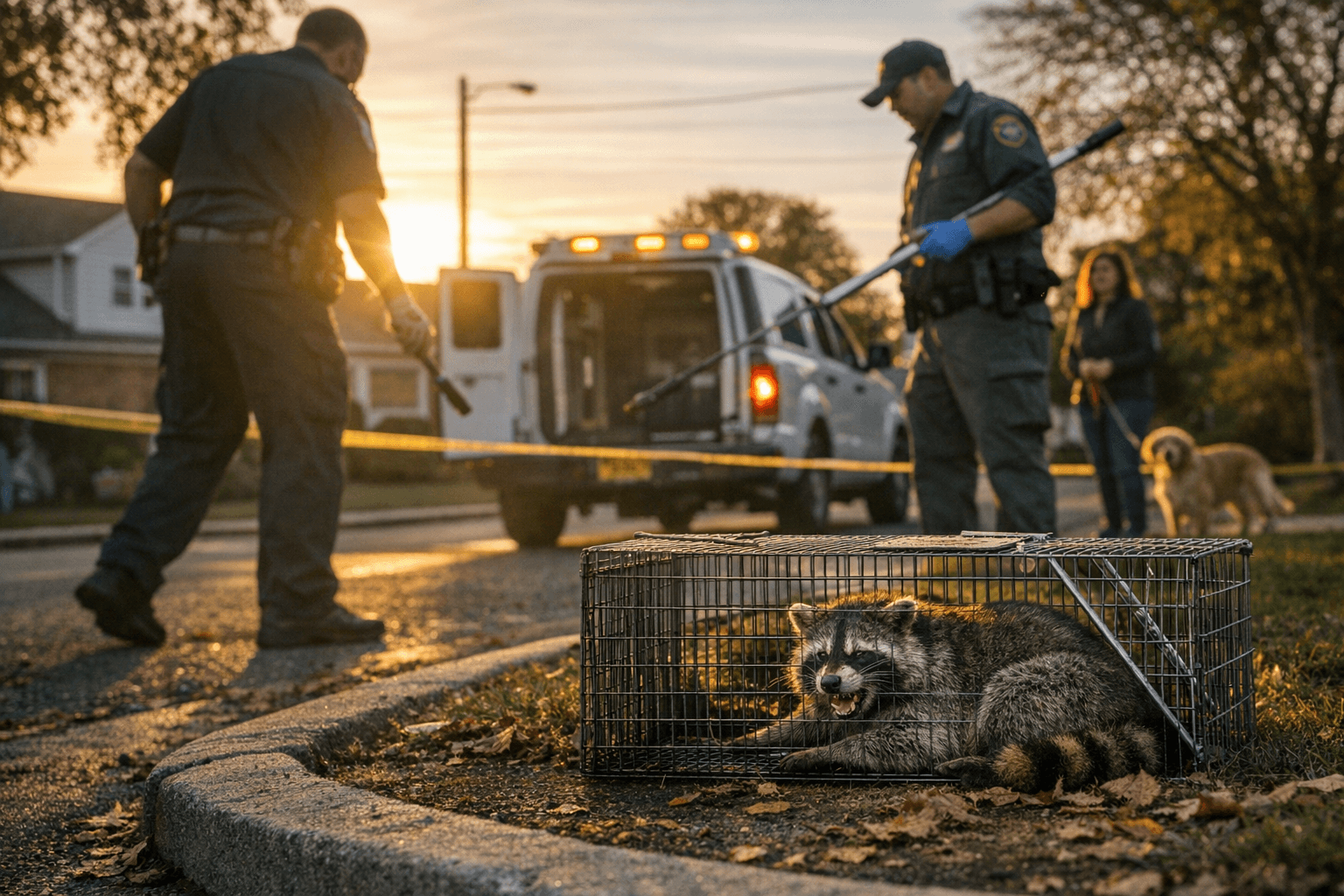
A raccoon carcass found near Cranberry Court in Melville, outside a house, tested positive for rabies after animal control submitted it for testing, and Town of Huntington officials said it was the first confirmed rabies case within the town. The finding also appears to be Long Island’s first recorded rabies case this year, turning a dead-animal pickup into a public-health alert for neighborhoods across western Suffolk.
Rabies is most often seen in raccoons, bats, skunks and foxes, and New York State says it is almost always fatal once symptoms appear. It can still be prevented if treatment begins soon after a bite, scratch or other exposure. Suffolk County Department of Health Services says residents should report animal bites or contact with wild animals immediately and, if possible, contain the animal so it can be tested. Pet owners should keep vaccinations current and avoid approaching any wild animal that is acting oddly.
The Melville case comes after Suffolk County logged 17 locally acquired terrestrial rabies cases in 2025 by late November, including one feral cat and 16 raccoons. County health officials said those cases were concentrated in Amityville, Deer Park, Lindenhurst and Wyandanch. Suffolk’s first locally acquired terrestrial rabies case since 2009 was a raccoon in North Amityville reported Jan. 28, 2025, with confirmation from the Wadsworth Center on Feb. 7, 2025.
County officials have said their raccoon rabies control program uses oral rabies vaccine baits distributed with the U.S. Department of Agriculture’s Wildlife Services National Rabies Management Program. Outside New York City, county health departments authorize post-exposure treatment and handle bites and exposures involving known or suspected rabid animals. That local system matters because every minute counts once a person or pet may have had contact with a rabid animal.
The broader Long Island picture has stayed uneasy as well. Nassau County recorded 22 confirmed rabies cases in 2025, a sign that the virus remains active on the Island even when most residents do not see it day to day. The Melville case is a reminder that a single raccoon near a residential street can quickly become a serious health issue for people, pets and wildlife alike.
This article was produced by Prism’s automated news system from verified source data, official records, and press releases, then run through automated quality and moderation checks before publishing. The system is built and supervised by the people who set the standards it runs under. Read our full AI policy.
Did this article answer your question?