North Newport powered Sullivan County manufacturing boom
North Newport was a small village with outsized industrial reach. Its chimneys, bridges, and river corridor still map the mills that once sent goods to Concord, Boston, Germany and India.

North Newport, also known as Northville, was never just another village along the Sugar River. It became one of Sullivan County’s key industrial nodes because it had three things manufacturers needed: water power, railroad access, and raw materials close at hand. That combination turned the river corridor into a working landscape of dams, canals, factory yards, and bridge approaches, and the traces still visible today tell the story of how deeply the place was built around production.
How a river village became a factory district
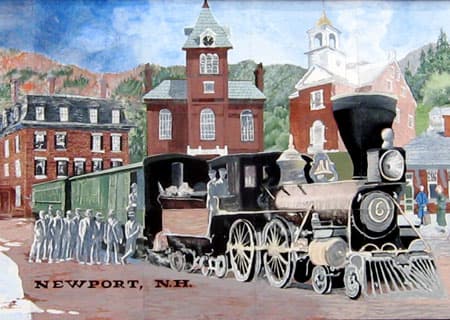
The industrial mix in North Newport was broader than a single mill or one dominant employer. Local manufacturing included a saw mill, box and tub factory, rake factory, shoe-peg factory, bobbin blank factory, and scythe factory. Entrepreneurs harnessed the Sugar River through a dam and canals, while the Concord & Claremont Railroad stopped in North Newport and carried goods on to Concord and Boston.
That mattered because the village’s economy was tied to movement as much as to manufacturing. The river supplied power, the railroad widened the market, and nearby timber and other raw materials made it possible to keep a steady flow of output going. Even the bridgework over the river was part of the industrial system: metal-truss bridges linked the plant area to the rest of the corridor and made the manufacturing district function as a connected whole.
The numbers behind the boom
North Newport’s biggest factories show how much output could come from a small place. The Draper bobbin blank factory produced about 65,000 bobbin blanks per day from 1907 to 1917. Those blanks were not finished goods; they were the wooden parts later turned into bobbins for Draper textile weaving looms, which places North Newport directly inside the larger machine-textile economy of New England.
The scythe trade was just as revealing. The Sibley scythe factory was established in 1840 and employed 18 workers, with facilities capable of making 2,500 dozen scythes annually. Ezra T. Sibley, born February 3, 1817, in Auburn, Massachusetts, came to Northville in 1845 and bought into the business that Sylvanus Larned had started around 1842. From that point on, it was known as the Sibley Scythe Factory.
The factory’s history was also shaped by loss and rebuilding. The original buildings were destroyed by fire in 1848 and again in 1928. One account says the 1848 blaze destroyed 100 dozen finished scythes and much of the machinery. Even so, the products had a wider reach than the village itself: Sibley scythes were reportedly shipped to Germany and India and were used in the Panama Canal era.
What still remains on the ground
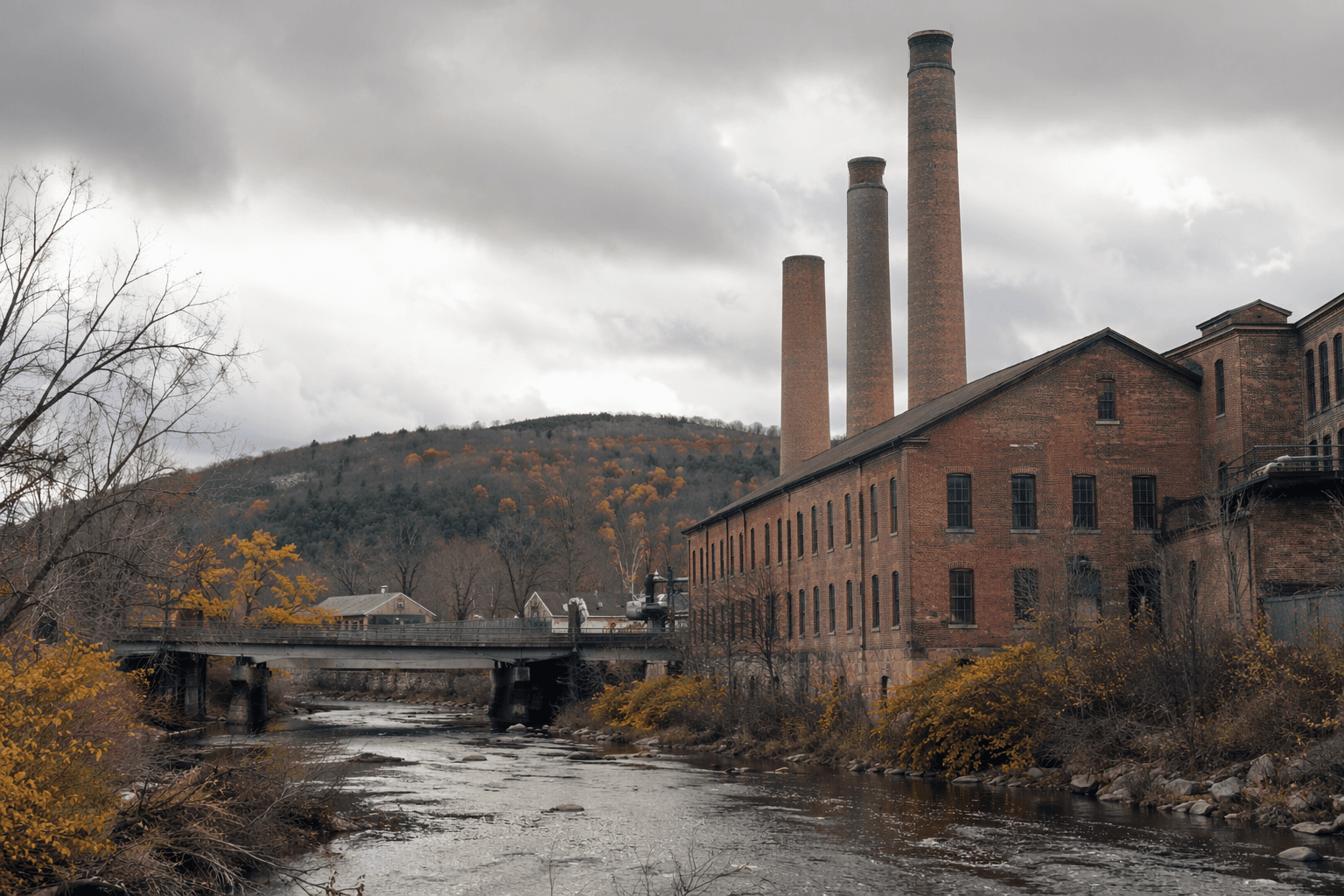
Much of the original mill landscape is gone, but not all of it. The Draper factory remnant still visible today is the tall chimney and power plant along Greenwood Road, a surviving marker that still anchors the industrial geography of North Newport. Best seen when the leaves are off the trees, it is one of the clearest reminders that this river bend once supported a dense manufacturing district, not just a few scattered buildings.
The railroad corridor has an equally visible legacy. The first two railroad covered bridges were built in 1871 and 1872 by the Sugar River Railroad. After the line was sold to the Concord & Claremont Railroad, the bridges were rebuilt in 1906 and 1907 to handle heavier steam engines. The Pier Bridge is 217 feet long and is described as the longest of the surviving railroad covered bridges, giving the area a physical link to the era when freight moved by rail as well as by river power.
Those surviving structures matter because they shape what can still happen here. A corridor with a chimney, bridge spans, and a narrow riverfront has a different set of redevelopment choices than a cleared site with no industrial memory. The assets are useful because they give the place identity; they are also a constraint because they tie any new investment to the old pattern of river, rail, and engineered crossings.
The people who lived inside the industrial economy
The mills were not just production sites. They supported households, church life, and local memory. Gordon B. Flint, a native of North Newport and a former superintendent of Newport schools, remembered that his parents, Alonzo and Martha Flint, moved to Newport in 1908 to work at Draper Corporation, where Alonzo was business manager. That detail shows how the industrial district drew in families and gave the village a workforce with ties to both manufacturing and civic life.
Flint also recalled the North Newport Union Chapel bandstand near the church and said his father played bass horn in the North Newport band. That kind of detail matters because it shows the district as more than a factory row. Schools, churches, music, and company employment all sat inside the same small geography, which is part of why North Newport has remained legible in local memory long after much of the manufacturing floor disappeared.
North Newport in the longer Newport timeline
North Newport’s story fits into a much older Newport history. Newport was founded in 1761, and Benjamin Giles built a sawmill and gristmill on the Sugar River in 1768. That early use of the river established a pattern that later manufacturers expanded: take advantage of the continuous drop in the waterway and build around the power it could provide.
The town’s rail history deepened that pattern. Newport was connected to the Sugar River Railroad from Bradford in 1871, adding another transport layer to the industrial corridor. Newport is also the birthplace of Sarah Josepha Buell Hale, which adds a separate cultural line to a town best known locally for mills, rails, and river power.
North Newport still reads as a place where industrial history is not buried, only thinned out. The chimney on Greenwood Road, the covered railroad bridges, and the old river alignment show that the village’s historic assets are both a barrier and an opportunity for current investment: they limit easy redevelopment, but they also give the place a built-in identity that newer projects would struggle to create from scratch.
This article was produced by Prism’s automated news system from verified source data, official records, and press releases, then run through automated quality and moderation checks before publishing. The system is built and supervised by the people who set the standards it runs under. Read our full AI policy.
Did this article answer your question?