Del Rio canal system fueled agriculture and city growth
Del Rio’s canal lines are more than old waterworks. They turned San Felipe Springs into farms, neighborhoods, and a city that still depends on the system’s footprint today.
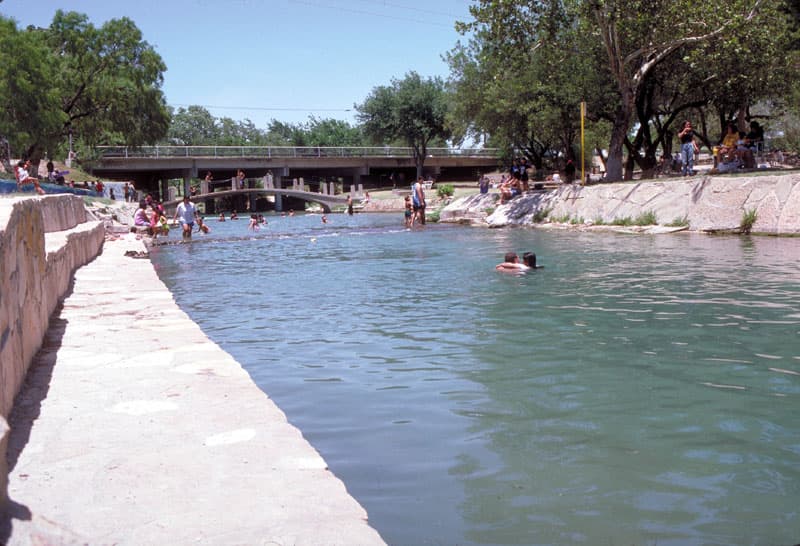
The canal lines around San Felipe Springs are still one of the clearest ways to read Del Rio’s growth. What began as crude irrigation along San Felipe Creek became a working civic system, one that watered fields, shaped settlement, and helped turn a spring-fed edge of Val Verde County into a functioning city.
From spring water to a built system
Long before modern Del Rio took shape, Indian and Spanish inhabitants were already drawing irrigation from San Felipe Springs and San Felipe Creek. The later canal network did not invent agriculture here, but it changed the scale of it by turning a natural water source into organized infrastructure.
Around 1869, local landowners formed the San Felipe Agricultural, Manufacturing and Irrigation Company to put that water to work more systematically. Among the early stockholders were W. C. Adams, Donald Jackson, Joseph Ney, Randolph Pafford, James H. Taylor and A. O. Strickland. Their names matter because the canal system was not built by a distant utility or a state agency. It was a local enterprise, assembled by people with direct stakes in whether Del Rio could farm, settle, and grow.
The company dammed San Felipe Creek just below the springs and started channeling water through a network that was practical rather than decorative. By 1871, the canals were already watering 1,500 acres. That figure gives a sense of how quickly the project moved from a local experiment to the backbone of a growing agricultural zone.
The charter that made growth possible
The next major step came in 1875, when the company received a 99-year charter under an irrigation law that authorized two named canals and laterals. In plain terms, that gave the system a long-term legal foundation and the right to expand water delivery through branch channels. The charter mattered because irrigation works need stability: landowners will plant, build, and invest only when the water supply is organized enough to last.
By 1876, a state inspector reported that roughly 3,000 acres were being irrigated. In one year, the canal system had nearly doubled the area under water since the 1871 benchmark. That jump shows how quickly the system moved from local utility to regional development tool, especially in a part of Texas where reliable water could decide whether land stayed sparse or became productive.
The state later granted the company 5,000 acres of land based on the mileage of its canals. That reward tied public land policy directly to infrastructure mileage, a reminder that 19th-century Texas often treated irrigation works as engines of settlement. The canal company was not only moving water; it was being recognized for building the physical framework that made more land usable.
What the canal system still means on the ground
The Val Verde County Historical Commission says the canal system remains in operation today, which is why it still matters to anyone trying to understand Del Rio’s layout. The old routes are not just historical markers. They help explain why some areas developed as farms, why others became neighborhoods, and why the city’s relationship to water never disappeared.
The Madre Ditch and the San Felipe Ditch are especially important for reading that landscape. They show how the original spring-fed creek was turned into a distribution system, with water moving from a central source into laterals that could serve both agricultural land and the city itself. That dual purpose is the key to the canal story: it was never only about crops, and it was never only about urban supply.
That is why Del Rio’s early settlement pattern looks the way it does. Irrigation made it possible to support gardens, farms, and the growing needs of a town built around dependable water management. The canal network gave residents a reason to build close to the source and a way to extend life beyond the springs themselves.
Why this infrastructure story still fits Del Rio
The canal system is best understood as civic infrastructure, not just a relic of frontier agriculture. It connected a natural spring to a legal charter, a private company to public land, and a local water source to long-term development. It also shows how a small group of landowners, through the San Felipe Agricultural, Manufacturing and Irrigation Company, turned a creek below the springs into a system that still leaves its mark on Del Rio.
That legacy is visible in the city’s development history and in the continuing presence of the canal routes themselves. The system helped promote agriculture, supplied water to the city, and created a durable pattern of growth that still defines how Val Verde County’s county seat sits on the land today.
This article was produced by Prism’s automated news system from verified source data, official records, and press releases, then run through automated quality and moderation checks before publishing. The system is built and supervised by the people who set the standards it runs under. Read our full AI policy.
Did this article answer your question?