Eight Yuma Schools Earn A and B State Accountability Grades
The Arizona State Board of Education issued A through F letter grades on November 19, 2025, and Yuma School District One celebrated eight campuses that earned A or B ratings for the 2024 to 2025 school year. The results matter locally because they affect community reputation, enrollment dynamics, and longer term workforce and property market signals tied to school quality.
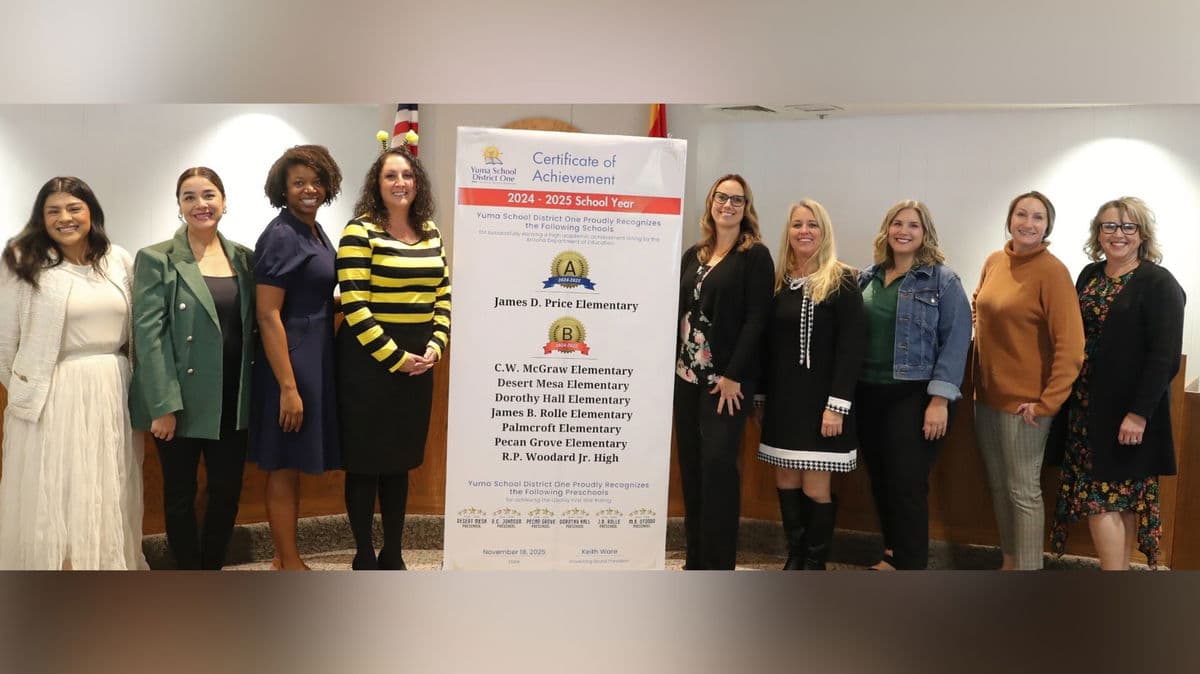
On November 19, 2025 the Arizona State Board of Education released its annual A through F letter grades for the 2024 to 2025 school year and KYMA reported that eight schools in Yuma School District One received A or B ratings. James D. Price Elementary School earned an A grade. Seven schools earned B grades, including C.W. McGraw Elementary, Desert Mesa Elementary, Dorothy Hall Elementary, James B. Rolle Elementary, Palmcroft Elementary, Pecan Grove Elementary, and R.P. Woodward Jr. High School. The district presented recognition banners to the eight campuses to mark the achievement.
The state accountability system assigns letter grades based on a combination of proficiency, growth, and related indicators. Those measures are intended to capture both current student performance and year to year academic progress. District officials framed the letter grades as one metric among many that reflects teacher dedication and student learning, and the recognition reflects a focus on measurable improvement at specific campuses.
For Yuma County residents these grades carry real economic and community implications. School ratings often influence family decisions about where to enroll children, and they can affect local housing demand and perceptions of neighborhood quality. Higher rated schools can make nearby homes more attractive to buyers who prioritize education, while B level performance across multiple campuses can support steady enrollment rather than dramatic shifts. For district labor markets the results can aid teacher recruitment and retention efforts by signaling institutional strengths in particular schools.

Policy consequences are also possible. State accountability ratings inform where the state and district target resources for improvement, professional development, and interventions. Communities with schools that scored B or higher may see recognition and incremental investment, while lower rated campuses typically receive more intensive support aimed at boosting proficiency and growth measures.
Looking ahead the district will likely use these grades as a benchmark while continuing to weigh multiple indicators of success. For families, homebuyers, and local employers the letter grades provide a snapshot of academic performance that interacts with broader economic trends in housing and labor. The eight honored schools offer a focal point for both community pride and ongoing policy attention as Yuma School District One pursues further gains.
This article was produced by Prism’s automated news system from verified source data, official records, and press releases, then run through automated quality and moderation checks before publishing. The system is built and supervised by the people who set the standards it runs under. Read our full AI policy.
Did this article answer your question?