Yuma workers, businesses adapt as AI reshapes the workplace
AI is already changing Yuma work, from fast food counters to small-business offices, and the winners will be workers who learn the tools before pay and hiring gaps widen.
AI is already showing up in Yuma jobs
For Yuma workers, artificial intelligence is no longer a distant workplace buzzword. Jorge Diaz said he is already seeing automation become more visible, especially in fast-food settings where computers appear to be taking on more of the work. His view is not anti-technology. It is a warning that AI can help only if it stays balanced and does not push human workers out of the picture.
That tension matters in Yuma because the stakes are practical, not theoretical. If local employers use AI to speed up scheduling, customer service, document handling and routine office tasks, then workers who cannot adapt risk falling behind in hiring and pay. The question in Yuma is not whether AI will arrive. It is whether local workers and businesses will learn to use it well enough to keep pace with the people and companies that already are.
The pressure is already inside Arizona small business
Chris Willis, chief officer at Domo, argued that employers should not panic. His point was sharper than simple optimism: the bigger risk is not being replaced overnight, but being unprepared to use AI well. In his view, the winners will be the organizations and individuals that adopt the technology in the smartest way, not necessarily the fastest way.
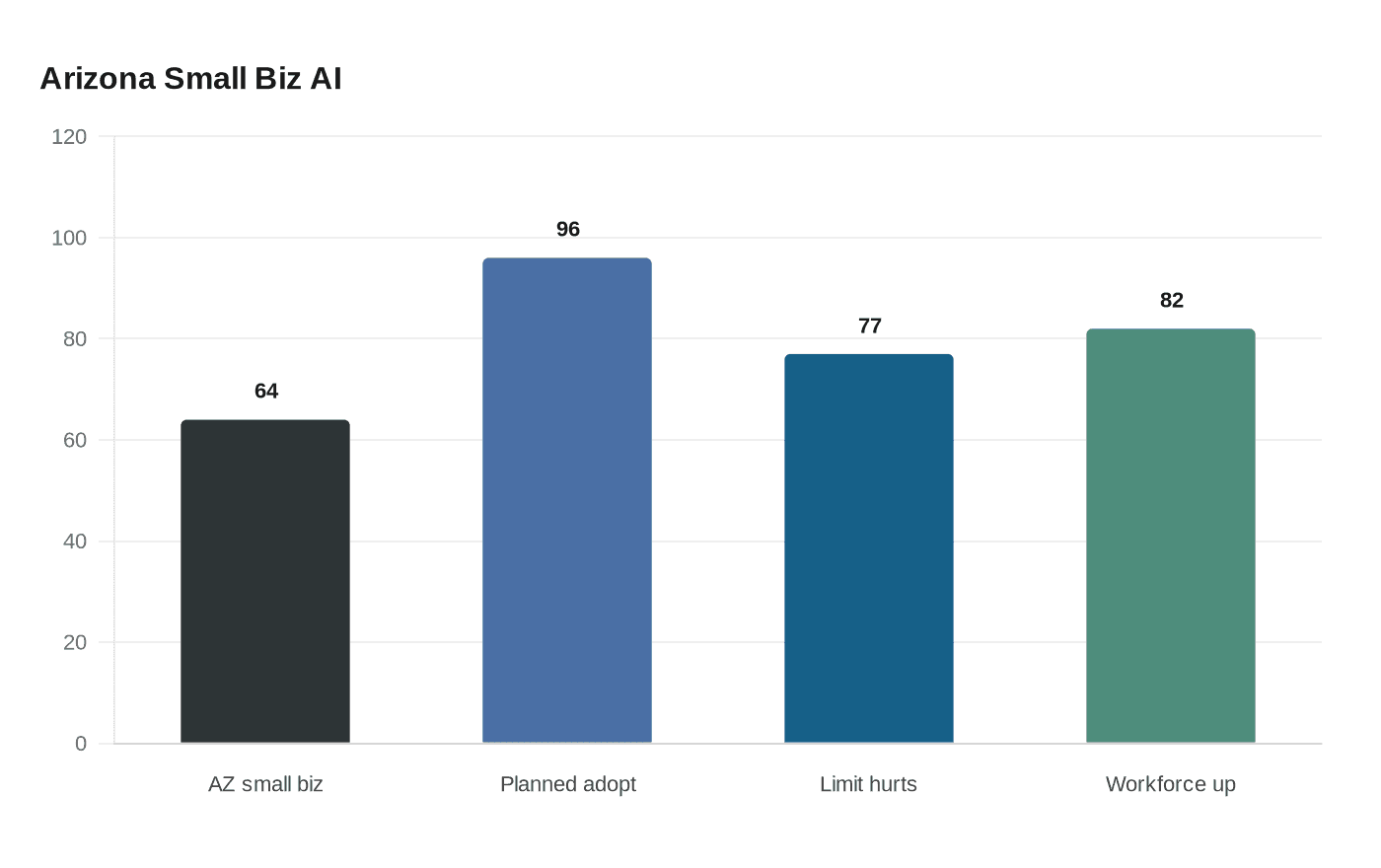
That warning is backed by hard numbers. The U.S. Chamber of Commerce says 64% of small businesses in Arizona are already using some form of AI platform. In its broader 2025 small-business technology report, the chamber said almost 60% of small businesses nationwide were using AI for business operations, more than double the share from 2023. It also found that 96% planned to adopt emerging technologies, including AI and cryptocurrencies.
The same report shows why many employers feel pressure to move now. Among small businesses already using AI, 77% said limits on the technology would hurt growth, operations and the bottom line. Even more striking, 82% said their workforce increased over the past year. That combination suggests AI is not simply a cost-cutting tool. For many firms, it is becoming part of how they expand, compete and keep staff productive.
Which Yuma jobs feel the change first
Yuma County’s economy has long depended on agriculture, logistics, retail and service work, and those are exactly the kinds of sectors where software can quickly alter everyday tasks. AI can influence how workers manage schedules, answer customers, sort information, draft messages and process routine records. In other words, the first changes often show up in the parts of a job that used to be treated as background work.
That is why Willis’s advice is so relevant to local employers. He recommended starting small with low-risk tasks such as drafting emails or extracting information from documents, rather than trying to overhaul an entire operation at once. That approach gives businesses a way to test AI without turning it loose on every decision. It also shows workers what skills are becoming more valuable: using AI tools, checking their output, and still applying human judgment when the answer matters.
For employees, the practical lesson is clear. AI comfort is starting to matter in jobs that used to depend mostly on repetition and speed. Workers who can handle customer interactions, review AI-generated drafts, verify data and catch errors will be in a stronger position than those who avoid the tools entirely. The technology is not replacing judgment. It is raising the value of people who can use judgment around the technology.
Yuma’s training system is trying to keep up
Local workforce leaders are not waiting for the shift to become a crisis. On May 6, 2026, Arizona Western Entrepreneurial College officially opened the Future48 Workforce Accelerator in Wellton, in eastern Yuma County. The 5,600-square-foot facility is designed to expand hands-on training in high-demand industries, a sign that Yuma County is investing in readiness while the labor market changes around it.
That matters because AI adaptation is not just a corporate decision. It is part of the county’s broader workforce-development system, including ARIZONA@WORK Yuma County and the Yuma County Workforce Development Board. The county also has a 2025-2028 Workforce Development 4-Year Plan, which shows that local training providers are already organized around preparing job seekers for in-demand occupations.
The new Wellton facility adds a concrete place where that preparation can happen. For workers who want to stay competitive, the point is not to become a software engineer overnight. It is to build comfort with the tools employers are starting to expect, whether that means learning how to use AI in office work, understanding automated workflows, or improving the ability to move between human tasks and digital systems.
What skills matter now
The clearest message from the Yuma AI conversation is that employers are not just looking for speed. They want workers who can use tools without losing reliability, context or common sense. In practice, that means a few abilities are becoming more valuable across the board:
- Drafting and editing emails quickly and accurately
- Pulling useful information from documents
- Checking AI-generated work for mistakes or weak reasoning
- Using technology to save time without dropping service quality
- Keeping customer interactions human when judgment or empathy matters
Those are not abstract skills. They are the kind of day-to-day abilities that can shape whether a worker gets hired, keeps a job, or moves up in pay. In a county where agriculture, logistics, retail and service work are central to the economy, even small efficiency gains can change what employers expect from every shift.
Why this is a local economic story, not just a tech story
The real force behind the Yuma AI debate is competition. Businesses worry about falling behind rivals that use AI better. Workers worry about falling behind in a labor market where digital fluency increasingly matters. Training institutions worry about whether they can move quickly enough to keep students aligned with employer demand.
That is why the numbers matter. If 64% of Arizona small businesses are already using AI, and national adoption is rising fast, then Yuma firms are not deciding whether to join a future trend. They are deciding how to keep their place in a market that has already changed. The opening of the Future48 Workforce Accelerator in Wellton, combined with the county’s active workforce plan, shows that local leaders understand the same thing: AI readiness is now part of workforce readiness.
For Yuma County, the race is not to replace people. It is to make sure people learn the tools fast enough to stay valuable as the workplace changes around them.
This article was produced by Prism’s automated news system from verified source data, official records, and press releases, then run through automated quality and moderation checks before publishing. The system is built and supervised by the people who set the standards it runs under. Read our full AI policy.
Did this article answer your question?