12 Expert Secrets to Keep Indoor Bonsai Thriving Year-Round
Keep the basics steady — light, humidity and water — and you’ll stop losing indoor bonsai to mysterious decline; these 12 pro-tested steps show exactly how.
I keep my indoor bonsai because they force me to pay attention: they tell you when something’s off. Bonsai Empire’s how‑to reach (the channel has 547,000 subscribers and one referenced video with 525,054 views and 8,004 likes) proves hundreds of thousands of growers want clear, practical rules — so here are 12 expert secrets, each grounded in what recognized bonsai educators actually recommend and what I’ve tested on Ficus, Portulacaria/Crassula and Ulmus parvifolia.
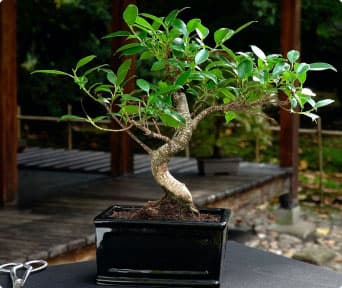
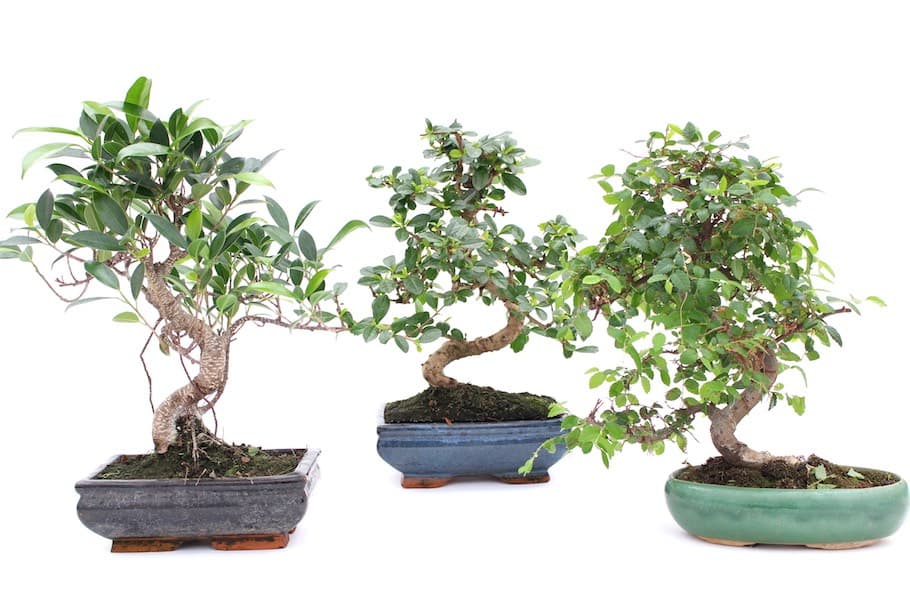
Secret: pick the right species for indoors Not every bonsai belongs on the windowsill. Bonsai Empire puts it bluntly: “Only tropical and subtropical plants can survive in the indoor climate of your house; where temperatures are high and stable throughout the year.” That’s why I stick to Ficus, Dwarf jade (Portulacaria/Crassula), Chinese elm (Ulmus parvifolia), Carmona (Fukien tea), Schefflera and Sageretia — the names that multiple sources call indoor‑friendly. Leavesandsoul’s takeaway sums it up: “Some species are better suited for indoor environments than others.”
Secret: match the light to the species Light is the first failure mode for indoor trees. Leavesandsoul advises “at least 4 to 6 hours of indirect sunlight per day,” while a Danish how‑to says subtropical indoor bonsai “har brug for et par timers direkte sollys hver dag.” Bonsai Empire recommends placing trees directly in front of a south‑facing window when possible. In practice, decide whether your species wants indirect (4–6 hours) or a few hours of direct sun, and treat that as non‑negotiable.
Secret: supplement with artificial lighting when the window lies Indoor windows lie: intensity drops dramatically compared with outside. Bonsai Empire’s practical fix is artificial lighting — fluorescent or LED — run for about 10 hours a day when natural light is insufficient. I’ve used supplemental LED panels on a timed schedule during short winter days and seen growth stop weakening; treating the light source as part of the environment is essential.
Secret: keep temperatures steady (and avoid drafts) Most indoor varieties prefer steady warmth: Leavesandsoul gives a 60–75°F (15–24°C) comfort band. Keep trees away from radiators, heat vents and cold drafts from windows or air conditioners — those rapid swings dry foliage and stress roots. Temperature control is boring but the single easiest step to prevent leaf drop.
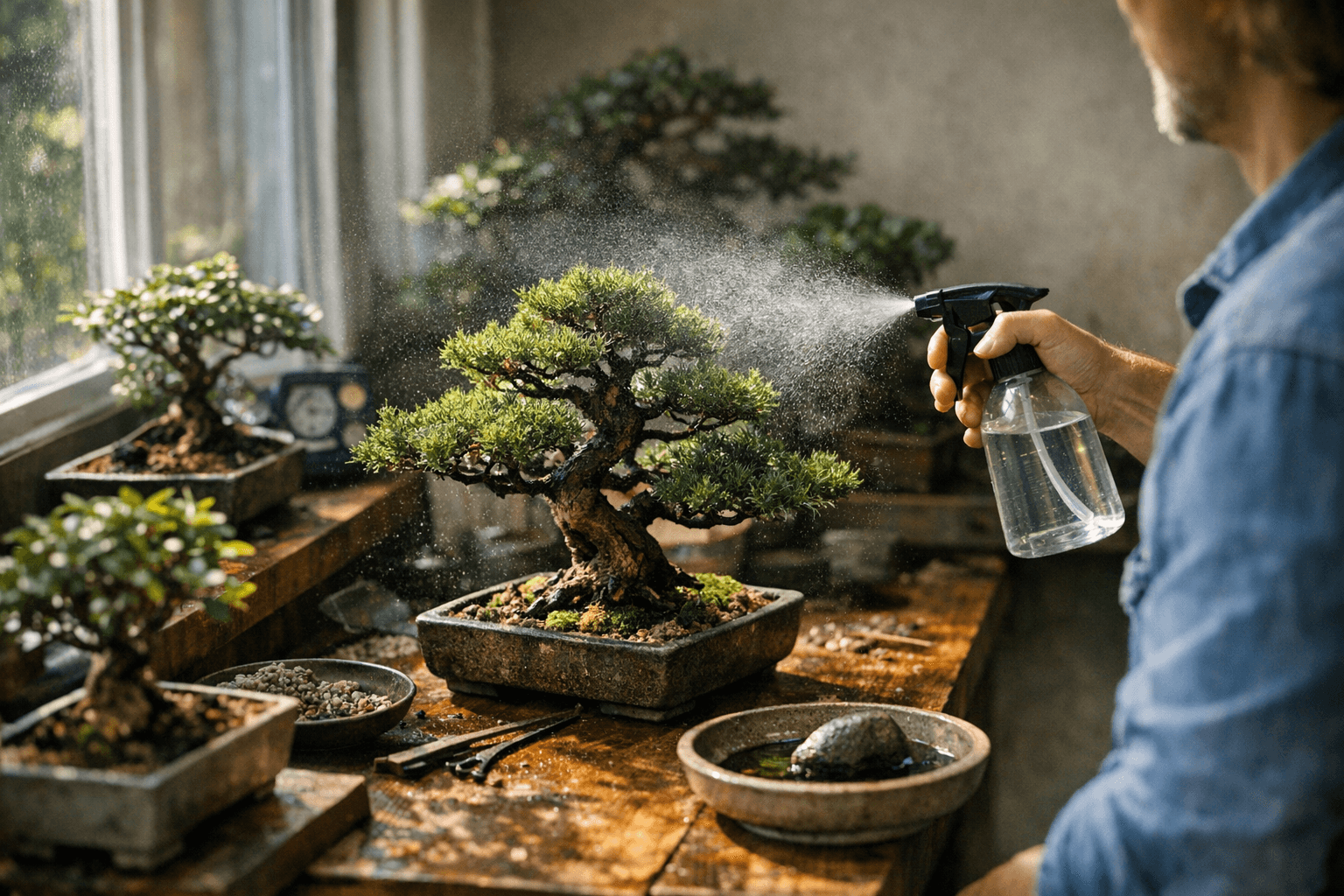
Secret: raise humidity — trays, misting, or a room humidifier Homes are drier than bonsai like. Bonsai Empire and Leavesandsoul both stress humidity: use a humidity tray filled with water, mist a few times a day, or run a room humidifier. The Danish snippet notes “Daglig brugs vil hjælpe med at hæve fugtigheden” — daily attention (misting or trays) meaningfully raises the microclimate around your tree.
Secret: water by feel, not by date Here’s the one line I tattooed mentally from Bonsai Empire: “The most important rule is, never water on a routine. Ignore the label attached to your Bonsai tree which states you need to water every x amount of days.” Complement that with Leavesandsoul’s rule of thumb — water when the top 1 inch of soil feels dry — and Costafarms’ touch test: “Scratch up the top inch of the soil—if it is dry, it’s time to water.” The Danish routine adds a useful technique: water, wait a moment, then water again to make sure the entire root system is wet. Always let excess drain; stagnant water invites root rot.
Secret: use a bonsai‑specific, well‑draining soil and a pot with drainage Nebonsai is uncompromising: “Use well-draining soil specifically designed for bonsai trees. Avoid using regular potting soil, as it can retain too much moisture and harm the roots of your bonsai.” Leavesandsoul echoes that a proper pot, soil, and drainage system are essential. If your soil holds too much water, you’re courting root rot even if you’re careful with watering.
Secret: fertilize, but reconcile the conflicting advice Fertilizer schedules vary in the wild. The Danish snippet says plainly: "Gød din indendørs bonsai en gang hver anden uge, ved at bruge en flydende gødning under vandingen." By contrast Costafarms recommends fertilizing “once or twice during the spring and summer months with a general-purpose indoor plant food.” Bonsai Empire points readers to a dedicated fertilizing resource. My take: match the product and frequency to the species — a liquid feed under watering every other week suits many subtropicals, while other growers prefer a lighter seasonal approach. Read the label and adjust to how your tree responds.
Secret: prune to train and to keep energy in check Pruning is where a bonsai’s personality shows and where you prevent lazy, leggy growth. The Danish guide gives a sharp, usable rule: “Du skal blot beskære skud, der strækker ud til 4-5 blade, tilbage til 2-3 blade ved hjælp af en skarp saks.” Costafarms adds timing: trim in spring after new growth emerges, and don’t forget root pruning when you repot. Use sharp scissors and treat pruning as both styling and health maintenance.
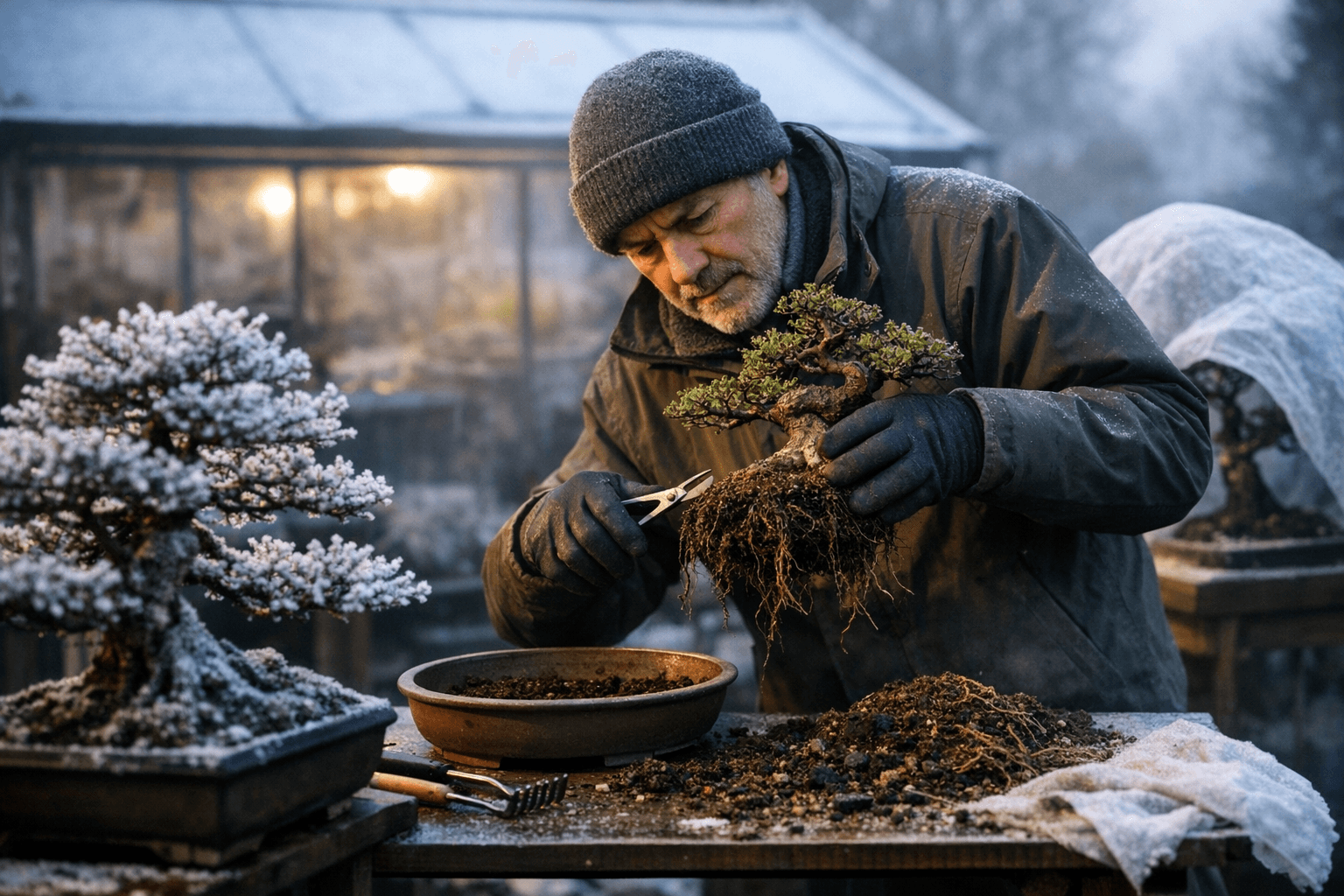
Secret: repot on cue — early spring, every 1–2 years for many indoor bonsai Repotting keeps roots healthy. Nebonsai recommends repotting “every one to two years,” and the Danish snippet specifies repotting “every other year in the early spring,” adding repot if you see roots circling the rootball. Check for circling roots at repot time: if the roots are bound, it’s time to refresh the soil and trim the roots.
Secret: build a simple maintenance routine and tools kit You don’t need a fancy bench; you need routine. Keep sharp scissors, a basic set of bonsai tools, a humidity tray and a watering can with a gentle flow. Nebonsai and the Danish text both refer to styling and regular maintenance — daily observation (for humidity and moisture) and scheduled seasonal jobs (pruning in spring, repotting in early spring) save more trees than dramatic rescues.
Secret: troubleshoot common failure modes and practice patience Leavesandsoul nails the mindset: “Patience is key: bonsai trees grow slowly, and each tree has its own needs.” Common failures are predictable — overwatering → root rot; inadequate light → weakened growth; heavy indoor heat → dry leaves; moisture‑retaining potting soil → drowned roots. Bonsai Empire warns that “Most Bonsai should be placed outside,” a reminder that if a temperate species struggles indoors, moving it outside might be the solution rather than doubling down on indoor fixes.
These are the nuts-and-bolts rules I teach friends who want a no‑surprises indoor bonsai shelf: choose species that tolerate indoor conditions, give predictable light and humidity, water by feel, and repot when roots demand it. Follow the specific numbers above — 4–6 hours indirect light or a couple hours direct for some subtropicals, 60–75°F steady temperatures, top‑inch touch tests, repot every 1–2 years — and you’ll cut most of the mystery out of keeping miniature trees alive. Keep notes, watch how each species responds, and let the tree tell you when to tweak the schedule.
Know something we missed? Have a correction or additional information?
Submit a Tip