12-Week School Yoga Pilot in Sierra Leone Lowers Student Stress
A 12-week PHE-integrated yoga pilot in 12 Sierra Leone secondary schools cut students' perceived stress from 22.8 to 17.6 (n = 180, p < .001).
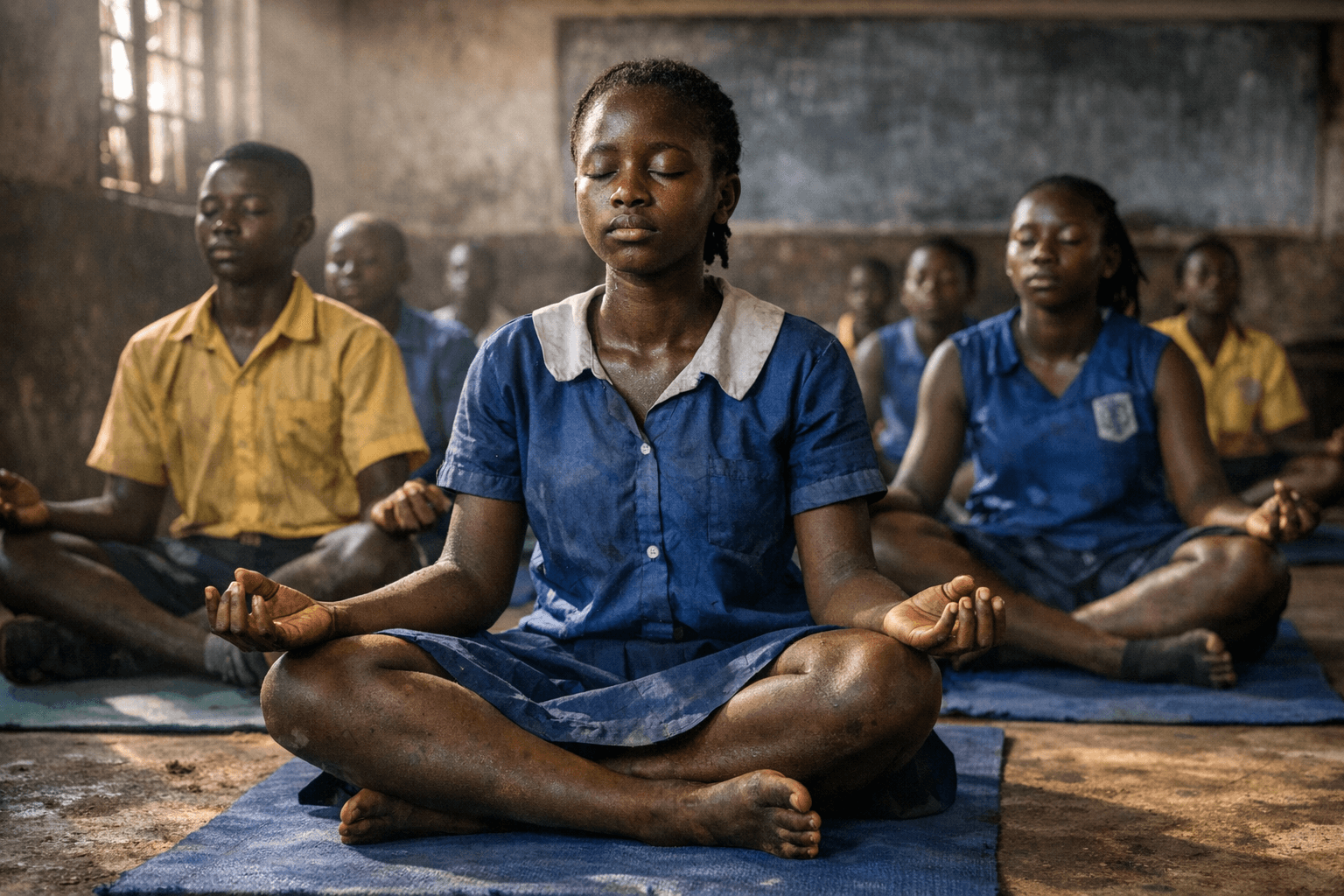
A mixed-methods pilot of school-based yoga found large short-term drops in student-perceived stress after the practice was folded into Physical Health Education (PHE) classes across 12 secondary schools in Sierra Leone. The study, published March 1, 2026, reported that perceived stress scores fell from a pre-test mean of 22.8 to a post-test mean of 17.6, with statistical significance at p < .001.
The intervention ran for 12 weeks and was explicitly integrated into the PHE curriculum rather than delivered as an extracurricular add-on. A total of 180 adolescents participated in the quantitative arm: 92 males and 88 females, aged 12-18 years, with a mean age of 15.2 years (SD = 1.74). The twelve schools spanned the country, with the report noting that "each sector (government-assisted or private) was equally represented across the six administrative regions of Sierra Leone."
Methodologically the study combined quantitative pre/post measurement with qualitative evaluation of implementation processes. On the quantitative side, the authors concluded that "the perceived stress scores reduced significantly from pre-test to post-test (M = 22.8 to M = 17.6, p < .001), which endorsed the positive psychological impact of yoga." Those figures formed the headline finding for the 12-week pilot delivered inside regular PHE time.
The qualitative component was organized around the central aim of evaluating integration into the PHE curriculum and practical feasibility in Sierra Leonean secondary schools. In describing those results the study asserts it "provides robust empirical and contextual evidence advocating for yoga as an effective and feasible stress intervention for adolescents, concurrent with the global literature on school-based mind-body practices." The report framed its findings as both an impact and process evaluation, tracking how yoga-based stress management could be operationalized within school timetables.
The authors also flagged clear limits to their pilot. They recommended readers recognize the "limited duration of the intervention (12 weeks noted as limited)," the study's "reliance on self-reported data," and the "geographical scope of the study" as constraints on generalizing the results. For next steps the report calls for longer follow-up and comparative designs, noting that future studies should explore longitudinal designs to track behaviour and psychosocial outcomes and that comparative designs with control groups "would support causal inference."
These results give curriculum planners and school health advocates a quantifiable short-term outcome to consider: in this 180-student pilot, embedding yoga into PHE coincided with a statistically robust drop in self-reported stress, while authors urge larger, longer, controlled trials to test durability and causality.
Know something we missed? Have a correction or additional information?
Submit a Tip