18 World Leaders Demand Lebanon Be Included in US-Iran Ceasefire Deal
Israel struck 100+ Hezbollah sites within hours of a ceasefire announcement, killing over 300 people as 18 world leaders demanded Lebanon be included in the deal.
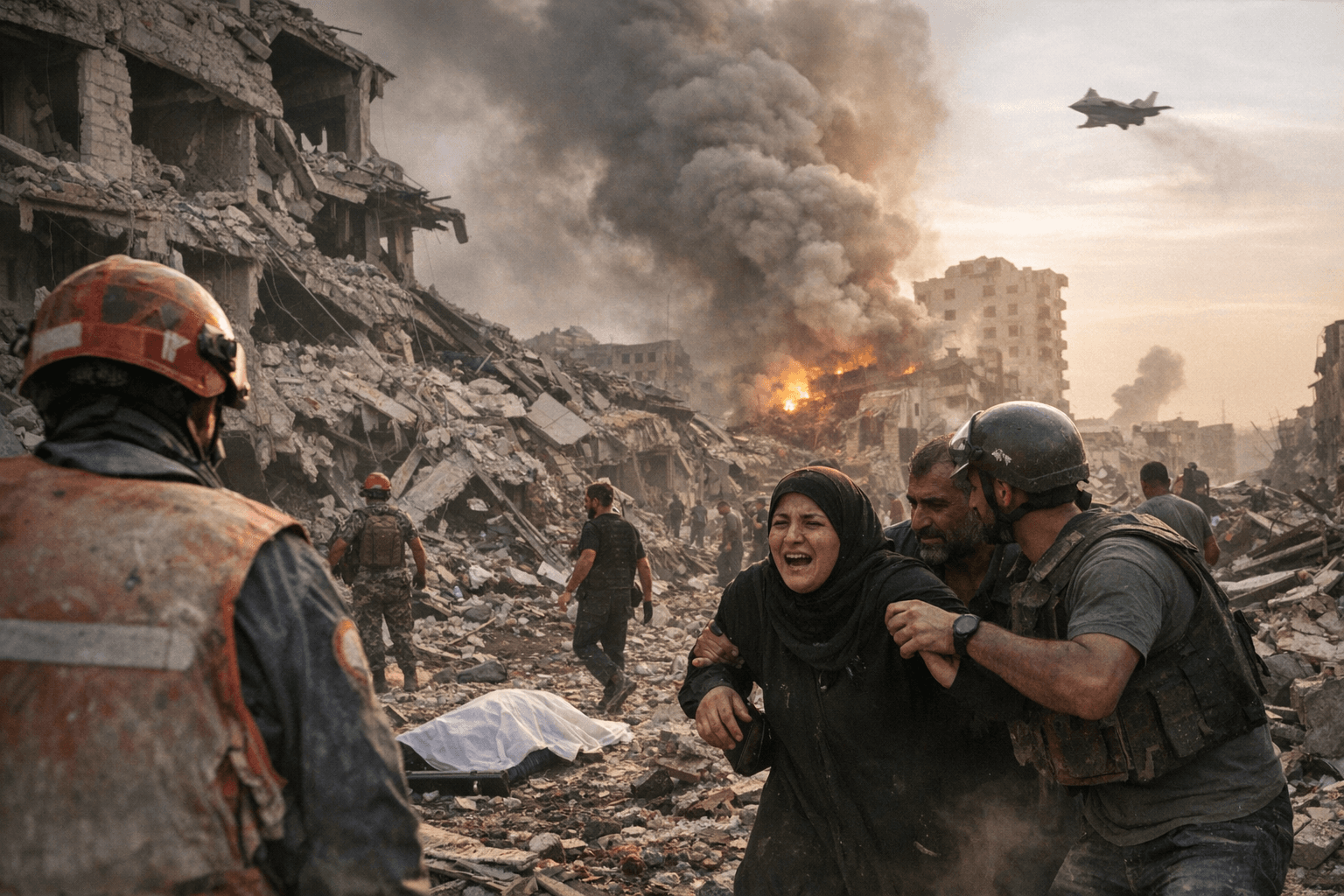
Hours after a U.S.-Iran ceasefire was announced on April 7, 2026, Israel launched what it described as its "largest coordinated wave of strikes" on Lebanon, targeting more than 100 Hezbollah command centers in a 10-minute window. By the following day, 18 heads of government had signed a joint statement demanding the truce be extended to cover Lebanon, drawing a sharp line between the deal Washington brokered and the war it was permitting to continue next door.
The April 8 statement, co-signed by the leaders of Germany, France, Italy, the United Kingdom, Denmark, Spain, the Netherlands, Canada, Japan, and the European Union, pressed all parties to act. The European Council's language was direct: "We call upon all sides to implement the ceasefire, including in Lebanon. Our Governments will contribute to ensuring freedom of navigation in the Strait of Hormuz." The pledge was not symbolic. Iran's Islamic Revolutionary Guard Corps had already halted all shipping through the Strait, citing the Israeli strikes as a ceasefire violation, and traffic through the waterway, which carries roughly one-fifth of the world's oil, was at a virtual standstill by April 9.
Pakistani Prime Minister Shehbaz Sharif, who brokered the two-week ceasefire, had explicitly stated Lebanon was covered under its terms. The Trump administration and Israeli Prime Minister Benjamin Netanyahu moved quickly to close that door. White House Press Secretary Karoline Leavitt stated: "Lebanon is not part of the ceasefire. That has been relayed to all parties involved." President Trump described the conflict there as a "separate skirmish," and Netanyahu said Israel was "continuing to strike it with force."
The consequences were immediate. Israel's April 8 strikes hit commercial and residential areas across Beirut, Sidon, southern Lebanon, and the Bekaa Valley during rush hour. By April 9, Lebanon's Health Ministry had confirmed at least 203 killed and more than 1,000 wounded; civil defense figures revised the toll to 254 dead and 1,165 injured, while Lebanon's health authorities put the total at 303, making it the deadliest single day since Israel relaunched military operations on March 2, 2026. An Israeli Navy strike killed Hajj Yusuf Ismail Hashem, commander of Hezbollah's Southern Front, whose predecessor Ali Karaki was killed in September 2024. Two additional strikes hit a UNIFIL battalion headquarters in al-Qaouzah in Bint Jbeil, injuring three UN peacekeepers from Ghana.
Since the renewed war began, more than 1,497 people have been killed in Lebanon, including 57 health workers, and over 1 million have been displaced. Amnesty International's Regional Director for the Middle East and North Africa, Heba Morayef, said: "Just hours after the world cautiously welcomed news of a US-Israeli ceasefire with Iran, in Lebanon the nightmare for civilians has become more terrifying."
Iran accused Washington of violating the ceasefire by allowing Israeli strikes to continue, warning the U.S. must choose between ceasefire or continued war. French President Emmanuel Macron confirmed France was among at least 15 countries working with Iran to reopen the Strait of Hormuz, giving the European pressure campaign a concrete enforcement dimension tied directly to global energy supply lines.
Netanyahu announced on April 9 that he had authorized direct negotiations with Lebanon "as soon as possible," even as strikes continued. Further U.S.-Iran talks were scheduled in Islamabad on April 10, led by Vice President JD Vance, with the geographic scope of any eventual agreement still the central unresolved question.
This article was produced by Prism’s automated news system from verified source data, official records, and press releases, then run through automated quality and moderation checks before publishing. The system is built and supervised by the people who set the standards it runs under. Read our full AI policy.
Did this article answer your question?


