2030 Census Could Push Democrats Off an Electoral Cliff by 2032
Projected population shifts after the 2030 census could strip Democrats of up to 12 House seats and reduce their Electoral College path to just 256 votes, well short of the 270 needed to win.
The math problem bearing down on Democrats is structural, bipartisan analysts agree on its direction, and it has nothing to do with any single candidate or campaign: the 2030 census threatens to fundamentally redraw the electoral map against them just in time for the 2032 presidential race.
Current population estimates from the Census Bureau project that states that voted for Kamala Harris would lose around a dozen House seats and the corresponding Electoral College votes to states that backed Donald Trump. Because each state's Electoral College allocation mirrors its congressional delegation, those lost seats translate directly into lost presidential votes.
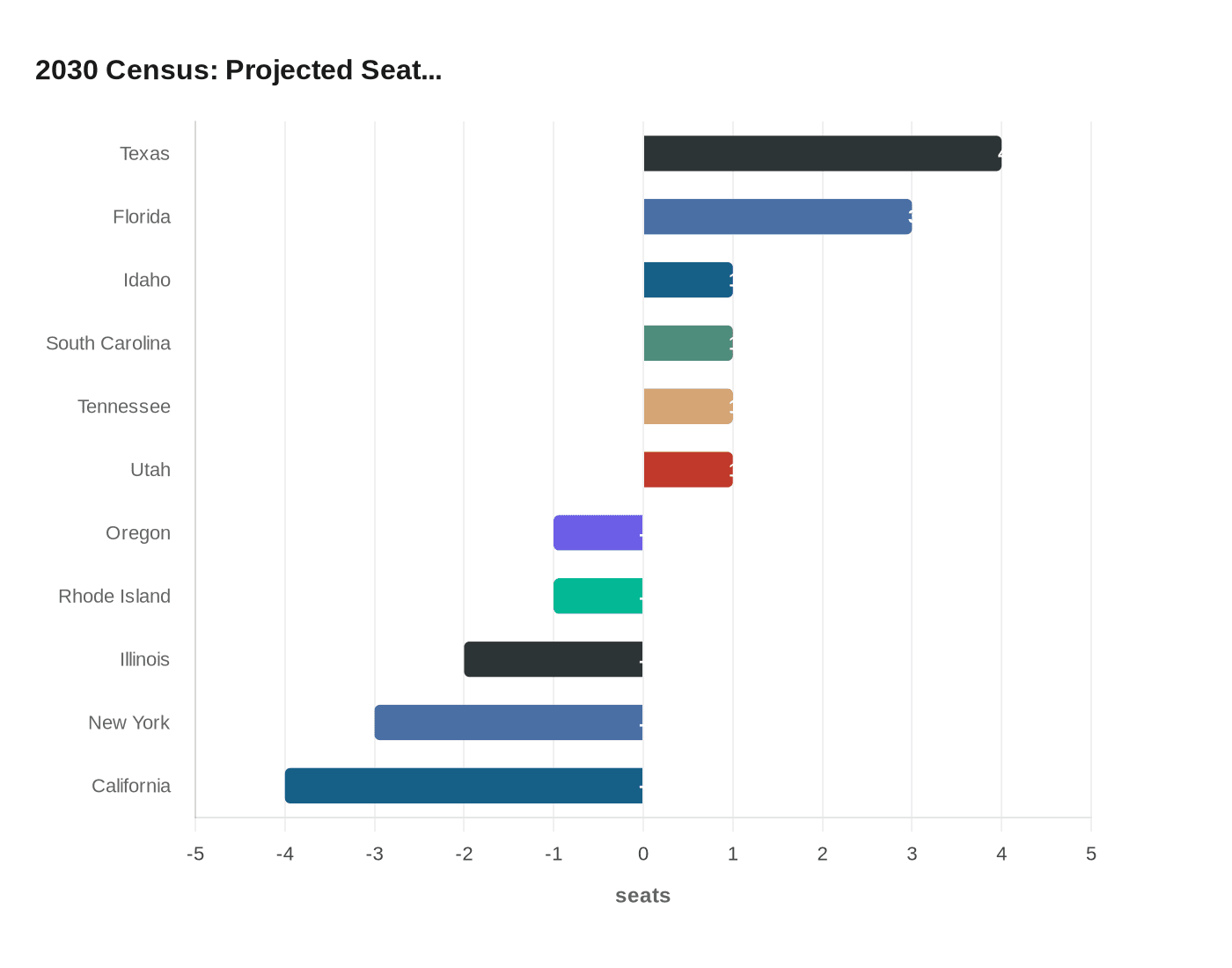
California is expected to lose four seats, New York could lose three, and Illinois is poised to lose two seats, while Oregon and Rhode Island are also at risk of losing a seat each. Meanwhile, the gains concentrate in the opposite direction. Texas is forecast to gain four seats, Florida three, while Idaho, South Carolina, Tennessee, and Utah are each expected to add one seat.

The practical consequence for any Democrat running for president in 2032 is severe. The traditional Blue Wall strategy of carrying Michigan, Pennsylvania, and Wisconsin, along with Nebraska's 2nd Congressional District, would produce only 258 electoral votes under the projected post-2030 map, leaving the party 12 votes short of the 270 needed to win the White House. That electoral math would force Democrats to win some combination of Sun Belt battlegrounds in Arizona, Georgia, Nevada, or North Carolina to reach the presidency.
The Brennan Center for Justice, which leans left, and the American Redistricting Project, which leans right, have each independently reached similar conclusions. The Brennan Center projects Democratic-leaning states would lose 12 seats in the next census, while the American Redistricting Project forecasts a comparable blue-to-red shift of 11 seats. The rare ideological convergence gives the projections unusual credibility.
Michael Li, senior counsel for the Democracy Program at New York University School of Law's Brennan Center, put the stakes plainly: "At the end of the day, Democrats have to be able to win in the South or compete in the South" to control the levers of government. "Otherwise, it's a really uphill battle every time."
Population increases in Florida and Texas mean those states will only grow more important for any party's Electoral College math, though analysts emphasize the numbers are still estimates and do not fully account for potential political shifts over the coming years. States gaining seats, including Arizona and Georgia, have shown movement toward Democrats in recent cycles, offering at least a partial counterweight to the structural disadvantage.
The 2020 census offered an early preview: Texas gained two seats while Colorado, Florida, Montana, North Carolina, and Oregon each gained one, while California, Illinois, Michigan, New York, Ohio, Pennsylvania, and West Virginia each lost a seat. The 2030 cycle, if current trends hold, would accelerate that same shift at greater scale, leaving Democrats needing to build a new coalition geography before the decade ends.
Know something we missed? Have a correction or additional information?
Submit a Tip

