350 French Tractors Muster in Paris to Protest EU-Mercosur Pact
Farmers drove about 350 tractors into central Paris to oppose the EU-Mercosur trade pact and press long-standing rural grievances.
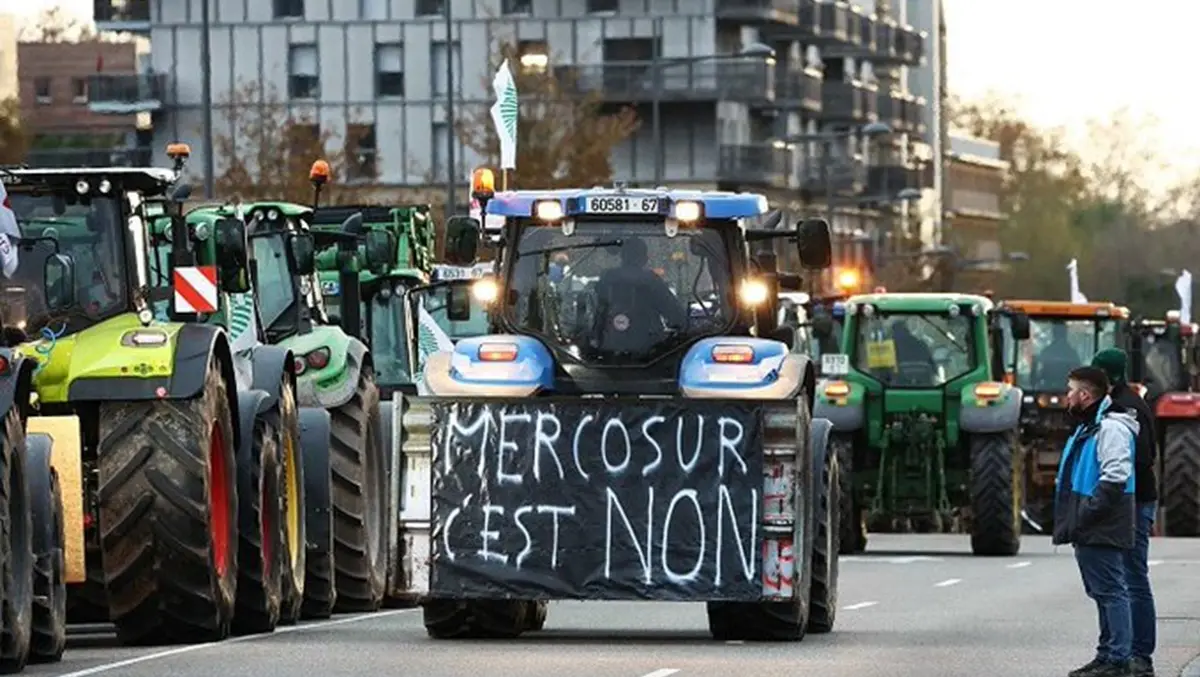
Hundreds of tractors converged on central Paris on Tuesday as French farmers escalated a second week of demonstrations against the EU-Mercosur trade agreement and mounting rural distress. Organized by the FNSEA, one of France’s largest farm unions, convoys circled the Arc de Triomphe, rolled down the Champs-Élysées, crossed the Seine and gathered near the National Assembly, creating horn-blaring disruption during the morning commute.
Paris police and multiple media outlets estimated the action at about 350 tractors. The first convoy of roughly 15 tractors entered the capital shortly before 6 a.m., and was joined by dozens more as the morning progressed. Police escorted the vehicles along cobbled avenues and into central boulevards; some farmers had briefly blocked motorways on their approach. Organizers said the convoys intentionally occupied symbolic and political spaces to pressure elected officials to address their demands.
The demonstrators’ principal objection is the EU-Mercosur trade pact, a wide-ranging agreement between the European Union and the Mercosur bloc of Brazil, Argentina, Paraguay and Uruguay that would lower tariffs and create a significant free-trade area. Farmers warn that cheaper South American beef and other imports will undercut French producers and imperil rural livelihoods. Protesters also pressed immediate grievances: low farm incomes, burdensome administration, environmental regulations, and dissatisfaction with the government’s handling of a lumpy skin disease outbreak affecting breeders.
FNSEA vice-president Luc Smessaert framed the protest as a readiness to intensify pressure if officials do not engage. Smessaert told BFMTV that protesters were “currently along the Seine” and said the union aimed to leave that evening but would remain “as long as it takes” if a meeting with the prime minister was not secured. A regional FNSEA leader said farmers “haven’t made any money from our farms for three years.” Individual participants described distress in personal terms: Guillaume Moret, 56, said “We’re at the end of our tether.”
The action follows a surprise demonstration last Thursday by Coordination Rurale that brought tractors beneath the Eiffel Tower and the Arc de Triomphe. Since December farmers have staged roadblocks around the country and announced a boycott of France’s biggest agricultural show in February, a decision its chairman Jerome Despey called “a blow to the show” and the first time no cows will appear since 1964.

The demonstrations carry wider political and diplomatic implications. Most EU member states have approved the Mercosur pact despite strong opposition from French politicians and farming groups, setting up a clash between Paris’s domestic political imperatives and broader EU trade commitments. The protests underline how national agricultural concerns can ripple across European policymaking, complicating ratification and implementation at a time when trade agreements are scrutinized for their environmental and food security impacts.
Parliamentary and executive figures moved to engage. The National Assembly president, Yaël Braun-Pivet, met farmers after a prior encounter in which she was jeered. Prime Minister Sébastien Lecornu’s office was due to receive a delegation of farmers on Tuesday, and the government signalled new measures to come. FNSEA leaders said they would press for meetings and keep pressure until officials deliver “measures that allow us to catch our breath a little,” with the possibility of remaining in Paris beyond the day if demands are not met.
As the tractors dispersed into afternoon traffic, the protests suggested the dispute will not be confined to rural France; it will continue to test domestic politics, European trade cohesion and the delicate balance between free trade and territorial food security.
This article was produced by Prism’s automated news system from verified source data, official records, and press releases, then run through automated quality and moderation checks before publishing. The system is built and supervised by the people who set the standards it runs under. Read our full AI policy.
Did this article answer your question?