Accenture to deploy Microsoft Copilot to 743,000 employees in major enterprise win
Accenture is turning Copilot into a 743,000-seat test of whether enterprise AI can deliver measurable gains, not just hype.

Microsoft won its biggest enterprise Copilot deployment yet as Accenture moved to give the chatbot-style assistant to all of its roughly 743,000 employees, a scale that turns the rollout into a real-world test of whether AI copilots can justify their price tag and security burden.
The deal matters because Microsoft has been trying to prove that its AI push can drive paid adoption, not just usage. The company said only a little more than 3% of its more than 450 million Microsoft 365 enterprise users currently pay for the $30-a-month Copilot offering, even as it presents the Accenture rollout as its largest enterprise deployment to date. Financial terms were not disclosed.
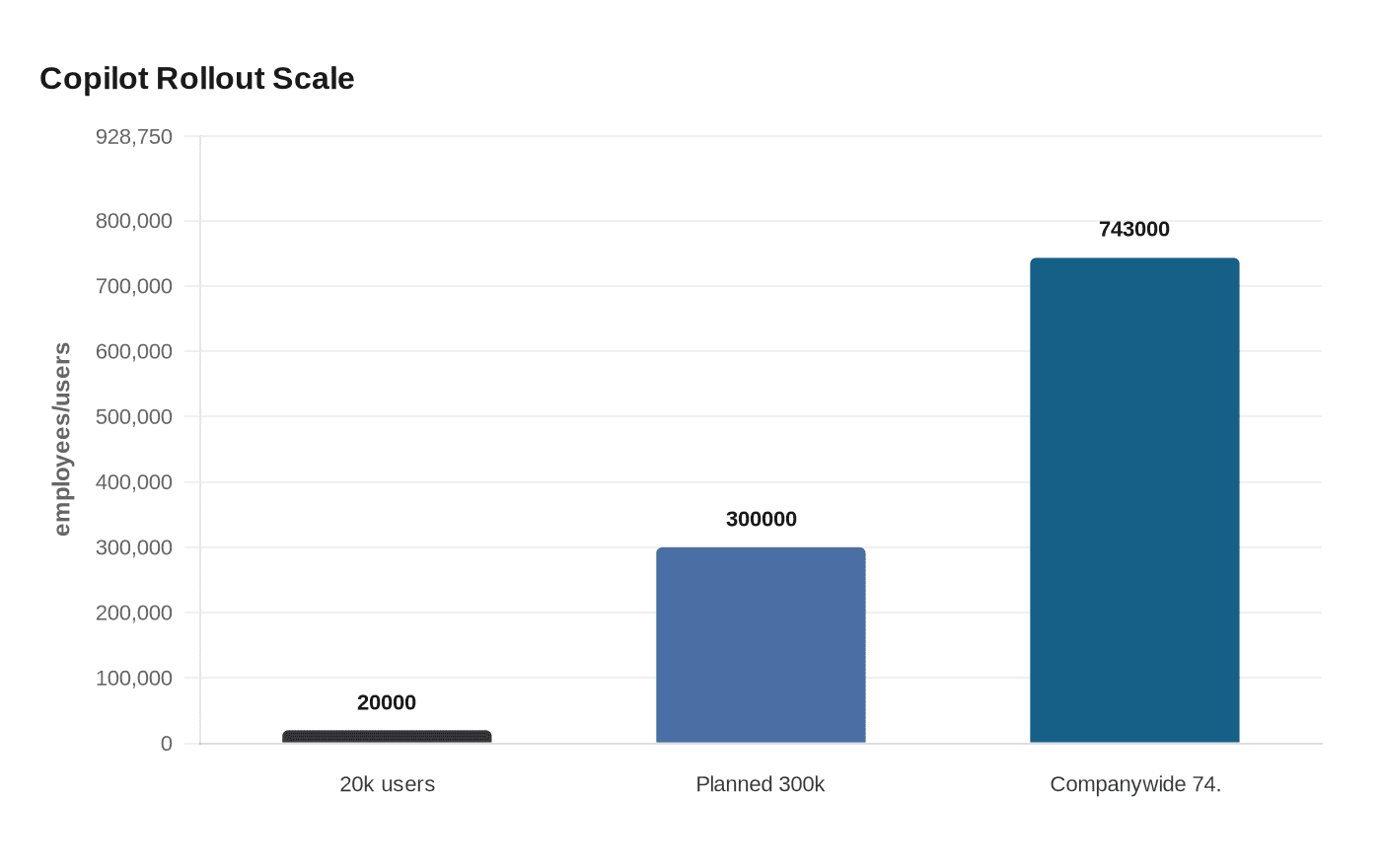
Accenture had once planned a far smaller rollout, saying in 2024 that it would offer Copilot to as many as 300,000 employees. Microsoft said the firm expanded in stages, starting with a pilot of a few hundred senior leaders and select employees, then growing to 20,000 users as it worked through data governance, access controls and everyday use cases in Outlook, Teams and Word. That phased approach points to where the first changes are likely to land: in drafting, messaging, meeting workflows and other routine knowledge work that can be measured more easily than abstract promises of transformation.
Accenture said the internal results were strong enough to justify widening the program companywide. In a self-reported survey of 200,000 users, 97% said Copilot helped them complete routine tasks up to 15 times faster, and 53% reported major productivity gains. Microsoft said those figures came from 2025 company data. Julie Sweet, Accenture’s chief executive, said the company’s teams were already doing higher-value work because of the technology.
The timing also reflects the pressure facing Microsoft. Reuters reported that Microsoft shares were down 12% this year and had their biggest quarterly drop since the 2008 financial crisis in the January-to-March period, a sign that investors remain uneasy about the return on the company’s AI spending and uneven cloud growth. A large deployment at one of the world’s biggest consulting and services employers gives Microsoft a prominent proof point, but it also raises the harder questions: how much productivity improves in practice, which roles change first, and whether the gains hold once enterprises factor in training, governance and worker skepticism.
That skepticism is still widespread. A National Bureau of Economic Research working paper issued in February surveyed nearly 6,000 senior business executives in the United States, United Kingdom, Germany and Australia, and found that nearly 90% said AI had not yet affected employment or productivity over the past three years. Microsoft’s own partnership work with Accenture and Avanade, including a November 2024 Copilot business transformation practice, shows the company has been preparing for this moment. The Accenture rollout is now the clearest test yet of whether enterprise AI can move from pilot enthusiasm to durable value at scale.
This article was produced by Prism’s automated news system from verified source data, official records, and press releases, then run through automated quality and moderation checks before publishing. The system is built and supervised by the people who set the standards it runs under. Read our full AI policy.
Did this article answer your question?