After Khamenei's Death, Revolutionary Guards Seize Power as Young Military Leaders Rise
The IRGC seized control of Iran's succession after Khamenei's assassination, installing a hardline new leader with deep Guard ties and a nuclear stance that Washington cannot read.
The clerical counterweight to Iran's Revolutionary Guards collapsed the moment Ayatollah Ali Khamenei was killed in a joint U.S.-Israeli airstrike on his Tehran compound on February 28. What followed was less a constitutional succession than a military takeover dressed in theological clothing.
While front-runners to succeed Khamenei emerged and a formal process unfolded, the real power shifted to the heavily armed force that had propped up Khamenei for decades: the Islamic Revolutionary Guard Corps. According to Iran International, the IRGC tried to appoint a new supreme leader on the very day of the assassination, bypassing the formal electoral process that involves the Assembly of Experts. When that failed, IRGC commanders applied what Iran International described as "repeated contacts and psychological and political pressure" on Assembly of Experts members to vote for Mojtaba Khamenei as Supreme Leader.
Ahmad Vahidi, who had been named IRGC deputy commander just weeks before the war, insisted that all critical and sensitive leadership positions must be decided by the IRGC. President Masoud Pezeshkian, who had apologized to neighboring countries for Tehran's strikes on Gulf states, was effectively sidelined. According to analyst Mohsen Sazegara, the IRGC had "threatened everyone that under wartime conditions, if you oppose them, you may even be sentenced to prison or execution."
On March 7, the Assembly of Experts announced Mojtaba Khamenei, son of Ali Khamenei, as the new Supreme Leader. Mojtaba joined the IRGC at age 17 and fought in the Iran-Iraq War. He later took control of the Basij paramilitary volunteer militia in 2009. Kasra Aarabi, head of research on the Guards at United Against Nuclear Iran, noted that Mojtaba "has a strong constituency and support within the IRGC, in particular amongst the younger radical generations."
That generational dimension reshapes the risk calculus in ways that go beyond a simple leadership swap. Analysts say the Guard's losses opened pathways for a new generation of commanders, often described as more hardline and less constrained, to move into key positions. Vali Nasr noted that figures seen as more pragmatic have been sidelined in favor of those aligned with a more confrontational posture, with the replacement of officials such as Ali Larijani by figures like Mohammad Zolghadr illustrating that shift. As Nasr put it, "The leadership is being replaced, but not weakened."
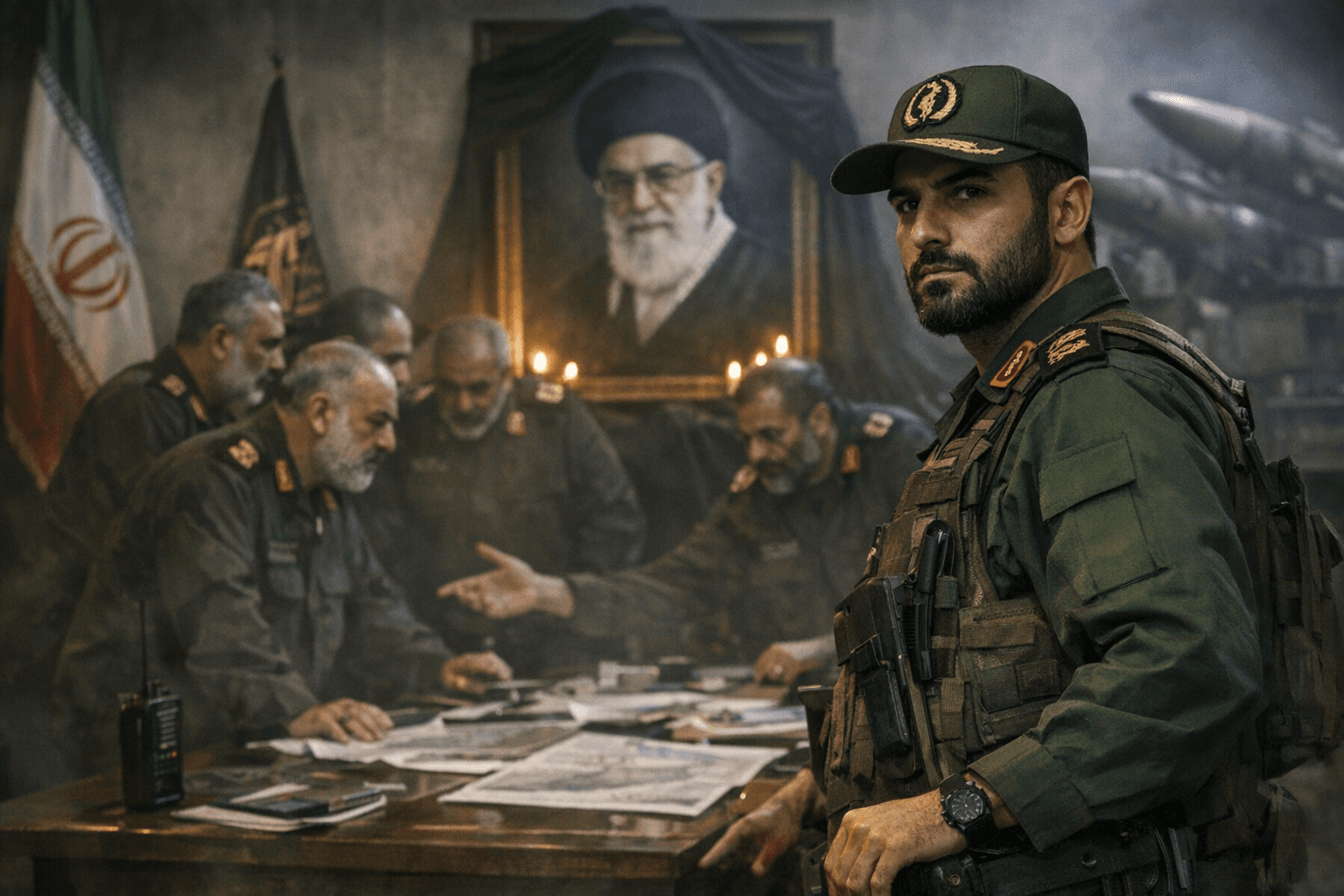
The sharpest implication is nuclear. Days after being named supreme leader, Mojtaba Khamenei issued a statement demanding vengeance against the U.S. and Israel, but made no mention of Iran's nuclear program, leaving U.S. officials largely in the dark about his stance on weaponization. The IRGC consolidated power by reappointing hardline retired commanders to lead a younger, more vengeful generation of fighters, and hardline commentator Nasser Torabi told state television: "After this war, Iran will be recognized as a global superpower. We must take measures to produce or possess nuclear weapons." Ahmad Haqtalab, the IRGC commander responsible for protecting Iran's nuclear facilities, had already declared in 2024 that "A reversal of Iran's nuclear doctrine and policies, including a shift away from previous considerations, is likely and conceivable."
Inside Iran, the same institutions driving foreign policy are tightening their grip domestically. The January 2026 uprising saw mass killings, large-scale arbitrary arrests, and the deliberate imposition of a nationwide digital blackout, with preliminary assessments indicating thousands of deaths and approximately 50,000 arrests. Internet monitor NetBlocks reported that by March 16, the regime had further tightened internet restrictions.
The IRGC controls Iran's ballistic missiles, its proxy network, its internal security, and now its political succession. As its influence grows, analysts expect a more assertive foreign policy paired with efforts to rebuild capabilities weakened by the war, along with a stronger inclination to pursue deterrence through unconventional means. The commanders now steering those decisions came of age fighting Saddam Hussein with chemical weapons raining on their positions while the West looked away. Their institutional memory is not one of negotiated restraint. The risk of miscalculation in the next confrontation, whoever triggers it, has risen sharply.
This article was produced by Prism’s automated news system from verified source data, official records, and press releases, then run through automated quality and moderation checks before publishing. The system is built and supervised by the people who set the standards it runs under. Read our full AI policy.
Did this article answer your question?