AI-driven hierarchical control enables sub-centimeter mobile 3D printing outdoors
Researchers posted a preprint showing AI-driven sensor fusion and hierarchical control let mobile printers reach sub-centimeter accuracy on uneven terrain. This advances on-site and expeditionary additive construction.
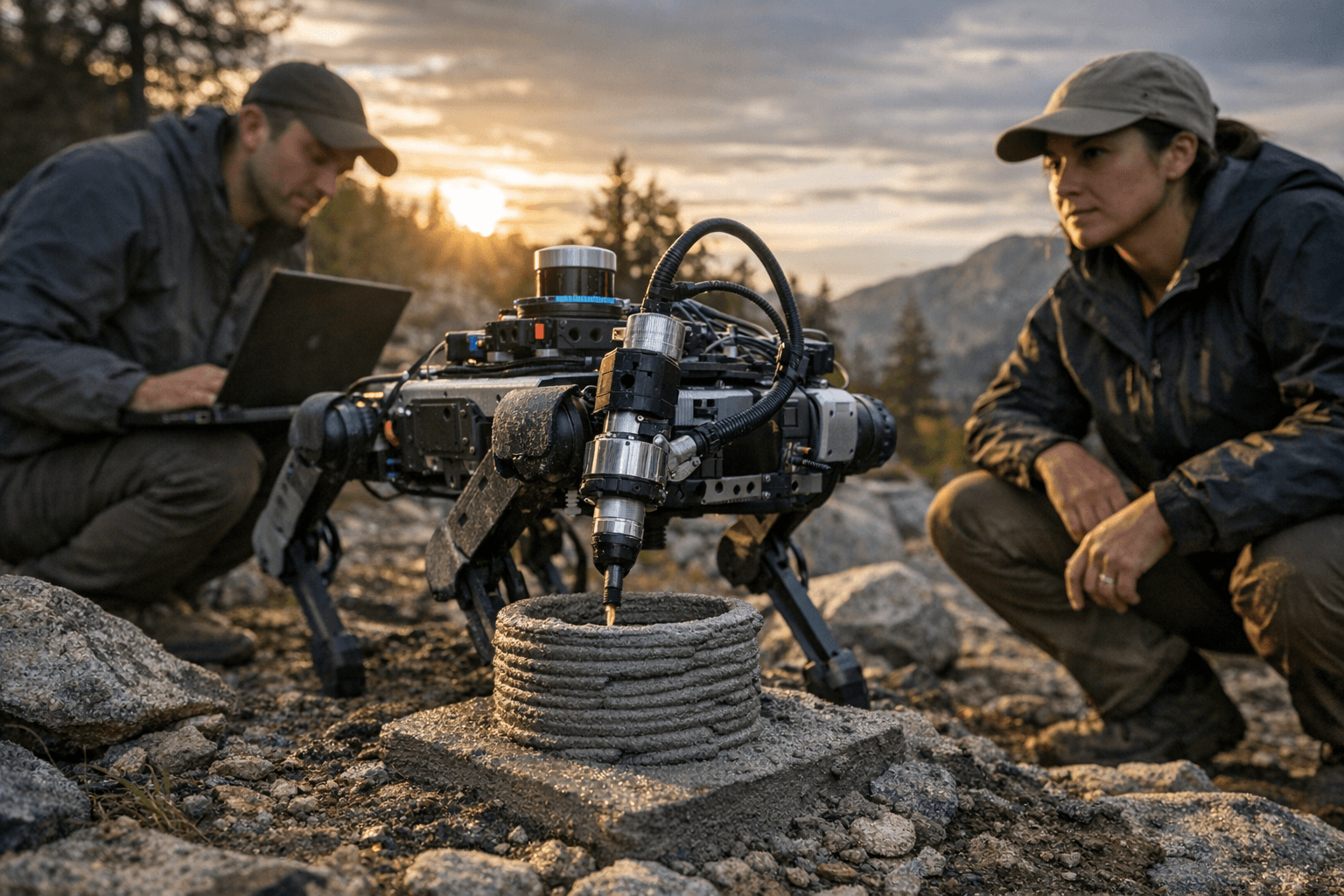
Researchers Shuangshan Nors Li and J. Nathan Kutz posted a preprint to arXiv on January 15, 2026, describing a system that bridges the long-standing gap between deposition precision and platform mobility for outdoor 3D printing. The team combined multi-modal sensing, machine learning, and layered hardware control into a closed-loop perception-learning-actuation stack that predicts terrain disturbances and compensates proactively, producing sub-centimeter deposition accuracy during field trials.
The core innovation is an AI module trained to map terrain signatures from IMU, vision, and depth sensors to the perturbations those terrains induce on a mobile printer. Rather than waiting for a visible print defect and correcting it after the fact, the system anticipates chassis and toolhead disturbances and plans around them. That intelligence sits inside a three-layer control architecture: global path planning, predictive chassis-manipulator coordination that choreographs movement and arm kinematics, and a precision execution layer that handles final hardware-level adjustments. Together these layers let a full mobile platform stay in motion while preserving layer fidelity.
Field experiments described in the preprint put the framework through slopes and surface irregularities native to unprepared sites. The tests demonstrated sub-centimeter accuracy while maintaining full platform mobility, a notable contrast with gantry systems that require prepared, flat infrastructure to meet similar tolerances. For practitioners interested in printing outside the workshop—whether for rapid shelter builds, remote repairs, or on-site prototyping—this approach reduces the logistics burden of transporting and assembling heavy gantries.
Practical takeaways are immediate for the community: sensor fusion matters. Combining IMU readings with depth and vision streams gives the predictive model the temporal and spatial context needed to forecast disturbances. Hierarchical control lets planners trade off motion and precision in predictable ways so you can keep printing even when the ground isn’t ideal. For builders and small labs experimenting with mobile rigs, prioritize synchronized sensors, robust chassis-manipulator kinematics, and low-latency control loops; those elements are the foundations that let predictive models move from simulation to repeatable field performance.
The paper also sketches where this tech goes next. Scaling the approach to larger-material extrusion, ruggedized payloads, and extended autonomous missions will be the logical follow-ups. For the 3D printing community, the work signals a shift: precision no longer must be bought exclusively with immobile hardware. Expect more rigs built to print on the go, smarter G-code generation that factors in terrain, and a growing emphasis on tight sensor-to-actuator integration as the standard for field-capable printers.
Sources:
Know something we missed? Have a correction or additional information?
Submit a Tip