AI investment drives U.S. trade deficit wider in March, Commerce reports
AI data-center spending pushed imports higher, widening the March trade deficit to $60.3 billion even as exports and petroleum shipments rose.

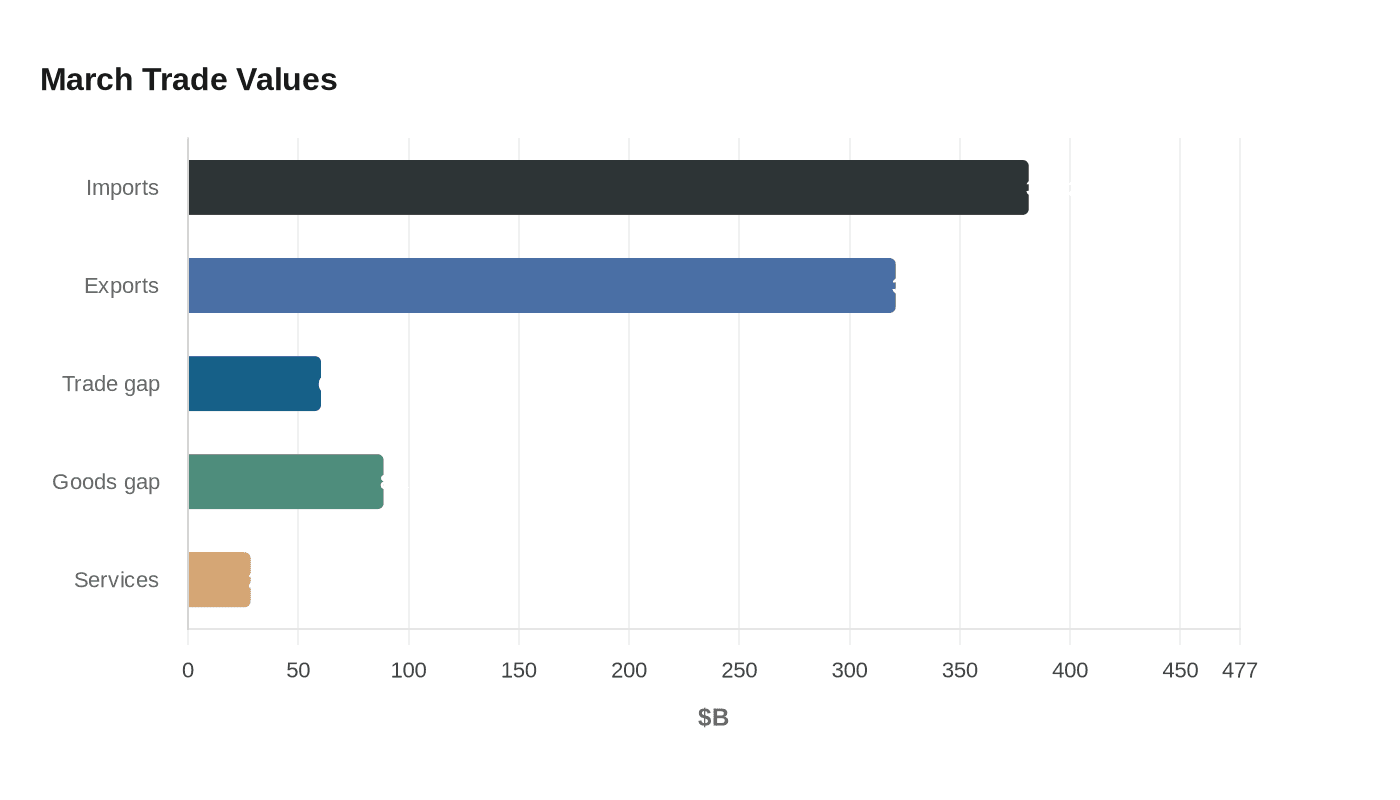
A rush to buy the hardware behind artificial intelligence helped push the U.S. trade deficit wider in March, even as exports reached a record and petroleum shipments gave the country a lift. The goods and services gap rose to $60.3 billion from a revised $57.8 billion in February, as imports climbed faster than exports and the larger goods deficit outweighed a stronger services surplus.
Exports increased 2.0% to $320.9 billion, while imports rose 2.3% to $381.2 billion. The March widening came from a goods deficit of $88.7 billion, up $4.1 billion, partly offset by a $1.6 billion rise in the services surplus to $28.4 billion. For the first quarter, trade cut 1.30 percentage points from real GDP growth, a sharp drag in a quarter when the economy still expanded at a 2.0% annual rate.
The pressure on imports was most visible in capital goods, which hit a record $120.7 billion. Goods imports rose 3.6% to $302.2 billion, with computer accessories up $2.0 billion, motor vehicles and parts up $3.6 billion, and industrial supplies and materials up $2.1 billion. That is the hidden cost of the AI buildout: data centers, servers and advanced chips may be powering a domestic technology boom, but the equipment needed to assemble that boom is still arriving from abroad.
The export side was not weak. Goods exports rose 3.1% to a record $213.5 billion, led by a $5.0 billion jump in industrial supplies and materials to an all-time high. Crude oil exports increased $2.8 billion, other petroleum products rose $1.7 billion and fuel oil shipments gained $1.6 billion. Exports of foods, feeds and beverages reached their highest level since August 2022, helped mostly by soybeans.
Some of that strength reflected conflict-related disruption in the Middle East, which helped lift crude shipments. Grace Zwemmer of Oxford Economics said, “We expect the trade deficit to narrow in April as U.S. exports of oil and petroleum products have surged.” Even with March’s widening, the deficit was still down $211.2 billion, or 55.0%, from the same period in 2025, underscoring how volatile the trade picture has become as AI investment, energy markets and global supply chains collide.
This article was produced by Prism’s automated news system from verified source data, official records, and press releases, then run through automated quality and moderation checks before publishing. The system is built and supervised by the people who set the standards it runs under. Read our full AI policy.
Did this article answer your question?

