Air Canada Express Jet Collides With Fire Truck at LaGuardia, Killing Two Pilots
A controller cleared a fire truck to cross a runway just 20 seconds before pilots Antoine Forest and Mackenzie Gunther were killed on landing at LaGuardia.

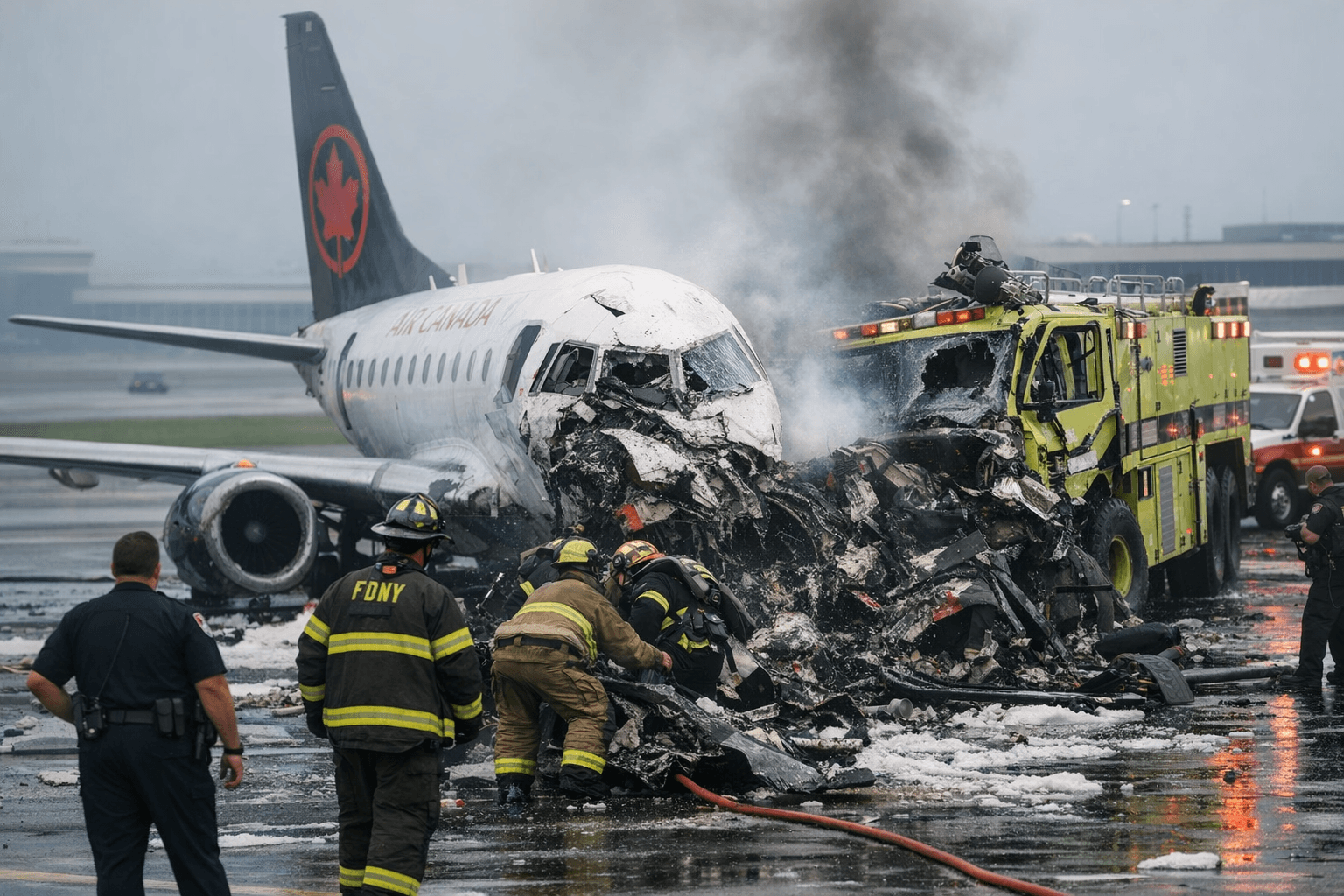
The radio call came with 20 seconds to spare: the LaGuardia tower cleared a Port Authority fire truck to cross Runway 4 as Air Canada Express Flight 8646 was already on final approach, traveling at approximately 100 miles per hour. Nine seconds later, the same controller ordered the truck to stop. It was too late. On the night of March 22, 2026, the Bombardier CRJ900 experienced a runway incursion with a LaGuardia airport firefighting truck that was crossing to reach an unrelated emergency, and the collision destroyed the aircraft's cockpit and forward galley sections, killing both pilots.
The pilots were identified as 30-year-old Antoine Forest of Coteau-du-Lac, Quebec, and 38-year-old MacKenzie Gunther of Peterborough, Ontario. Gunther had graduated from Seneca Polytechnic's honors bachelor of aviation technology program in 2023 and joined Jazz Aviation right after graduation; the school lowered flags to half-staff in his honor. Flight attendant Solange Tremblay remained hospitalized after being found strapped to her seat outside the plane, having apparently fallen through an opening in the aircraft after the cockpit was severed.
Forty-one people, including passengers, crew, and both occupants of the truck, were hospitalized following the collision; nine remained under medical care the following day. The two occupants of the fire truck, a Port Authority police officer and sergeant, suffered broken bones and were both transported to NewYork Presbyterian-Queens in critical but non-life threatening condition.
The flight, operated by Jazz Aviation on behalf of Air Canada, was carrying 72 passengers and four crew members when it struck the truck. The fire truck had been heading to a United Airlines flight where there were reportedly fumes onboard. According to NTSB senior aviation investigator Doug Brazy's breakdown of the cockpit voice recorder, the flight crew checked in with the tower at 2 minutes and 22 seconds, and the tower cleared the airplane to land on Runway 4 at 2 minutes and 17 seconds. At 25 seconds out, the truck requested permission to cross Runway 4; at 20 seconds, the tower cleared it to cross; at 17 seconds, the fire truck read back the clearance; and at 9 seconds, the tower told the truck to stop.
Audio posted to LiveATC captured what followed. Eighteen minutes after the collision, one controller appeared to blame himself in a conversation with a pilot who witnessed the crash. "That wasn't good to watch," the pilot said. "Yeah, I know. I tried to reach out to them," the controller replied. "We were dealing with an emergency earlier. I messed up."
National Transportation Safety Board Chair Jennifer Homendy urged caution about rushing to fault any individual. "It is not clear who was conducting the duties of the ground controller. We have conflicting information," Homendy said. She noted the NTSB has seen "different information" about how many certified controllers were in the facility at the time, and investigators have also seen "conflicting information" in the control tower's logs that they need to verify.
Two compounding technical failures emerged from the investigation. The fire truck was not equipped with a transponder, the technology that helps air traffic controllers identify and track vehicles on the airfield. Additionally, the airport's surface detection equipment, known as ASDE-X, did not generate an alert ahead of the collision "due to the close proximity of vehicles merging and unmerging near the runway, resulting in the inability to create a track of high confidence," Homendy said. Homendy confirmed that LaGuardia's runway status lights, an additional layer of safety, were working at the time.
Homendy said controllers are using an "old system" that needs to be upgraded, adding: "Controllers should have all the info and tools they need to do their job. This is 2026."
It is the first fatal crash at LaGuardia, the New York area's third-busiest airport, in 34 years, according to Port Authority Executive Director Kathryn Garcia. Sunday night's collision caused LaGuardia, a major transit hub that served more than 32 million passengers last year, to close for about 14 hours Monday, forcing hundreds of flights to be canceled.
The NTSB sent a team to investigate the crash, with the Transportation Safety Board of Canada also dispatching investigators to assist in accordance with international agreements. The cockpit voice recorder captured more than 25 hours of audio, while the flight data recorder contained around 80 hours of data; the NTSB convened a cockpit voice recorder review group at its Washington headquarters to produce a written transcript. Among factors the NTSB found led to last year's midair collision of an Army Black Hawk helicopter and American Airlines regional jet that killed 67 near Washington was air traffic control's "degraded performance," with two positions combined in the tower — a strikingly similar structural condition to what investigators are now scrutinizing at LaGuardia.
Know something we missed? Have a correction or additional information?
Submit a Tip