Albanese Orders Royal Commission into Bondi Beach Mass Shooting
Prime Minister Anthony Albanese announced a federal royal commission to probe the Dec. 14, 2025 Bondi Beach mass shooting that killed 15 people at a Hanukkah celebration, appointing former High Court justice Virginia Bell AC as commissioner. The inquiry will examine the attack’s circumstances, the drivers of antisemitism and whether intelligence or law enforcement failures contributed, with a final report due by Dec. 14, 2026.

The federal government will establish a royal commission into the Bondi Beach mass shooting, Prime Minister Anthony Albanese announced on Jan. 8, 2026, after cabinet endorsed the move and he agreed to recommend the inquiry to the governor-general at an executive council meeting. The commission will be led by former High Court justice Virginia Bell AC and is scheduled to deliver interim findings in April 2026 and a final report by Dec. 14, 2026, the first anniversary of the attack.
The inquiry’s remit is broad. Officials say it will investigate the circumstances of the Dec. 14, 2025 attack at a Hanukkah celebration that left 15 people dead, examine the nature, prevalence and drivers of antisemitism in Australia, probe social cohesion and the spread of extremist ideology, and assess whether intelligence and law enforcement agencies could have prevented the violence. The commission is also expected to make recommendations to agencies on tackling antisemitism, strengthening social cohesion and countering violent extremism.
Albanese framed the decision as a national response to an event he called “an antisemitic terrorist attack, aimed at Jewish Australians, inspired by ISIS,” and described it as “the deadliest that has ever occurred on Australian soil.” The government’s announcement follows sustained calls from victims’ families, Jewish community leaders and lawmakers for a national inquiry rather than a state-limited probe.
Police investigations, conducted under the name Operation Arques, have identified two alleged perpetrators as a father-and-son pair, named in official accounts as Sajid Akram and his son Naveed Akram. Reports indicate the surviving suspect, Naveed Akram, has been charged with dozens of offences, one account cited as many as 59 counts, including 15 counts of murder, and has been reported as 24 years old. Authorities have said the suspects were inspired by Islamic State ideology, and some accounts noted travel to the southern Philippines in the weeks before the attack that prompted suspicions of possible militant links. At the same time, Australian Federal Police Commissioner Krissy Barrett said there was “no evidence to suggest these alleged offenders were part of a broader terrorist cell, or were directed by others to carry out the attack.”
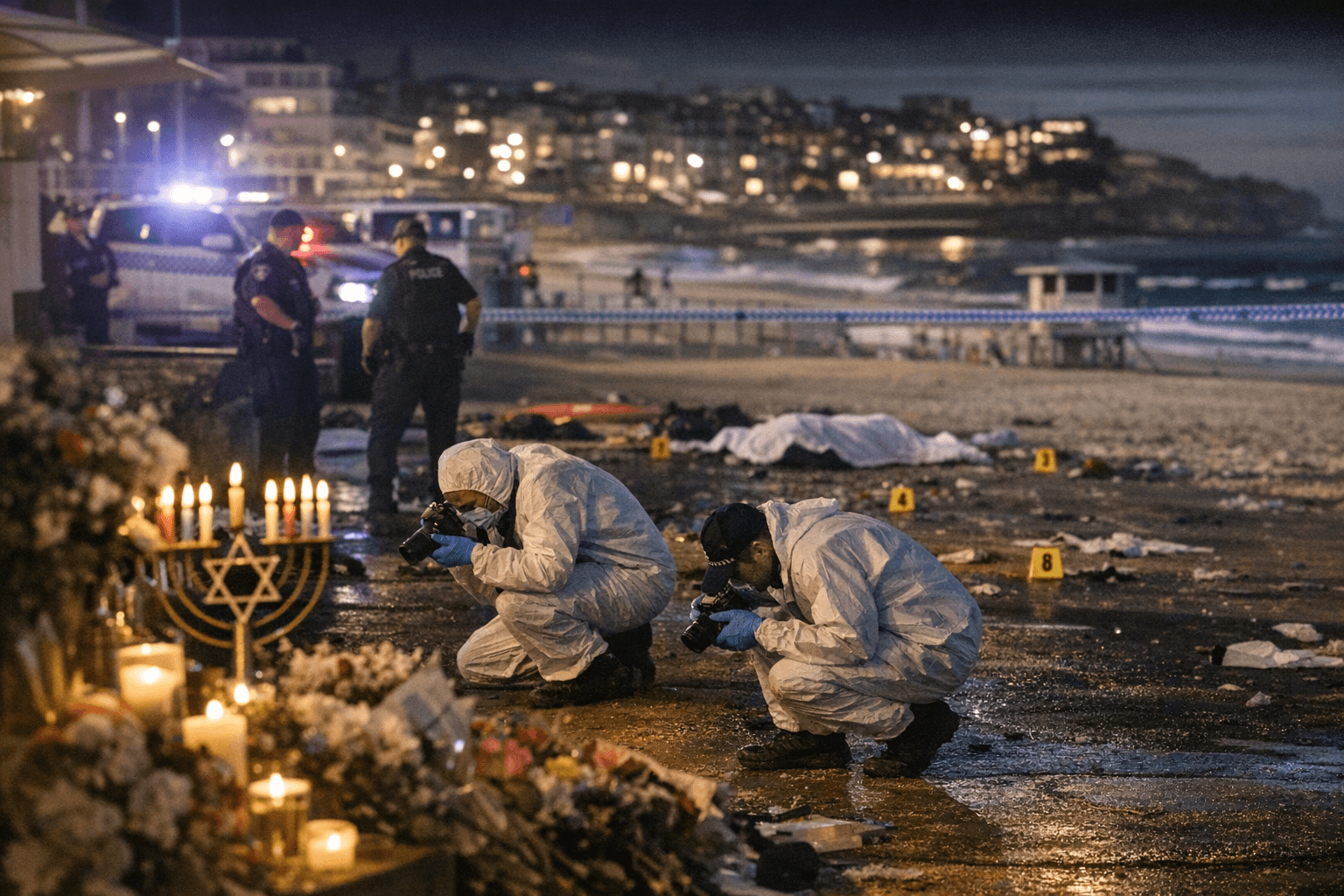
The federal inquiry follows parallel actions at the state level. New South Wales announced a state-based royal commission to examine local authorities’ responses, police actions, gun licensing and antisemitism. On Dec. 24, 2025, the NSW parliament passed the Terrorism and Other Legislation Amendment Bill 2025, tightening gun controls and expanding the scope of hate speech and offensive-symbol prohibitions, steps that the state government says are part of a broader effort to prevent similar attacks.
Beyond immediate criminal and legal questions, the royal commission will have broader policy and social implications. It will test whether Australia’s intelligence and community-safety frameworks have adapted to a changing threat landscape in which lone-actor attacks inspired by online extremist ideology have become harder to predict. Economically, the commission and follow-up policy changes could lead to increased security spending at public events and tourist sites, regulatory shifts affecting civil liberties debates, and reputational impacts for local economies reliant on tourism, notably the Bondi precinct.
The inquiry’s findings, due on the anniversary of the attack, will shape proposals for legal and operational reforms across federal and state agencies and will set a benchmark for how Australia addresses antisemitism, violent extremism and national resilience in the years ahead.
This article was produced by Prism’s automated news system from verified source data, official records, and press releases, then run through automated quality and moderation checks before publishing. The system is built and supervised by the people who set the standards it runs under. Read our full AI policy.
Did this article answer your question?