Albany County EMS capacity in focus as Medicaid ambulance, birth-center bills advance
Albany County EMS capacity is under scrutiny as lawmakers advanced SF 4 to raise Medicaid ambulance pay to 100% of Medicare and proposed a $1.3M state match to draw $1.3M federal dollars.

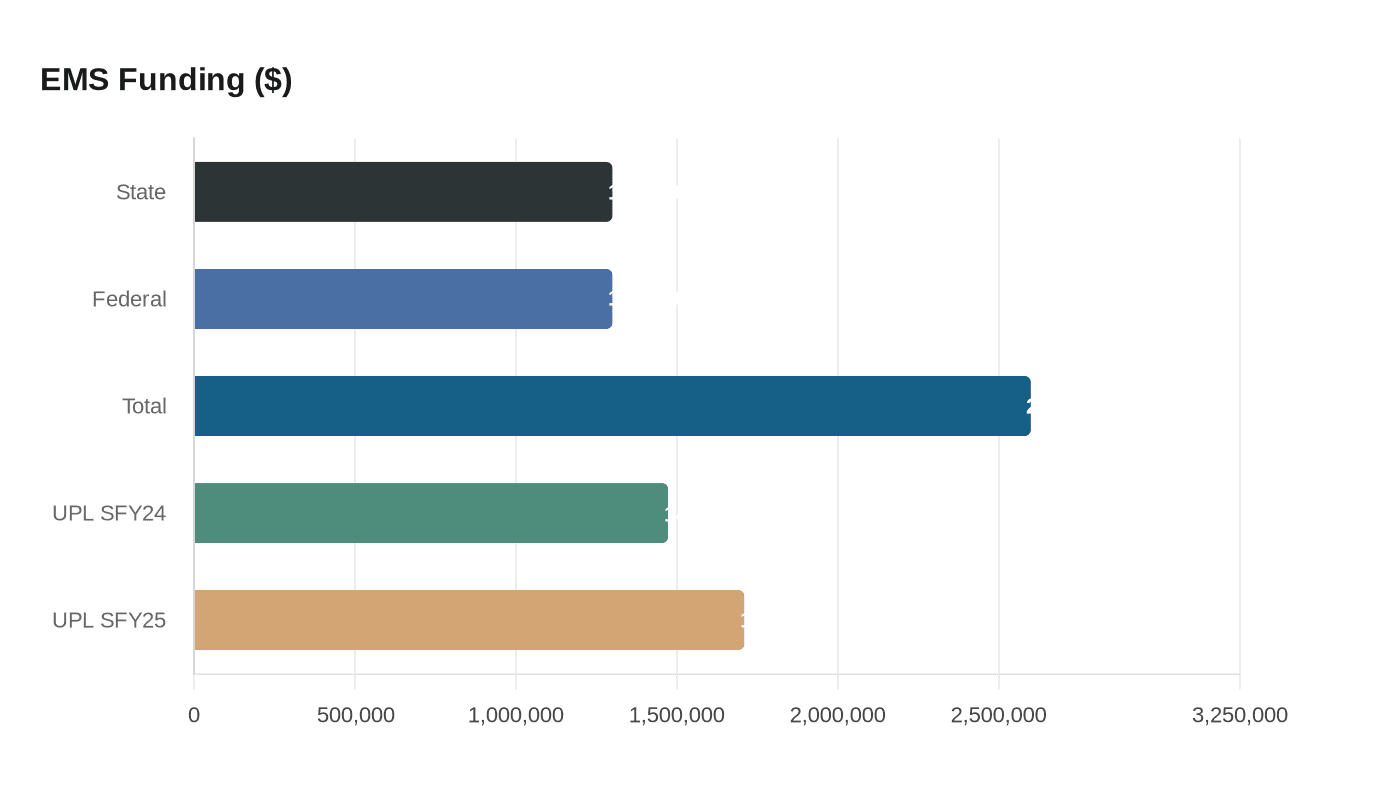
Albany County leaders and EMS directors are watching state lawmakers after two Medicaid measures moving through the Wyoming Legislature would change how ambulance and birth‑center services are paid. Senate File 4 would raise ground ambulance reimbursement for Medicaid recipients from 66% to 100% of the Medicare rate and include a $1.3 million state appropriation that Rep. Rachel Rodriguez‑Williams said would draw an additional $1.3 million in federal funds, creating a $2.6 million funding package to stabilize rural EMS.
The House Labor, Health and Social Services Committee voted 5‑3 to advance SF 4 to the House floor, and supporters framed the change as the first statewide EMS Medicaid rate increase in more than a decade. Jesse Springer, Medicaid division administrator with the Wyoming Department of Health, said, "It's been a long time since these have been touched." Eric Boley, president of the Wyoming Hospital Association, called the proposal "a great start in fixing a growing problem" while warning that "in our small communities, we're seeing our EMS services either go out of business or really decline in the services they are providing."
Statewide context underlines those concerns: Wyoming has 44 EMS providers that handle roughly 77,000 calls per year, and Medicare covers 40 to 50 percent of ground EMS transports. Franz Fuchs, deputy director at the Wyoming Department of Health, noted that ground EMS includes both 911‑response ambulances and interfacility transports and that Medicaid ambulance claims have traditionally been paid on a fee‑for‑service basis.
Fiscal mechanics already in play complicate the picture. Wyoming has used the Upper Payment Limit program to draw federal dollars for ambulance payments, netting $1,472,889 in SFY2024 and $1,709,827 in SFY2025 for ground EMS providers, a mechanism Health Wyo materials describe as effectively doubling Medicaid ambulance payments using federal funds alone. Supporters say SF 4 leverages state dollars to secure federal matches; critics caution that the bill simply shifts the responsibility to the state budget.
The companion measure, House Bill 4, would add freestanding birth centers to Medicaid‑authorized services. WyoFile defines freestanding birth centers as "state‑licensed outpatient health care facilities that specialize in pregnancy, birth and postpartum care and are not part of a hospital." HB 4 passed the House on Feb. 17 and was advanced later in a Senate labor committee; lawmakers in committee voted 8‑1 to require Medicaid reimburse birth centers for some costs. Franz Fuchs said, "The bill would result in net savings to the state." Sarah Morey, co‑founder of Earthside Birth and Wellness Center in Cheyenne, said, "We're basically eating $4,000 to $5,000 per [Medicaid] client."
Mountain Heart Birth Center off I‑80 in Evanston and Earthside in Cheyenne are cited as examples of facilities feeling financial strain. As of Feb. 24‑25, legislative action has sent SF 4 toward a House floor vote and pushed HB 4 further into Senate consideration; Albany County EMS officials will be tracking whether the $1.3 million state appropriation and the birth‑center coverage change clear final votes and how those outcomes affect volunteer staffing, interfacility transport funding, and rural ambulance service continuity.
Know something we missed? Have a correction or additional information?
Submit a Tip