Allied teams win $1.1M to standardize LPBF metal supply chains
America Makes and NCDMM named winners of a $1.1M AAMI project to develop LPBF qualification, equivalency and interoperability for U.S. Department of War and UK Ministry of Defence supply chains.
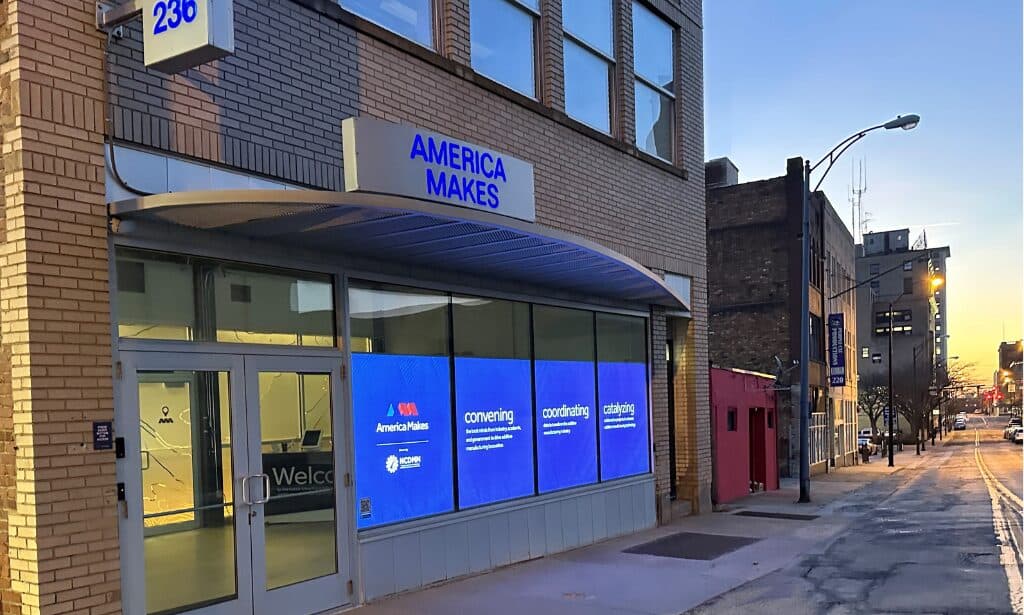
America Makes and the National Center for Defense Manufacturing and Machining (NCDMM) announced on January 15, 2026 that two industry teams won a $1.1 million Project Call under the Allied Additive Manufacturing Interoperability (AAMI) program. The awards fund development of approaches to establish qualification, equivalency and interoperability for laser powder bed fusion (LPBF) metal additive manufacturing across U.S. Department of War and UK Ministry of Defence supply chains.
The two selected efforts are led by Lockheed Martin and Eaton Corporation. Lockheed Martin’s team includes ASTM International and Additive Manufacturing Solutions Ltd. Eaton’s team brings together EOS North America, Materials Solutions/Siemens Energy, and 3Degrees. Each project will tackle the core barriers that slow cross‑allied use of LPBF for critical parts: material consistency and characterization, standards alignment, data exchange formats, and qualification strategies that enable supplier equivalency.
For the community that designs, prints, certifies and supplies metal parts, the projects aim to address familiar pain points. LPBF users contend with powder lot variability, process parameter sensitivity, and fragmented qualification regimes that force redundant testing and narrow supplier pools. By pursuing interoperable qualification and data exchange, the AAMI winners aim to shorten lead times, reduce duplicated testing across jurisdictions, and make it easier to shift production between vetted suppliers on both sides of the Atlantic.
Standards and data formats are central to the work. One winning team includes ASTM International, signaling a pathway to feed project outputs into established standards processes. The other team’s mix of OEM, materials and service providers reflects a practical focus on translating standards into factory-ready workflows and supply chain validation steps. Both tracks intend to deliver methods that regulators, defense acquisition teams and commercial suppliers can use to assess when a part produced on different equipment or in a different country can be treated as equivalent.
The practical value is immediate for service bureaus, defense contractors, and shops that supply mission-critical components. Expect clearer guidance on qualification templates, better ways to exchange build and material data, and frameworks for testing equivalency rather than repeating full qualification campaigns. That can expand qualified supplier bases and improve resilience for parts that have long lead times or single-source constraints.
Next steps will be technical development, testing and coordination with standards bodies and defense procurement. Track the AAMI program outputs for templates and data schemas that affect procurement and shop-floor validation. For now, prepare to verify supplier equivalency claims, update material traceability practices, and watch for standards-aligned qualification tools that could speed cross-allied adoption of LPBF for critical parts.
Sources:
Know something we missed? Have a correction or additional information?
Submit a Tip