AME-3D Adds In-House FDM Printing to Speed Prototyping and Testing
AME-3D in Sheffield added in-house FDM/FFF 3D printing on 3 March 2026 to provide faster, lower-cost prototyping and functional test part.
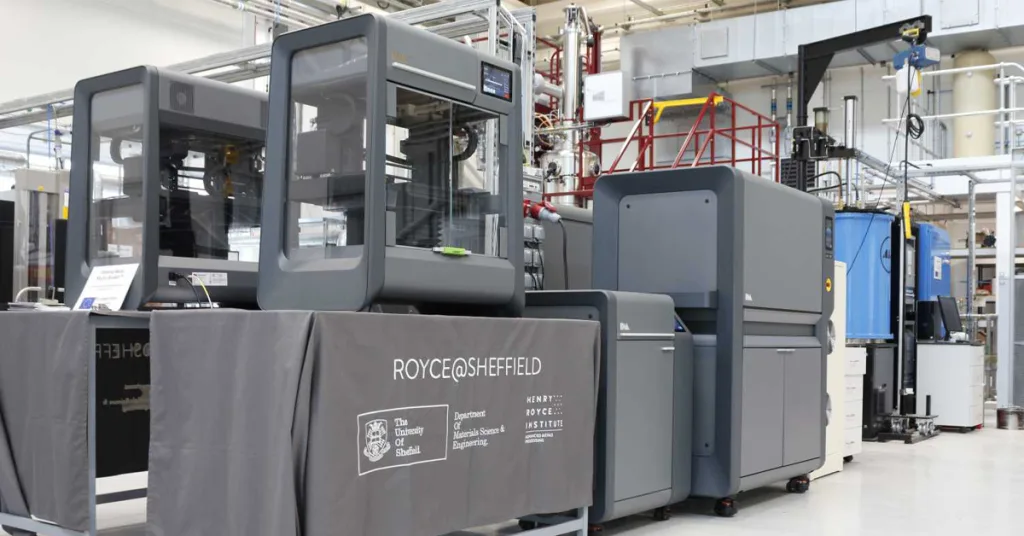
AME-3D, the Sheffield-based product development and prototyping company, announced on 3 March 2026 that it has added in-house Fused Deposition Modelling (FDM/FFF) 3D printing to its manufacturing services “to provide faster, lower-cost prototyping and functional test part.” The move extends the firm’s on-site toolset and targets quicker iteration for functional test pieces and prototypes.
The company’s website describes AME-3D as “a UK-based 3D printing and low-volume manufacturing partner supporting product development from concept to production with our own in-house product design team.” Current site copy lists SLA, SLS, MJF and LCD 3D printing, vacuum casting, and finishing services, and the firm claims it can “Produce 1-1000+ parts on-demand within a short timescale using a combination of technologies.” The site also names automotive, medical, subsea, aerospace, consumer products, and industrial manufacturing as industries served.
This is not AME-3D’s first operational upgrade. In 2023 the business implemented AMFG’s manufacturing execution and workflow automation software; Rich Proctor, managing director of AME Group, said at the time, “AMFG has a lot of capability packed into the software. I was specifically looking for a solution that enabled faster quoting, an online quoting platform and production management, and AMFG has all of these. There is more that we can do with the software as we get further into the integrations with other parts of our business too.” That prior investment in MES and workflow automation frames the FDM addition as part of an ongoing push to reduce manual steps and speed supply-side response.
Industry marketing around FDM highlights why AME-3D might have chosen this route. Ames Industries’ service copy notes that FDM supports rapid prototyping, fixture creation and custom tooling and allows “low-cost, fast-turnaround prototypes” for design review, validation and iteration before committing to full-scale tooling. FDM is commonly pitched for precision, material versatility and build strength that enable functional prototypes and shop-floor jigs and fixtures.

Broader industry programs show alternative paths to the same capability: Pavan Muzumdar, CEO of Project DIAMOnD and COO of Automation Alley, said, “The Digital Transformation Center was built to help companies move from experimentation with additive manufacturing to real production. By opening the DTC to businesses beyond our membership network, we’re removing another barrier to adoption of this powerful technology and giving more companies a low-risk path to validate products, scale production and compete using additive manufacturing.” That underlines why some firms buy machines and others access shared production-grade equipment.
AME-3D’s announcement did not include printer models, vendor names, build volumes, material lists, throughput figures or pricing, and the provided website excerpts listing SLA, SLS, MJF and LCD do not yet reflect FDM in the technology list. With a 26-year track record in design and prototyping and prior automation work, AME-3D’s FDM rollout is a predictable capacity expansion; with “design, manufacturing, and finishing under one roof, AME-3D reduces risk, shortens development cycles, and delivers production-ready parts for industries including automotive, medical, subsea, aerospace, consumer products, and industrial manufacturing.”
Know something we missed? Have a correction or additional information?
Submit a Tip