Americans say war with Iran is not worth fighting
Two-thirds of Americans say the Iran war is not worth the risk, and only a quarter want military action to continue. Trump’s approval on Iran has slipped to 33%.

Two-thirds of U.S. adults say the war with Iran is not worth the risk, putting a clear public-opinion brake on any effort by the White House to widen the conflict. In the AP-NORC survey, 64% rejected the fight as not worth it, while only about a quarter said military action should continue.
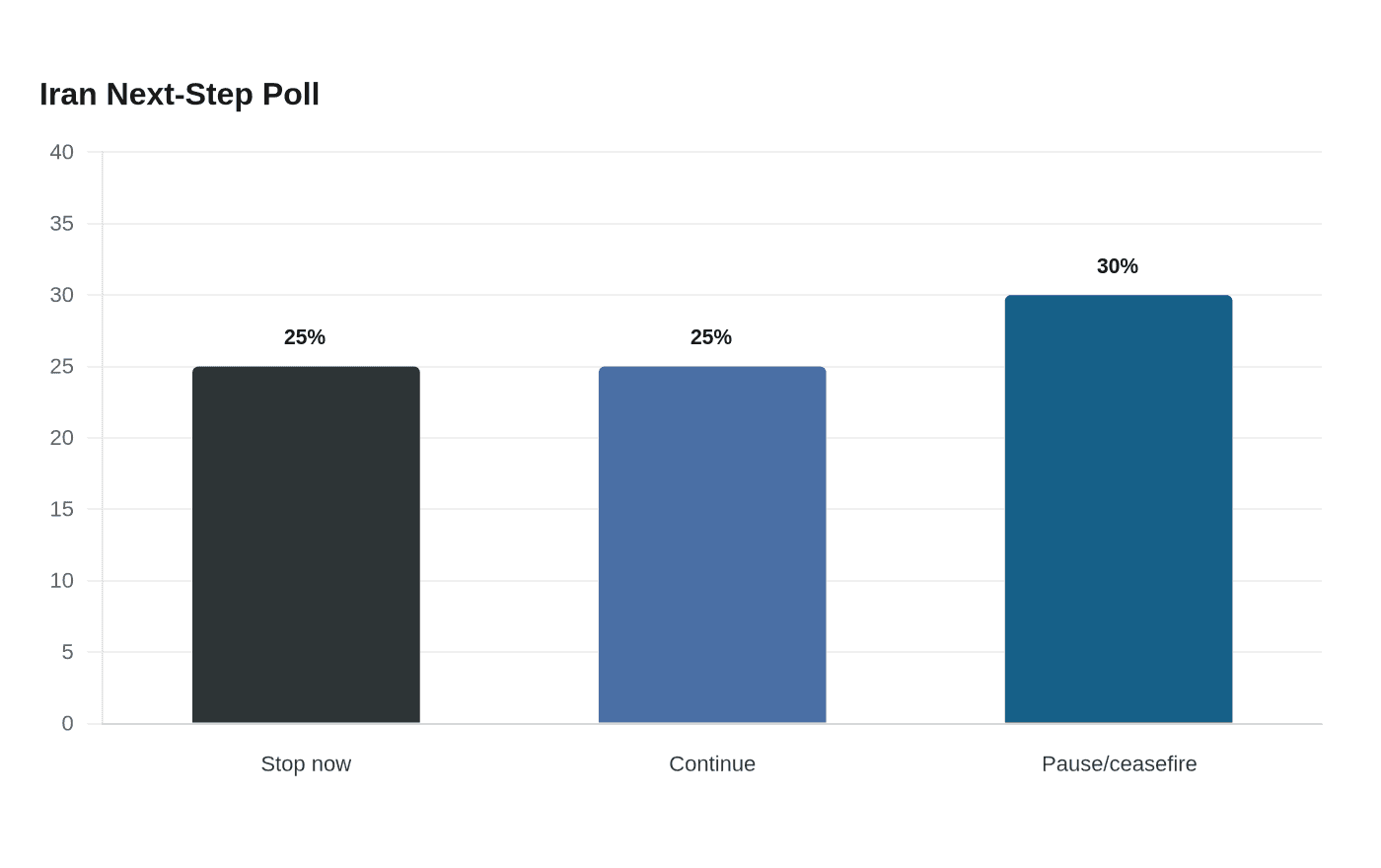
The same poll showed a divided but still caution-heavy public response to the conflict’s next step. One-quarter of Americans said the war should be stopped immediately, one-quarter said military action should continue, and roughly 3 in 10 said the United States should pause military action while seeking a renewed ceasefire. President Donald Trump’s approval rating on Iran also dipped, with one related result placing it at 33%.

The political fault line runs through party identity, but the pressure is broad. AP-NORC’s June 19 approval summary said Republicans largely approve of Trump’s handling of Iran, while most Democrats and independents disapprove. That leaves the White House with support from its own partisan base, but far less room to claim a national mandate for escalation.
Other national polls point in the same direction. Quinnipiac University’s March 9 survey found 74% opposed sending ground troops into Iran, a particularly sharp warning for lawmakers facing any vote tied to a larger military commitment. Reuters/Ipsos polling found 65% of Americans believed Trump would order troops into a large-scale ground war in Iran, while only 7% supported that idea. Marist Poll found a majority of Americans opposed or strongly opposed U.S. military action in Iran, and Pew Research Center’s March 25 analysis said Americans broadly disapproved of the campaign.
The reasons behind the resistance look less like abstract isolationism than fear of what a war could cost. CBS News chief White House correspondent Nancy Cordes has framed the administration as scrambling to justify intervention amid conflicting presidential explanations, while CBS coverage of polling said many Americans linked their doubts to the length of the war, the way the administration explained it, and its effect on the economy. A July 29 Quinnipiac poll found 6 in 10 voters opposed U.S. military action in Iran amid rising expectations that the conflict would last a year or more, and nearly half said they were worse off financially than a year ago.
That combination of casualty fears, cost concerns, and war fatigue makes future military decisions politically harder, not easier. Any move toward more strikes, a prolonged air campaign, or especially ground troops would run into a public that has repeatedly signaled the same message: keep the war from expanding.
This article was produced by Prism’s automated news system from verified source data, official records, and press releases, then run through automated quality and moderation checks before publishing. The system is built and supervised by the people who set the standards it runs under. Read our full AI policy.
Did this article answer your question?